
REAL IPMAT STUDENT SUCCESS STORY

A practical look at diagnosis, personal mentoring, VARC strategy and mock-test analysis.
Editorial Note
This article is based on the actual preparation journey of a VerbalHub student. Personal details have been left out to protect the student's privacy. No score, percentile or college claim has been added beyond the information shared by the student.
Quick Snapshot
| Exam | IPMAT 2025 |
| Key Challenge | Difficult Quant topics, slow Reading Comprehension and inconsistent mock scores despite hard work |
| Solution | Error-pattern diagnosis, personalised pacing, Verbal Ability mentoring and structured mock-test analysis |
| Verbal Mentor | Hasan Raja — IIM Kozhikode alumnus, three-time CAT VARC 99th percentiler |
| Training Provider | VerbalHub |
Most Class 12 students preparing for IPMAT are not short of determination.
They attend classes, collect books, watch preparation videos and solve hundreds of questions. Yet after a few months, many face the same frustrating situation: they are working hard, but their mock scores are no longer improving.
That was also the challenge faced by one of our students during IPMAT 2025 preparation. The student had a clear goal and was willing to put in the required effort. However, some Quantitative Aptitude topics remained difficult, Reading Comprehension took too much time and mock-test scores were inconsistent.
The first reaction in such a situation is usually to solve more questions. We took a different approach. Before increasing the workload, we tried to understand exactly where the marks were being lost. That decision changed the direction of the student's preparation.
Identifying the Root Problem Behind the Mock-Score Plateau
A low or stagnant mock score does not always mean that a student lacks subject knowledge. The same score can come from very different problems.
One student may not understand the concepts. Another may know the concepts but use a slow method. A third may spend too much time on difficult questions and miss easier ones later. For this student, we began with a simple three-step diagnostic process.
Step 1: Establishing a Clear Baseline
The first step was to assess the student's current level across the areas tested in the targeted IPMAT examinations.
- Quantitative Aptitude
- Verbal Ability
- Reading Comprehension
- Vocabulary and grammar
- Logical Reasoning
- Speed and accuracy
- Question selection
- Time management
The purpose was not simply to produce another score. We wanted to find out what the score was telling us. Could the student solve the question without a time limit? Was the concept understood but forgotten during the test? Did the student know the method but take too long to apply it? Was a correct answer being changed because of doubt?
These details gave us a much clearer picture than the overall score alone.
Step 2: Separating Different Types of Errors
Not every wrong answer needs the same correction. We placed the student's mistakes into clear groups:
| Error Type | What It Means |
|---|---|
| Concept errors | The underlying rule or method was not understood |
| Application errors | The concept was known, but the student could not apply it to a new question |
| Reading errors | An important word, condition or sentence was missed |
| Calculation errors | The approach was correct, but the arithmetic went wrong |
| Option-elimination errors | The student removed the correct choice or kept an option that did not fully fit |
| Time-pressure errors | The student rushed because too much time had already been spent elsewhere |
| Question-selection errors | A difficult question was attempted too early or pursued for too long |
| Careless errors | The student overlooked a familiar point despite knowing the concept |
This separation mattered because a concept error cannot be fixed only through faster practice. In the same way, a time-management problem will not disappear simply by attending another theory class.
Step 3: Adjusting the Study Pace
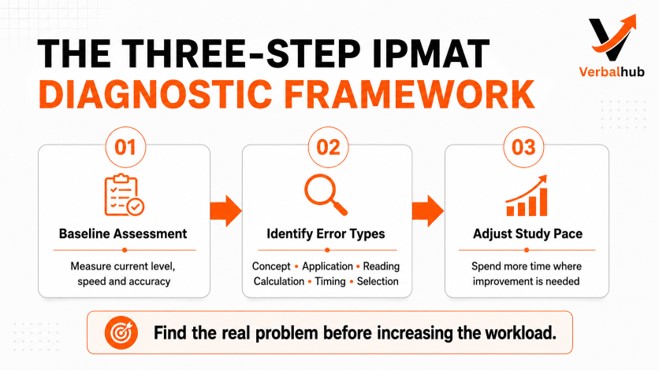
Once the error pattern was clear, we changed the pace of the preparation. Topics the student already understood did not receive unnecessary classroom time. Weak areas were given more explanation, guided practice and revision.
The student's schedule was no longer based only on the syllabus order. It was based on performance.
Key takeaway: A useful IPMAT preparation strategy should tell a student not only what to study, but also why that topic needs attention now.
Why Personalised IPMAT Coaching Worked for This Student
Every IPMAT aspirant begins from a different point. Some students are comfortable with mathematics but struggle with long passages. Some read well but lack vocabulary. Others perform well during normal practice but lose control during timed mocks.
This is why one fixed study plan cannot work equally well for everyone. Through VerbalHub's personalised IPMAT coaching, the student received:
- One-on-one classes
- A weekly preparation plan
- Topic-wise assignments
- Regular doubt-clearing support
- Reading Comprehension practice
- Quantitative Aptitude practice
- Logical Reasoning practice
- Sectional tests
- Full-length IPMAT mock tests
- Personal error-log discussions
- Weekly progress reviews
If the student understood a topic well, we moved ahead. If a topic remained weak, we slowed down and worked through it again. The student did not have to match the pace of a large batch. The teaching pace changed according to the student's actual progress.
This made the preparation more focused and easier to manage alongside school studies.
Hasan Raja Sir's Role in IPMAT Verbal Ability Preparation
IPMAT Verbal Ability is often treated as a secondary section. Many students believe they can handle it by memorising long vocabulary lists and solving a few Reading Comprehension passages each week. That is rarely enough.
A strong IPMAT Verbal Ability score requires a student to understand sentence logic, follow the writer's argument, notice changes in tone and choose between closely worded options under time pressure.
Hasan Raja Sir personally guided the student in Verbal Ability and Reading Comprehension. Hasan Sir is an IIM Kozhikode alumnus and a three-time CAT VARC 99th-percentile scorer. His teaching focuses on helping students understand why an answer works rather than asking them to memorise fixed tricks.
Learning Vocabulary Through Context
The student moved away from depending only on dictionary meanings. Vocabulary practice included:
- Understanding words through sentences
- Identifying meaning from the surrounding lines
- Studying roots, prefixes and suffixes
- Noticing how the same word changes meaning in different situations
- Revising words through short passages
- Maintaining a personal vocabulary notebook
The aim was not to memorise the largest possible number of words. The aim was to recognise how words are actually used. This approach also helped the student deal with unfamiliar vocabulary during a test.
Using Rules for Para Jumbles
Para Jumbles often feel like guesswork when students try to arrange all the sentences at once. Hasan Sir taught the student to look for clear links first:
- Opening sentences that introduce the topic
- Pronouns that must refer to something already mentioned
- Cause-and-effect relationships
- Examples that must follow a general statement
- Contrast words such as however, but and yet
- Chronological order
- Repeated nouns and connected ideas
- Closing sentences that sum up the discussion
This rule-based method made Para Jumbles less confusing. The student learned to build smaller sentence pairs before arranging the complete paragraph.
Reading for Author Intent and Tone
Reading Comprehension is not a memory test. A student does not need to remember every sentence. The student needs to understand the job each paragraph is doing.
- The main issue being discussed
- The author's central point
- The purpose of each paragraph
- Supporting examples and evidence
- Shifts in viewpoint
- Agreement and disagreement
- The author's tone
- The difference between the author's view and someone else's view
This made it easier to answer main idea, inference, purpose and tone questions. The student also stopped treating every line as equally important and paid more attention to contrast words, conclusions, repeated ideas and changes in the argument.
Discussing Why an Option Looked Attractive
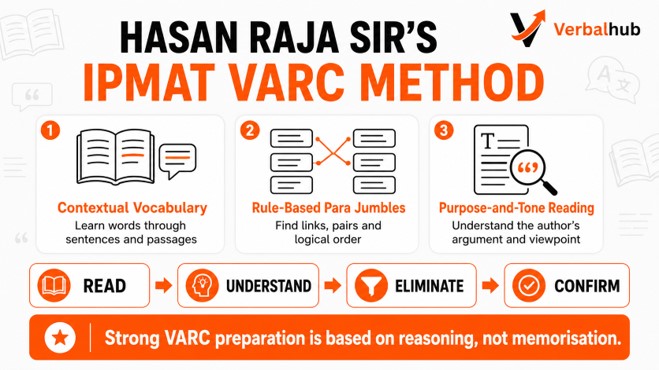
When the student selected a wrong answer, the class did not end with the correct option being revealed. Hasan Sir discussed two questions:
- Why did the wrong option appear correct?
- Why was the correct option stronger?
This helped the student notice common traps:
- Options that use words from the passage but change the meaning
- Statements that are partly correct but too broad
- Extreme choices that go beyond the author's claim
- Answers that discuss the topic but do not answer the question
- Inferences that sound reasonable but lack support
- Choices that reflect a quoted expert's view rather than the author's view
Key takeaway: Real improvement begins when students understand the thinking behind their mistakes.
How Mock-Test Analysis Changed the Preparation
Mock tests played an important role in this IPMAT student success story, but the improvement did not come from taking tests endlessly. It came from reviewing them properly.
- Which questions were answered incorrectly
- Which correct answers took too much time
- Which easy questions were missed
- Which topics caused repeated errors
- Where the student lost focus
- Whether the attempt order was working
- How much time was spent in each section
- Which difficult questions should have been left earlier
Moving Beyond the Raw Mock Score
A raw score shows the result of a test. It does not always show what needs to change. Two students may receive the same score even though one has weak concepts and the other has wasted time on three difficult questions. Their next study plans should not be identical.
We therefore treated each mock as a source of information rather than a judgement on the student's ability.
Building a Personal Error Log
The student maintained an error log containing:
- Topic
- Question type
- Selected answer
- Correct answer
- Reason for the mistake
- Better method
- Time taken
- Revision date
- Result after retesting
The error log helped us see whether a mistake was isolated or part of a repeated pattern. It also made weekly mentoring more useful because the discussion was based on actual evidence from the student's tests.
Turning Each Mock into a Weekly Action Plan
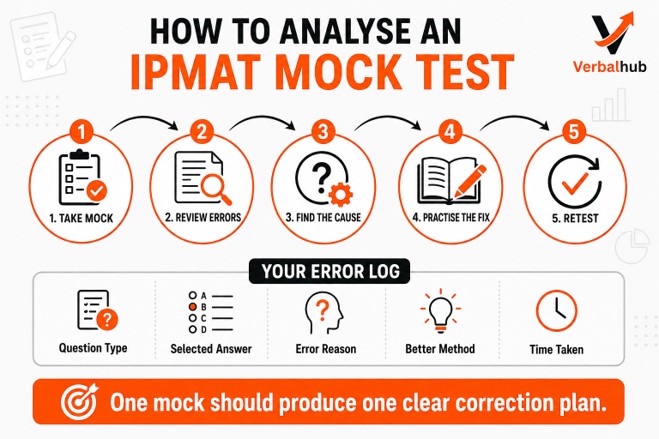
Every mock led to a small number of clear actions. A weak concept was revised. A slow method was replaced. Close-option errors led to elimination drills. A poor attempt order was changed. Pressure-related mistakes led to more timed practice.
Key takeaway: One mock should lead to one clear correction plan. That is more useful than taking several tests without reviewing them.
Building the Quant Foundation Before Chasing Speed
Speed matters in IPMAT, but trying to become fast too early can make accuracy worse. For this student, Quant preparation followed a simple order:
- Understand the concept.
- Solve basic questions accurately.
- Apply the concept to IPMAT-level questions.
- Choose the right method.
- Practise under a time limit.
- Retest the topic in a mixed set.
The student first worked on the foundation. Only after accuracy became stable did we increase the time pressure. This prevented dependence on shortcuts that the student did not fully understand and reduced mistakes caused by rushing through familiar-looking questions.
Key takeaway: Accuracy builds confidence. Speed should be added after the method is clear.
The Weekly Routine That Kept the Student on Track
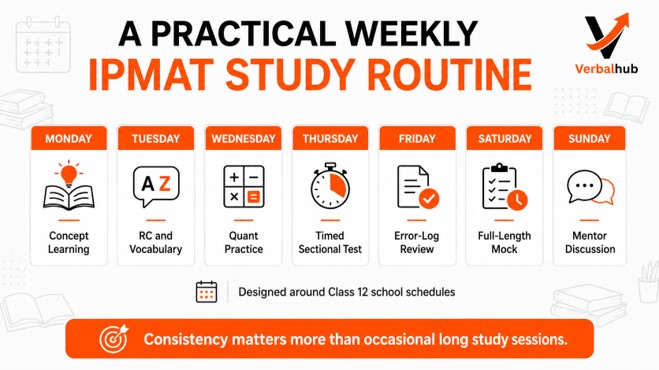
The student's progress did not come from studying for extremely long hours once or twice a week. It came from regular, planned work.
- Learning selected concepts
- Completing topic-wise assignments
- Practising Reading Comprehension
- Revising vocabulary through sentences
- Solving timed Quant and Verbal sets
- Taking a sectional or full-length mock
- Updating the error log
- Reviewing mistakes with the mentor
- Planning the following week
The routine was realistic. The student was preparing for IPMAT while also managing Class 12 studies. On a busy school day, the student could complete a shorter reading or vocabulary task. Longer timed tests were placed on days with more available time.
Consistency mattered more than occasional long study sessions.
What Other Class 12 IPMAT Aspirants Can Learn
Students often ask how many hours they should study for IPMAT. There is no single number that works for everyone. Two students can study for the same number of hours and get very different results because they use those hours differently.
Before adding more study time, ask yourself:
- Do I know my weakest topics?
- Do I know why I am making errors?
- Am I repeating the same errors?
- Do I review every mock properly?
- Is my accuracy improving?
- Can I leave a difficult question at the right time?
- Do I have a practical weekly plan?
- Am I receiving useful feedback?
If the answers are unclear, simply solving more questions may not fix the problem. You may need a more focused plan.
How VerbalHub Supports IPMAT Aspirants
VerbalHub offers personalised IPMAT online coaching for students preparing for:
- IPMAT Indore
- IPMAT Rohtak
- JIPMAT
- IIM Ranchi IPM
- IIM Jammu IPM
- IIM Bodh Gaya IPM
- Other undergraduate management entrance examinations
The program includes Quantitative Aptitude, Verbal Ability, Reading Comprehension, Logical Reasoning, vocabulary and grammar, assignments, sectional tests, full-length mocks, personal mock analysis, one-on-one mentoring, and interview and college guidance.
A student who needs support with the basics receives more concept-building classes. A student who already understands the syllabus spends more time on speed, accuracy, question selection and exam strategy.
The core goal is not just to complete the syllabus. The purpose is to help the student use that knowledge confidently during the examination.
The Final Lesson from This IPMAT Student Success Story
The credit for this IPMAT 2025 success belongs first to the student. The student attended classes, completed assignments, accepted feedback and continued working even when mock scores were not perfect.
Personalised guidance made that effort more focused. Hasan Raja Sir's support in Verbal Ability, regular one-on-one classes, detailed mock analysis and weekly mentoring helped the student prepare with greater clarity and confidence.
Good coaching cannot replace hard work. It can make sure that hard work is being used in the right place.
Frequently Asked Questions About VerbalHub IPMAT Coaching
Yes. VerbalHub offers personalised IPMAT online coaching with a study plan based on the student's current level, target exam, strengths and weak areas. The program includes individual classes, assignments, tests and regular mentor feedback.
Hasan Raja Sir guides students in IPMAT Verbal Ability and Reading Comprehension. He is an IIM Kozhikode alumnus and a three-time CAT VARC 99th-percentile scorer.
Yes. The course covers Quantitative Aptitude, Verbal Ability, Reading Comprehension and Logical Reasoning. The exact focus may change according to the exam and the student's current performance.
Yes. Students receive sectional tests and full-length IPMAT mock tests. Important tests are followed by personal analysis covering concepts, accuracy, speed, time management and question selection.
Yes. The weekly plan can be adjusted around school timings, examinations and academic workload. The pace is set according to the student's preparation stage and available study time.
VerbalHub prepares students for IPMAT Indore, IPMAT Rohtak, JIPMAT and other undergraduate management entrance examinations. Students should confirm the exact exam coverage when discussing their study plan with the mentor.