
IELTS SUCCESS STORY — BAND 7.5+
Quick Snapshot
| Overall Band | 7.5+ |
| Key Challenge | Random practice without direction, repeated mistakes across all four sections |
| Solution | Diagnostic assessment, phase-wise plan, section-wise feedback and mock analysis |
| Preparation Approach | Personalised IELTS coaching |
| Training Provider | VerbalHub |
Scoring Band 7.5+ in IELTS is not simply about knowing English. You also need to understand the exam, manage your time and know exactly what the examiner expects in Listening, Reading, Writing and Speaking.
That was the biggest lesson for one of our VerbalHub students.
Before joining VerbalHub, the student was practising regularly. They watched IELTS preparation videos, solved sample questions and read model essays. Yet the results were not improving as expected.
The problem was not a lack of effort. The preparation lacked personal direction.
After joining VerbalHub's personalised IELTS coaching programme, the student received a clear study plan, regular feedback and individual guidance. Instead of continuing with random practice, every lesson focused on a specific weakness.
This IELTS success story explains how that change in approach helped the student achieve an overall Band 7.5+.
Earlier, I knew I was making mistakes, but I did not know why. At VerbalHub, every mistake was explained. That made my preparation much more focused.
Why Is IELTS Band 7.5 a Strong Score?
IELTS evaluates a candidate in four language skills:
- Listening
- Reading
- Writing
- Speaking
Each section receives an individual band score. These scores are then used to calculate the overall IELTS band score.
IELTS Academic and IELTS General Training have the same Listening and Speaking sections, but their Reading and Writing sections are different. Students should therefore prepare according to the test they are planning to take.
An IELTS Band 7.5 shows a strong ability to understand and use English in academic, professional and everyday situations. However, universities, employers, professional bodies and immigration programmes may have different overall and section-wise score requirements.
Students should always check the exact requirements of the institution or organisation to which they are applying.
The Student's Challenges Before Joining VerbalHub
The student had already spent a fair amount of time preparing for IELTS. There was no shortage of study material. In fact, too much material had become part of the problem.
Different videos suggested different strategies. Model answers were difficult to copy naturally, and mock scores kept changing.
The student faced several common problems:
- Reading passages took too much time
- Writing responses had ideas but lacked clear structure
- Speaking answers were short and hesitant
- Listening marks were lost because of spelling and concentration errors
- Difficult vocabulary was used incorrectly
- Practice tests were completed without proper analysis
- The same mistakes appeared again and again
- There was no clear plan for improving weaker sections
The student needed more than another recorded IELTS course. They needed an experienced mentor who could identify the real reasons behind the lost marks.
The First Step: A Detailed IELTS Assessment
The VerbalHub IELTS programme started with a diagnostic assessment.
The purpose was not simply to give the student a score. It was to understand how the student approached every section.
The mentor assessed:
- Present English level
- Target IELTS band
- Test date
- Available preparation time
- Reading speed and accuracy
- Listening attention
- Writing organisation
- Grammar and vocabulary
- Speaking fluency and pronunciation
- Time-management habits
- Repeated error patterns
This assessment showed that the student's problems were not the same across all four sections.
For example, Reading errors came mainly from poor time management and difficulty recognising paraphrases. Writing answers contained useful ideas but did not develop them clearly. Speaking performance was affected more by nervousness than by a lack of English knowledge.
Once these gaps were clear, the mentor created a personalised IELTS preparation plan.
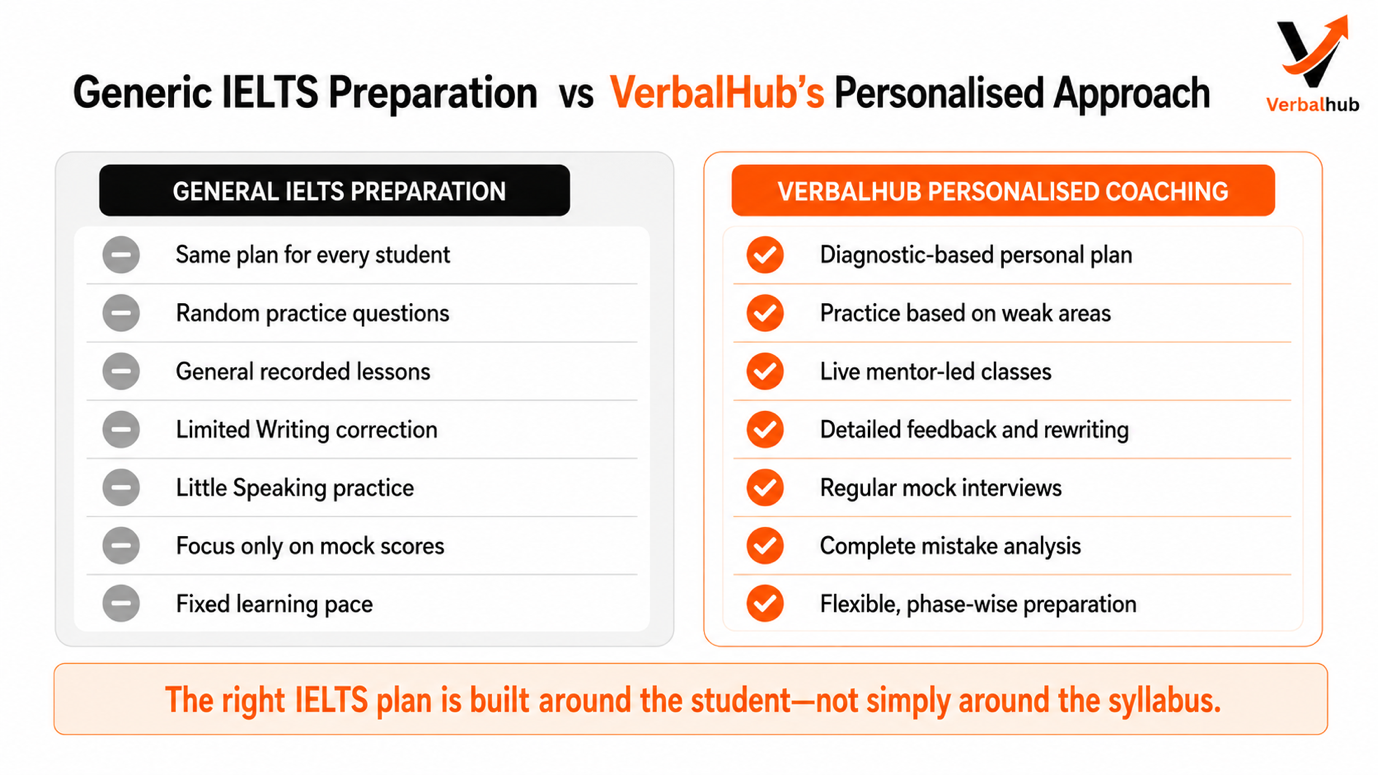
General IELTS Preparation vs VerbalHub's Personalised Approach
| General IELTS Preparation | VerbalHub Personalised IELTS Coaching |
|---|---|
| The same plan is followed by every student | The plan is based on the student's level and target |
| Students complete random practice questions | Practice is selected according to weak areas |
| Recorded lessons provide general explanations | Live mentors explain individual mistakes |
| Writing answers may receive only a score | Writing receives detailed correction and rewriting guidance |
| Speaking practice may be limited | Regular speaking sessions and mock interviews are conducted |
| Mock tests focus mainly on the final score | Every mock is analysed for timing, accuracy and error patterns |
| Students often repeat the same mistakes | Mistakes are recorded, corrected and retested |
| Progress is difficult to measure | Section-wise progress is monitored regularly |
| Limited personal accountability | Mentors track preparation and give regular feedback |
The main difference was not the amount of material. It was the quality of guidance the student received while using that material.
VerbalHub's Phase-Wise IELTS Course Plan
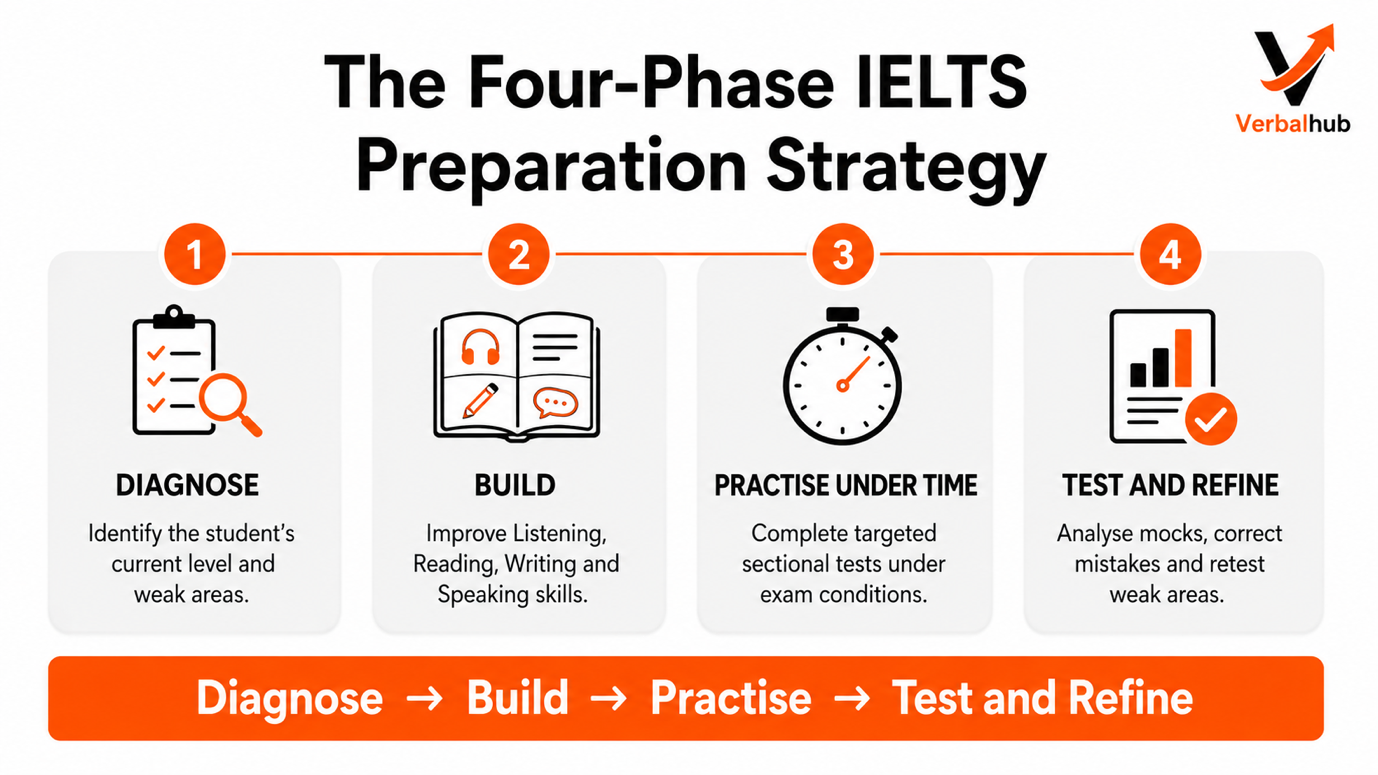
Instead of covering everything at once, VerbalHub divided the student's IELTS preparation into clear phases.
Phase 1: Diagnosis and Foundation
The first phase focused on understanding the exam and repairing the student's basic weaknesses — test format, section-wise scoring, grammar accuracy, sentence formation, vocabulary in context, reading comprehension, listening concentration, writing structure and speaking confidence.
Phase 2: Section-Wise Skill Building
This phase focused on the specific demands of Listening, Reading, Writing and Speaking. Different question types were taught separately, including why common wrong answers looked attractive — alongside paraphrasing, idea development and time management.
Phase 3: Timed Practice
Once the student understood the methods, the next task was to use them under time pressure. Timed sectional tests improved reading speed, listening focus, writing completion, speaking fluency and question selection.
Phase 4: Mock Tests and Final Improvement
In the final phase, the student attempted full IELTS mock tests in exam-like conditions. The mentor analysed section-wise scores, accuracy, time spent, repeated errors and areas requiring final revision.
How the Student Improved in IELTS Listening
The student initially believed that Listening mistakes happened because the recordings were too fast. A closer analysis showed several smaller problems.
Marks were being lost because of:
- Spelling mistakes
- Singular and plural confusion
- Missing word limits
- Losing focus after one difficult question
- Failing to notice corrections made by a speaker
- Not reading the questions before the recording
The VerbalHub mentor taught the student to use the preparation time more effectively — reading instructions carefully, underlining important words, predicting the possible type of answer, noticing whether a noun, number or place was required, and checking the permitted number of words.
After each practice test, mistakes were classified. This made it easier to see whether an answer was lost because of weak listening, spelling, vocabulary or carelessness. The student gradually became more attentive and stopped allowing one missed answer to affect the next few questions.
How the Student Improved in IELTS Reading
Reading had been one of the most time-consuming sections for the student.
The earlier method was to read every passage slowly and try to understand every sentence. Although this felt safe, it left too little time for the final questions.
VerbalHub introduced a question-based reading approach. The student learned how to understand the overall structure of a passage, locate relevant information quickly, recognise synonyms and paraphrased ideas, separate "False" from "Not Given," handle matching headings, identify keywords without relying only on exact word matches, leave a difficult question and return later, and review answers within the time limit.
The biggest improvement came when the student stopped treating every question in the same way. Some questions required close reading, while others required locating a specific detail. Choosing the right approach saved time and improved accuracy.
Why Personalised Writing Feedback Was Important
IELTS Writing often becomes the most difficult part of a student's preparation because it cannot be improved through answer keys alone.
An answer key can show a model response, but it cannot explain what is missing from an individual student's essay.
The student initially tried to use advanced words and memorised introductions. This made some responses sound unnatural. Ideas were present, but the paragraphs did not always support them properly.
VerbalHub's IELTS Writing classes focused on four important areas: answering the task properly, organising ideas clearly, using vocabulary accurately and maintaining grammatical control.
The student received detailed feedback on introductions, paragraph structure, main ideas, supporting examples, linking words, sentence variety, grammar mistakes, word choice, task completion and time management.
The mentor did not simply mark errors. The student was asked to rewrite weak sentences and paragraphs. This process was important because reading a correction is not the same as applying it. Rewriting helped the student understand how to produce a clearer response independently.
The student also learned that simple, accurate language is usually more effective than difficult vocabulary used in the wrong place.
Building Confidence in IELTS Speaking
The student could communicate in English but became nervous during formal speaking practice.
Common problems included very short answers, long pauses, repeated fillers, memorised phrases, limited answer development, rushing through unfamiliar questions and worrying too much about grammar.
Regular one-on-one speaking sessions helped the mentor identify these habits. The student learned a simple way to develop answers:
- Give a direct response.
- Explain the reason.
- Add a suitable example.
- Connect the answer to personal experience where relevant.
Mock speaking interviews were conducted for all three parts of the IELTS Speaking test. After each session, the student received feedback on fluency, pronunciation, grammar, vocabulary and answer development.
The focus was not on copying a particular accent. The aim was to speak clearly, naturally and confidently. Over time, the student became more comfortable with unexpected topics and stopped depending on memorised answers.
The Improvement Loop That Produced Results
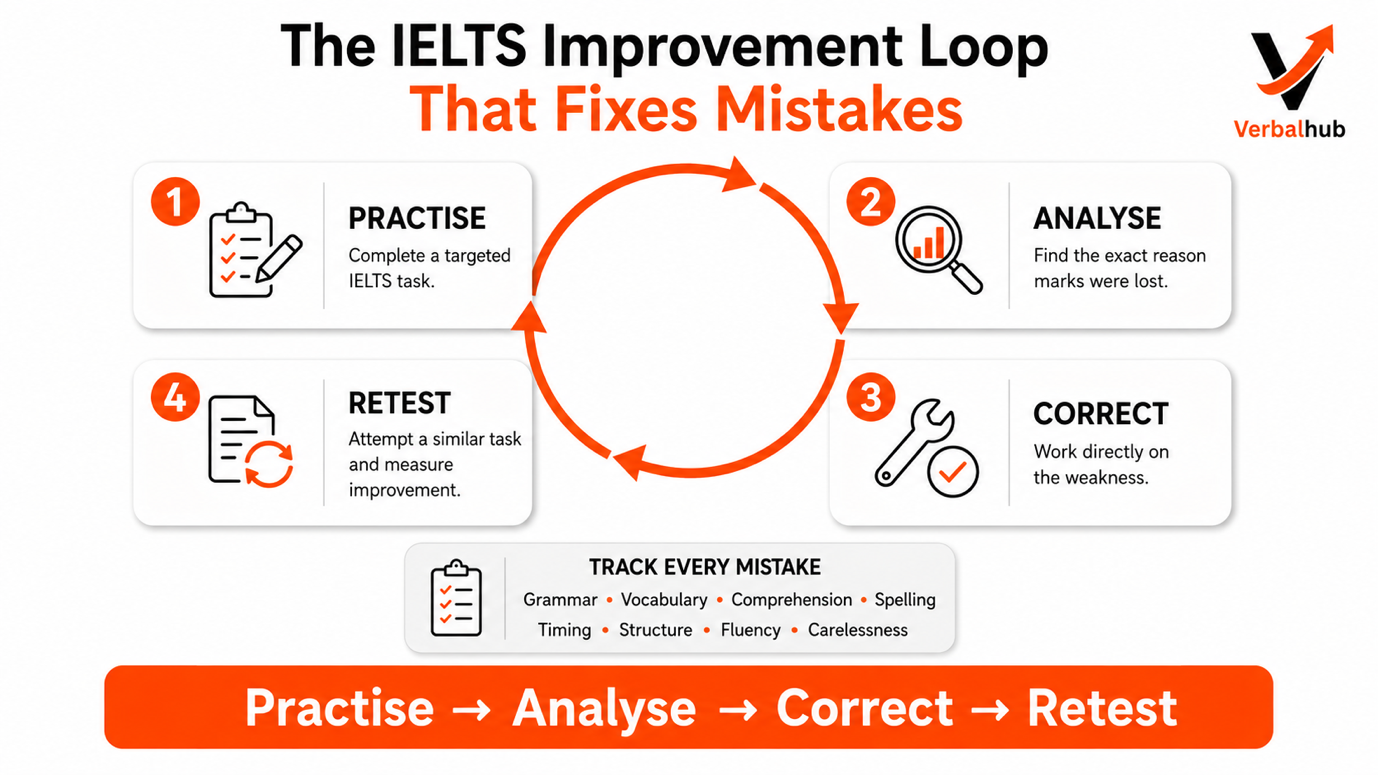
One of the most useful parts of the VerbalHub IELTS course was its four-step feedback loop:
| Step | What the Student Did |
|---|---|
| Practise | Completed a targeted IELTS task |
| Analyse | Identified why marks were lost |
| Correct | Worked on the exact weakness |
| Retest | Attempted a similar task to check improvement |
This cycle was followed in all four sections.
If a Writing answer lacked development, the student rewrote it. If a Reading answer was incorrect, the mentor checked the reasoning behind the choice. If a Speaking response sounded memorised, the student practised expressing the same idea in a more natural way.
The aim was not to complete the highest number of questions. It was to stop repeating the same mistakes.
How VerbalHub's Highly Qualified Mentors Help
Good IELTS study material is useful, but it cannot observe a student's habits or provide personal feedback.
VerbalHub's experienced IELTS mentors support students throughout the complete preparation journey. Their role includes understanding the student's target, identifying weak sections, creating a realistic course plan, explaining IELTS scoring criteria, correcting Writing tasks, conducting Speaking practice, reviewing mock-test performance, tracking repeated mistakes, adjusting the strategy when required and building confidence before the examination.
An experienced mentor can also tell whether a student needs more practice or a different method. This prevents students from spending weeks repeating exercises that are not solving the real problem.
Why Small-Group and One-on-One IELTS Classes Work
Every IELTS student has a different starting point. One student may need help with Writing Task 2. Another may struggle with Reading speed or Speaking confidence. A fixed programme cannot give equal attention to every need.
One-on-One IELTS Coaching
Suitable for students who need individual attention, have a limited preparation period, require flexible scheduling, have a specific weak section, want intensive Writing or Speaking feedback, or need a fully customised study plan. The mentor can adjust the pace, homework and lesson content according to the student's performance.
Small-Group IELTS Classes
Provide interaction without the pressure of a large classroom. Students can participate actively, learn from each other's questions, receive personal feedback, practise speaking regularly, stay accountable and get their doubts answered during live sessions.
This balance of interaction and individual attention makes learning more focused.
What Changed During the Student's Preparation?
| Before Personalised Coaching | After VerbalHub Training |
|---|---|
| Random daily practice | A structured, phase-wise plan |
| Slow Reading with no time strategy | Question-based Reading approach |
| Listening without prediction | Planned preview and answer prediction |
| Memorised Writing phrases | Clear, natural and relevant responses |
| Short and nervous Speaking answers | Better-developed and confident responses |
| Mock tests followed only by a score check | Detailed analysis of every mock |
| Repeated mistakes | Error log, correction and retesting |
| Unclear progress | Regular section-wise progress tracking |
The Band 7.5+ result was not caused by one shortcut. It was the outcome of many small improvements made consistently.
Lessons for Other IELTS Aspirants
This VerbalHub student review offers several useful lessons for anyone preparing for IELTS.
Do not confuse practice with progress. Completing more questions does not always improve your score. Progress happens when you understand your mistakes and correct them.
Do not memorise complete answers. Memorised essays and speaking responses may sound unnatural or fail to answer the actual question. Learn how to organise and express your own ideas.
Review every mock test. A mock score shows your current position. Detailed analysis shows what you need to do next.
Keep an IELTS error log. Record the question, your answer, the correct answer, why you made the mistake, the method you should use next time, and whether the mistake appeared again.
Get feedback on Writing and Speaking. These sections cannot be improved properly through passive learning alone. You need to write, speak, receive feedback and apply the correction.
Prepare for your personal target. The right IELTS preparation plan depends on your current level, required band, section-wise requirements and available time.
Is VerbalHub IELTS Coaching Right for You?
VerbalHub's online IELTS coaching may be suitable if:
- Your IELTS score is not improving
- You need Band 7, 7.5 or higher
- You want personal Writing feedback
- You need regular Speaking practice
- You keep repeating the same mistakes
- You want live online IELTS classes
- You prefer one-on-one or small-group coaching
- You have limited time before your exam
- You need a structured and personalised course plan
The programme supports both IELTS Academic and IELTS General Training students. The preparation plan is adjusted according to the test type, student level, target score and available timeline.
Final Thoughts
The student's IELTS Band 7.5+ success was not based on a secret trick or a memorised template.
It came from a simple but powerful process:
Diagnose → Learn → Practise → Receive feedback → Correct → Retest
The student already had the willingness to work. VerbalHub provided the direction, structure and personal guidance needed to turn that effort into a result.
If your IELTS score is stuck, studying for more hours may not be the complete answer. You may first need to understand where you are losing marks and why.
With personalised IELTS classes, experienced mentors, regular feedback and a phase-wise course plan, VerbalHub helps students prepare with clarity and confidence.
Frequently Asked Questions
Yes. Band 7.5 indicates a strong command of English. However, students should check the overall and section-wise requirements of their chosen university, employer or immigration programme.
Begin with a diagnostic test and identify your weaker sections. Follow a structured study plan, practise under time limits and get regular feedback on Writing and Speaking.
The required preparation time depends on your current English level, target band and available study hours. A diagnostic assessment can help create a realistic timeline.
Yes. VerbalHub offers live online IELTS coaching with personalised lessons, section-wise training, assignments, feedback and mock-test analysis.
Yes. One-on-one classes are available for students who need flexible pacing, individual attention and a customised IELTS preparation plan.
Yes. Students receive Writing corrections, rewriting guidance, speaking practice and mock interviews with individual feedback.
Yes. The preparation is adjusted for IELTS Academic or IELTS General Training, especially because their Reading and Writing sections differ.
Individual IELTS results vary based on starting level, preparation time, consistency, test strategy and exam-day performance. Coaching and mentoring can provide structure and feedback, but no fixed band score should be assumed.