
CAT STUDENT SUCCESS STORY

How personalised VARC coaching, close mock review and Hasan Sir's mentoring helped build a clearer CAT preparation process.
The Result
CAT 99th Percentile — a proud VerbalHub student achievement
A 99th percentile in CAT looks impressive on a scorecard. What the scorecard does not show is the work behind it—the confusing Reading Comprehension passages, close answer choices, uneven mock scores and the pressure to improve before exam day.
Anuj Sharma's result is a proud CAT student success story for VerbalHub. It also shows what focused preparation, regular practice and personal guidance can do when a student is aiming for a high percentile.
The goal was not to solve hundreds of random questions every week. It was to understand how CAT VARC works, find the exact reasons behind mistakes and build a method that could be used under time pressure.
With personalised CAT VARC classes, detailed CAT VARC mock analysis and guidance from Hasan Sir, Anuj worked towards a more controlled way of handling the section. His result offers useful lessons for students who work hard but still find their VARC scores unpredictable.
Why Do So Many CAT Aspirants Struggle with VARC?

Students often believe CAT VARC is difficult because the passages contain unfamiliar topics or complicated words. That is only a small part of the problem.
The real challenge is choosing between answer options that look very similar. You may understand the passage and still select the wrong answer because:
- The option sounds reasonable but is not supported by the passage.
- It uses an extreme word such as "always", "entirely" or "never".
- It mixes the author's opinion with someone else's view.
- It is partly correct but goes beyond the scope of the passage.
- It answers a different question from the one being asked.
- You rely on memory instead of returning to the relevant part of the text.
This is why simply reading newspapers or learning more vocabulary does not automatically improve a CAT VARC score. A student needs to understand how passages are organised, how questions are framed and how incorrect options are designed.
Personalised CAT VARC Classes Instead of a Fixed Study Plan
No two students struggle with VARC for exactly the same reason. One student may read slowly. Another may finish passages quickly but lose marks in inference questions. A third may perform well during practice but panic during sectional tests.
A common study plan cannot solve all these problems. VerbalHub's personalised CAT VARC coaching begins with the student's actual performance. Hasan Sir looks at how the student reads, selects passages, eliminates options and manages time.
The first review tries to answer practical questions:
- Which types of RC passages create the most difficulty?
- Is the student understanding the main argument?
- Are mistakes happening in inference, tone or main-idea questions?
- Is the student eliminating options for the right reasons?
- Which Verbal Ability question types need more attention?
- Does accuracy fall when the student tries to increase attempts?
- What changes when the student takes a timed mock?
Once these patterns become clear, the CAT VARC preparation plan can be adjusted around the student. That is what personal coaching should do: identify what is holding one student back and work on that problem.
Hasan Sir's Role in Anuj Sharma's CAT Preparation

Hasan Raja Sir is the Founder and Head Trainer at VerbalHub. He is an IIM Kozhikode alumnus and an experienced CAT VARC mentor who has spent more than 15 years teaching verbal aptitude.
- CAT VARC 99th percentile three times
- GMAT Verbal score of V50
- More than 15 years of teaching experience
- Over 10,000 students mentored
- Extensive experience in CAT VARC, GMAT Verbal and reasoning-based verbal exams
These credentials matter because CAT VARC cannot be taught through grammar rules and vocabulary lists alone. A strong mentor must understand how good test-takers read, separate evidence from assumption and make decisions when several options appear correct.
Hasan Sir's role goes beyond explaining why the official answer is right. During a personalised review, he also looks at why the student selected the wrong answer.
Why This Matters
A solution explains one question. A good mentor finds the thinking habit affecting many questions.
For example, a student may repeatedly add personal knowledge to the passage, choose an option because it repeats words from the text, reject a moderate answer in favour of a stronger one, or change correct answers without a clear reason. Once that pattern is visible, the practice becomes far more focused.
CAT VARC Is a Reasoning Section, Not an English Test
Students sometimes say, "My English is weak, so I cannot score well in VARC." That is not always true.
CAT VARC does require comfortable reading, but it does not test accent or the ability to use fancy words. It mainly tests whether you can understand an argument and make a logical choice from the given text.
In VerbalHub's CAT Reading Comprehension classes, students learn to look for:
- The central point of a passage
- The purpose of each paragraph
- The author's tone and position
- Examples used to support an argument
- Contrasts and changes in direction
- Assumptions behind a claim
- The exact scope of an answer option
- Words that make an option too broad or too narrow
This changes the way students approach RC. Instead of trying to memorise every detail, they follow the author's line of thought. Instead of selecting an option because it sounds good, they check whether it is supported by the passage.
How VerbalHub's CAT VARC Coaching Stands Out
Many CAT courses offer recorded lessons, question banks and large batches. These resources can be useful, but they may not tell a student why the score has stopped improving. VerbalHub uses a more personal, diagnosis-based approach.
1. Small Live CAT VARC Classes
VerbalHub keeps its live batches small—usually five to seven students—so learners can ask questions and take part in real discussions. Hasan Sir can ask a student to explain why an option was selected. That conversation often reveals more than the final answer.
2. A Personalised Study Plan
The plan is based on the current VARC score, target percentile, reading speed, accuracy, strong and weak question types, time available before CAT and performance in mocks. It changes as the student improves.
3. Strong Focus on Reading Comprehension
The CAT Reading Comprehension classes cover passage structure, the author's purpose, tone, evidence, inference, close-option comparison and scope errors. Students practise passages from philosophy, economics, science, history, sociology, psychology and culture—not to become experts in every topic, but to become comfortable with unfamiliar writing.
4. Step-by-Step Option Elimination
Students learn to ask whether an option is supported by the passage, answers the exact question, uses stronger language than the author, introduces a new idea or is only partly correct. This is especially useful when two CAT RC options appear equally attractive.
5. Complete Verbal Ability Preparation
The course also covers para jumbles, para summaries, odd-sentence questions, paragraph completion, sentence placement and other formats relevant to CAT. The focus stays on how ideas connect.
6. Personalised CAT VARC Mock Analysis
The review goes beyond the percentile. Hasan Sir checks passage order, time spent, missed easy questions, accuracy, attempts and the exact reason behind each important error. Every mock becomes a plan for the following week.
7. A Personalised VARC Error Log
Students record the question type, selected answer, correct answer, cause of the mistake, time taken, better method and lesson for the next test. Over time, repeated patterns become easy to spot.
8. Regular One-to-One Feedback
Students receive direct feedback on doubts, reading habits, test decisions and the next stage of CAT VARC preparation. The advice is specific: what to read, what to observe, which question type to practise and what to change in the next mock.
Why Mock Analysis Matters More Than Taking More Mocks
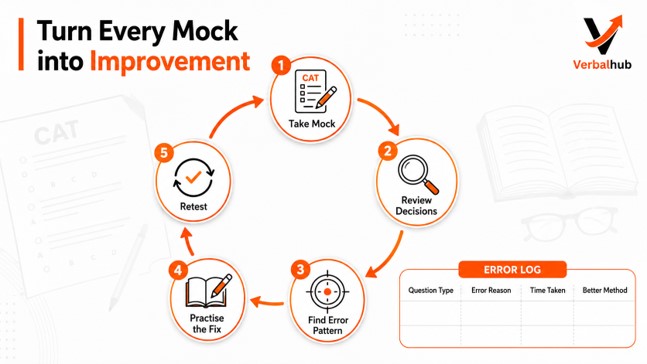
A low mock score can feel disappointing, but it can also provide useful information. The problem begins when a student checks the percentile, reads a few solutions and immediately takes another test.
A proper CAT VARC mock analysis separates mistakes into clear groups:
Passage-understanding error
Question-understanding error
Option-elimination error
Time-management error
Passage-selection error
Careless error
Guess made without enough evidence
Each type needs a different response. If the passage was misunderstood, the student may need more work on structure. If the passage was understood but the wrong option was selected, the issue may be scope or elimination. If time ran out, the attempt order may need to change.
What CAT Aspirants Can Learn from Anuj Sharma's Success Story
Know Your Real Weakness
Do not assume that every low VARC score comes from slow reading. Check whether the problem is comprehension, option elimination, selection or time pressure.
Follow One Clear Method
Changing strategies after every mock creates confusion. Learn a reliable process, practise it and improve it gradually.
Review Wrong and Correct Answers
A correct answer may still involve weak reasoning or too much time. Review the decisions, not just the marks.
Protect Accuracy
A high number of attempts helps only when accuracy stays under control. CAT VARC rewards sensible selection.
Work on Repeated Patterns
One mistake can happen by chance. The same mistake across several tests needs attention.
Ask for Feedback When Scores Stop Moving
A skilled CAT VARC mentor can notice habits that are difficult for a student to see alone.
Stay Consistent
VARC rarely improves overnight. Reading, analysis, timed practice and review must continue together.
Who Should Consider VerbalHub's Personalised CAT VARC Classes?
VerbalHub's CAT VARC online coaching can be particularly useful for students who:
- Find their VARC scores unpredictable
- Understand passages but select incorrect options
- Struggle with difficult RC topics
- Cannot manage time in the VARC section
- Need help with para jumbles or para summaries
- Have reached a score plateau
- Want individual mock-test analysis
- Prefer small live classes to large batches
- Need a study plan around college or work
- Are targeting a high CAT VARC percentile
More Than a CAT Score
Anuj Sharma's CAT 99th-percentile result is an achievement worth celebrating. For VerbalHub, it also represents the value of focused teaching. A student does not always need more material. Sometimes, the student needs a better way to use the material already available.
With Hasan Sir's guidance, students learn how to read with purpose, remove weak options, select questions wisely and use mock tests as learning tools. They receive honest feedback about what is working and what still needs attention.
There are no overnight promises. There is a clear process, regular correction and steady improvement.
Congratulations
Congratulations to Anuj Sharma on achieving the CAT 99th percentile—a proud moment for Anuj and the VerbalHub community.
Start Your Personalised CAT VARC Preparation with Hasan Sir
If your CAT VARC score is not matching the effort you are putting in, solving more random questions may not be the answer. You may first need to find out where the marks are being lost.
Join VerbalHub's personalised CAT VARC classes and prepare under the guidance of Hasan Sir—an IIM Kozhikode alumnus, three-time CAT VARC 99th percentiler and GMAT Verbal V50 scorer with more than 15 years of teaching experience.
The preparation includes small live classes, Reading Comprehension methods, Verbal Ability practice, individual feedback, error-log review and detailed CAT VARC mock analysis.
Next Step
Book a CAT VARC counselling session with VerbalHub and get a preparation plan based on your present score, target percentile and individual learning needs.
Frequently Asked Questions
The real challenge is usually not unfamiliar topics or difficult vocabulary. It is choosing between answer options that look very similar, where a wrong choice may sound reasonable but is not actually supported by the passage.
Hasan Raja Sir, Founder and Head Trainer at VerbalHub, teaches CAT VARC. He is an IIM Kozhikode alumnus, a three-time CAT VARC 99th percentiler, a GMAT Verbal V50 scorer, and has more than 15 years of teaching experience with over 10,000 students mentored.
No. CAT VARC requires comfortable reading, but it mainly tests whether a student can understand an argument and make a logical choice based on the given text, not whether they know difficult words or have a particular accent.
VerbalHub keeps its live CAT VARC batches small, usually five to seven students, so learners can ask questions and take part in real discussions with the mentor.
A mock score only shows what happened. Proper analysis separates mistakes into categories such as passage-understanding, option-elimination, time-management and passage-selection errors, and each type needs a different correction.
No responsible coaching programme can guarantee a fixed percentile. Results depend on the student's starting level, preparation time, consistency, test strategy and performance on exam day.
Result note: Anuj Sharma's percentile is based on VerbalHub's published student result information. Individual outcomes may vary.