
GMAT SUCCESS STORY — 500 TO 750

A four-phase preparation journey built on diagnosis, personal guidance, purposeful practice and detailed review.
500Starting Level
750Final Score
FIRST ATTEMPTOfficial GMAT
A low starting score does not mean that a high GMAT score is out of reach. Ankit's journey from 500 to 750 on his first GMAT attempt shows what focused learning, personal guidance and regular analysis can achieve.
His improvement did not come from collecting shortcuts or solving questions without a plan. He followed a clear learning process, worked on the reasons behind his mistakes and received personalised support through VerbalHub's one-on-one GMAT coaching.
THE FOUR-PHASE METHOD: Diagnose → Learn → Practise → Analyse
Ankit's GMAT Success Story at a Glance
- Starting score: Around 500
- Final GMAT score: 750
- Official attempt: First attempt
- Score improvement: Approximately 250 points
- Preparation method: Personalised learning and one-on-one guidance
- Main focus: Concepts, accuracy, option elimination, timing and mock analysis
Ankit's result shows that GMAT preparation becomes more effective when the study plan is based on the student's own strengths, weaknesses and target score.
The First Challenge: Moving Beyond a 500 GMAT Score
A score near 500 can feel discouraging, especially when the target is 700 or higher. The gap looks large, and many students are unsure where to begin.
Some students immediately start solving difficult questions. Others buy several books, watch random videos or take mock after mock. But more study material is not always helpful to achieve a better GMAT score. The first step is to understand why the score is low.
- Weak concepts or an incomplete foundation
- Poor reading habits and difficulty understanding arguments
- Confusion between the final two options
- Slow question-solving or rushed decisions
- Weak time management under test conditions
- Repeated mistakes that are never properly reviewed
Ankit's preparation began by finding these gaps. Instead of following a common plan, he received a personalised GMAT preparation strategy suited to his starting level and target score.
Hasan Raja Sir's Contribution to Ankit's Preparation
Personal coaching becomes useful when the teacher looks beyond the correct answer and understands why the student selected the wrong one. This was an important part of Ankit's GMAT Verbal preparation with Hasan Raja Sir.
Hasan Raja Sir is an IIM Kozhikode alumnus, GMAT Verbal expert and Lead Verbal Faculty at VerbalHub. With 20 years of teaching experience and 10,000+ students mentored, his approach focuses on logic, reading structure, option elimination, pacing and error analysis.
During Ankit's preparation, Hasan Sir's personal guidance focused on:
- Finding the exact reasons behind Verbal mistakes
- Building a clear method for GMAT Critical Reasoning
- Reading GMAT passages by structure rather than memory
- Eliminating close trap options with a valid reason
- Improving accuracy without creating time pressure
- Reviewing repeated patterns through an error log
- Helping Ankit build a process he could use independently on test day
HASAN SIR'S TEACHING PRINCIPLE: "Do not just practise more. Find the cause of the mistake and fix it."
Why a Four-Phase Learning Plan Works
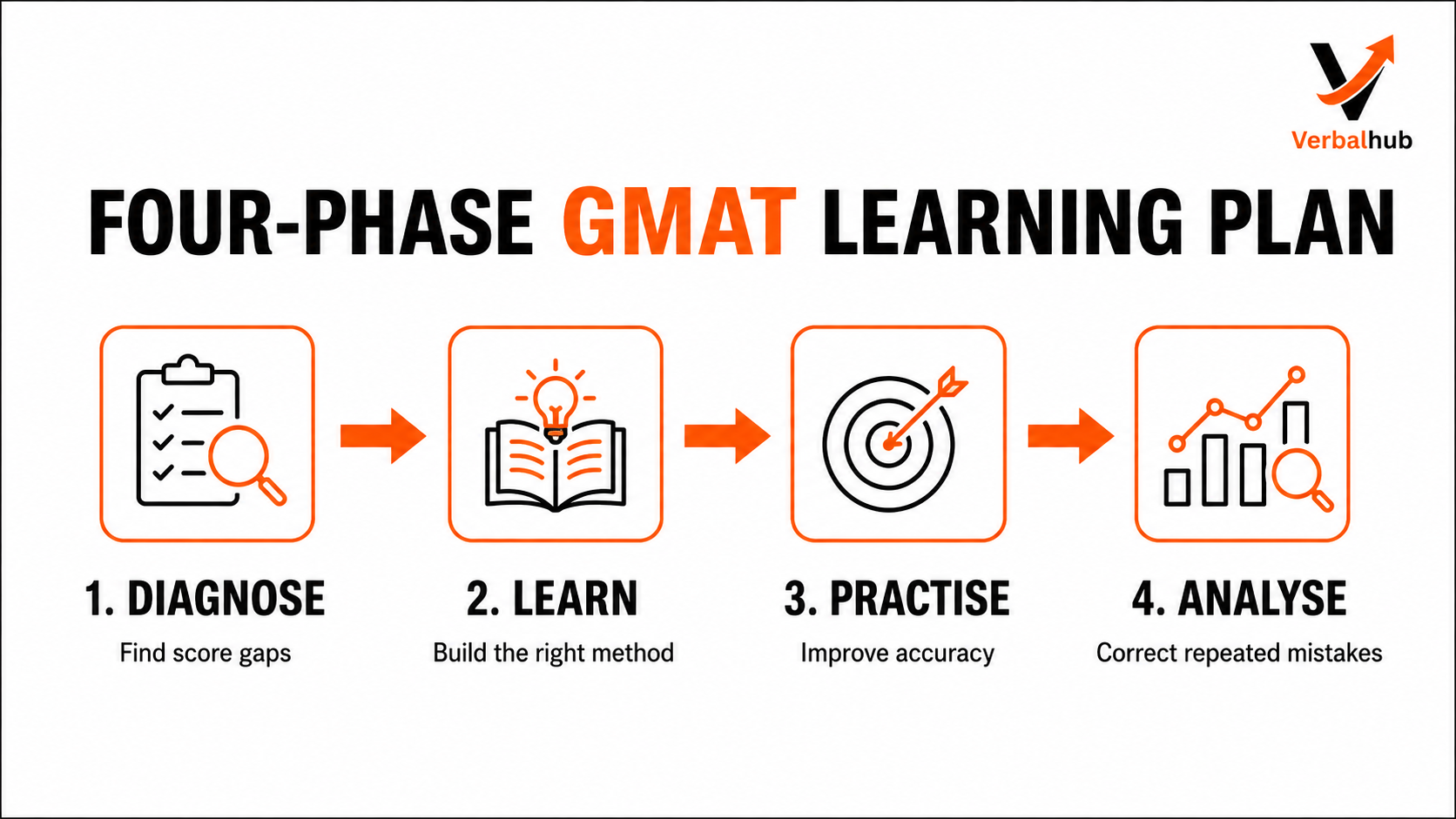
A large score jump is achievable if prep goes through divided into clear stages. Each phase has one job, and each phase prepares the student for the next.
LEARNING ROADMAP: Phase 1: Diagnose | Phase 2: Learn | Phase 3: Practise | Phase 4: Analyse
Phase 1: Diagnose the Real Problem
Before regular lessons begin, a diagnostic review should identify the exact reason behind the lost marks. "Weak in Verbal" is too broad. One student may miss assumptions in Critical Reasoning, while another may understand the argument but repeatedly choose the wrong option from the final two.
The diagnostic stage checks accuracy by question type, time spent, repeated error patterns and performance near the end of a section. This allows the mentor to create a personal study plan instead of giving the same schedule to every learner.
Phase 2: Learn the Right Method
Once the gaps are clear, the student needs a dependable method. The aim is not to remember tricks. It is to understand what the question is testing and make a controlled decision.
GMAT Critical Reasoning
- Identify the conclusion.
- Separate the evidence from the conclusion.
- Find the gap or assumption in the argument.
- Understand the exact task in the question stem.
- Choose the option that directly performs that task.
This process reduces guesswork. The student stops choosing an option merely because it sounds related and starts checking whether it truly strengthens, weakens, explains or evaluates the argument.
GMAT Reading Comprehension
In Reading Comprehension, the goal is not to memorise every sentence. The student learns to see the main purpose, the role of each paragraph, the author's view, any contrast and the connection between the major ideas.
Structural reading makes the passage easier to manage and helps the student return to the correct lines for detail-based questions.
Option Elimination
Many students understand the passage or argument but still end with the wrong choice. They need to recognise options that are too extreme, outside the scope, partly correct, based on an unsupported idea or answering a different question.
A BETTER QUESTION: "What exact difference makes one option correct and the other one wrong?"
Phase 3: Practise With Accuracy Before Speed
Once the method is clear, practice should be targeted. Random practice can create the feeling of progress, but targeted sets improve one skill at a time.
- Assumption questions to strengthen argument analysis
- Inference questions to build evidence-based reading
- Main-purpose questions to improve passage structure
- Timed sets to develop pacing
- Mixed sets to test whether the method remains stable
In the early stage, accuracy matters more than speed. Timing is added gradually after the method becomes stable.
PRACTICE SEQUENCE: Understand the method → Apply it correctly → Build accuracy → Add timing
Phase 4: Analyse Tests and Correct Repeated Mistakes
A mock score tells the student what happened. Proper analysis explains why it happened. That difference is important.
After a test, the review should examine where time was lost, which questions affected confidence, whether the student rushed near the end and which trap options were selected.
An error log can separate concept errors, reading errors, interpretation errors, elimination errors, timing mistakes, careless mistakes and unnecessary answer changes. Once you catch the pattern, you can easily correct them.
How Personalised One-on-One GMAT Coaching Helps

Every GMAT student starts at a different level. Some understand concepts but struggle with timing. Others solve quickly but lose accuracy. Working professionals may also need a plan that fits around office hours. A fixed schedule cannot solve all these problems equally well.
VerbalHub's personalised GMAT coaching focuses on the learner's actual performance. Personal guidance may include:
- A study plan based on the starting score and target
- Lessons focused on individual weak areas
- Question sets selected for a clear purpose
- Regular accuracy and pacing checks
- Personal error-log and mock-test review
- Direct feedback from the GMAT tutor
- Changes in the plan as the student improves
This makes one-on-one GMAT tutoring result-oriented. If accuracy improves but timing remains weak, the next stage focuses on pacing. If assumption questions remain a problem, the mentor returns to argument structure. The plan changes with the student's needs.
VerbalHub's Role in the 500-to-750 Journey
VerbalHub provided a structured preparation path rather than a collection of disconnected lessons. The support centred on personal attention, one-on-one guidance and regular performance review.
Personal Attention
Mistakes were reviewed individually so that repeated patterns could be found and corrected. This is difficult to achieve when every student follows the same classroom plan.
One-on-One Guidance
Direct interaction with a personal GMAT tutor allows the student to explain his reasoning, ask questions and understand exactly where the approach went wrong.
Regular Performance Review
Progress is not measured only by the number of completed questions. Accuracy, timing, decision-making and mock performance are reviewed together.
How Ankit Converted Learning Into a 750 Score
By the time Ankit appeared for the official GMAT, he had more than conceptual knowledge. He had a process he could trust under exam pressure.
- Read an argument without getting lost in unnecessary details
- Identify the conclusion and logical gap
- Understand the role of each paragraph
- Reject trap options for a clear reason
- Control time across the section
- Avoid investing extra minutes on one difficult question
- Review an answer only when there was a valid reason
The final result was an excellent 750 on his first GMAT attempt—an improvement of approximately 250 points from his starting level.
What GMAT Aspirants Can Learn From Ankit's Success
1. Do not let a low diagnostic score decide your target
Your first score shows your only present position, not final potential.
2. Find the cause before solving more questions
If the same mistake keeps returning, more practice alone will not fix it.
3. Build accuracy before chasing speed
A fast incorrect method is still incorrect. Build the process first and then improve timing.
4. Review every mock properly
The most valuable part of a mock often begins after the test is over.
5. Use personal guidance to correct hidden patterns
A skilled GMAT tutor identifies habits that students may not notice themselves.
Why Students Choose Personalised GMAT Coaching at VerbalHub
- One-on-one GMAT tutoring for individual attention
- Personal GMAT coaching based on the starting level
- Personal guidance for Critical Reasoning and Reading Comprehension
- Targeted practice instead of random question-solving
- Detailed mock-test and error-log analysis
- Flexible support for working professionals and retakers
- A clear study plan for students targeting a high GMAT score
The sole aim is not just to cover a syllabus. It is to find what is holding the score back and correct it with a clear, repeatable process.
Final Thoughts
Ankit's journey from 500 to 750 in his first GMAT attempt was built on a clear four-phase learning plan, purposeful practice, close performance review and personalised guidance.
The roadmap was simple: diagnose the weakness, learn the right method, practise with purpose and analyse every mistake. A low starting score may tell you where you are today, but it cannot tell you where you can finish.
START YOUR GMAT PREPARATION
Book a free 15-minute GMAT Verbal diagnostic with VerbalHub and get a personalised 700+ study plan.
Individual results may vary based on starting level, preparation time, consistency and test-day performance.