
PTE SUCCESS STORY — SCORE 76

Quick Snapshot
| PTE Score | 76 |
| Key Challenge | Turning consistent effort into a focused, section-wise study plan |
| Solution | Personalised trainer feedback, error tracking, timed practice and mock-test analysis |
| Preparation Approach | One-on-one personalised PTE coaching |
| Training Provider | VerbalHub |
A strong PTE score is rarely the result of solving hundreds of questions without a plan.
Students improve when they know what is going wrong, receive clear feedback and practise the right tasks regularly.
Akshita recently achieved an impressive overall score of 76 in PTE Academic after preparing with VerbalHub.
Her result reflects consistent effort, a focused study plan and regular support from her PTE trainer.
According to Pearson, a PTE Academic score between 76 and 84 represents a very high level of English proficiency and is aligned with CEFR C1.
This PTE success story explains how Akshita prepared for Speaking, Writing, Reading and Listening—and what other PTE aspirants can learn from her journey.
Akshita's Starting Point
Every student begins PTE preparation with a different set of strengths and weaknesses.
A student may speak English confidently but lose marks because of unclear pronunciation or frequent pauses. Another may understand passages easily but struggle with spelling, grammar or time management.
That is why Akshita's preparation did not begin with a general lesson.
Her VerbalHub trainer first reviewed her performance across the four language skills:
- Speaking
- Writing
- Reading
- Listening
The aim was to answer three simple questions:
- Which tasks were already her strengths?
- Where was she losing marks?
- What was causing those mistakes?
This first review helped the trainer create a personalised PTE study plan for her.
Instead of spending the same amount of time on every question type, Akshita worked more on the tasks that required attention.
The Study Method That Helped Her Improve
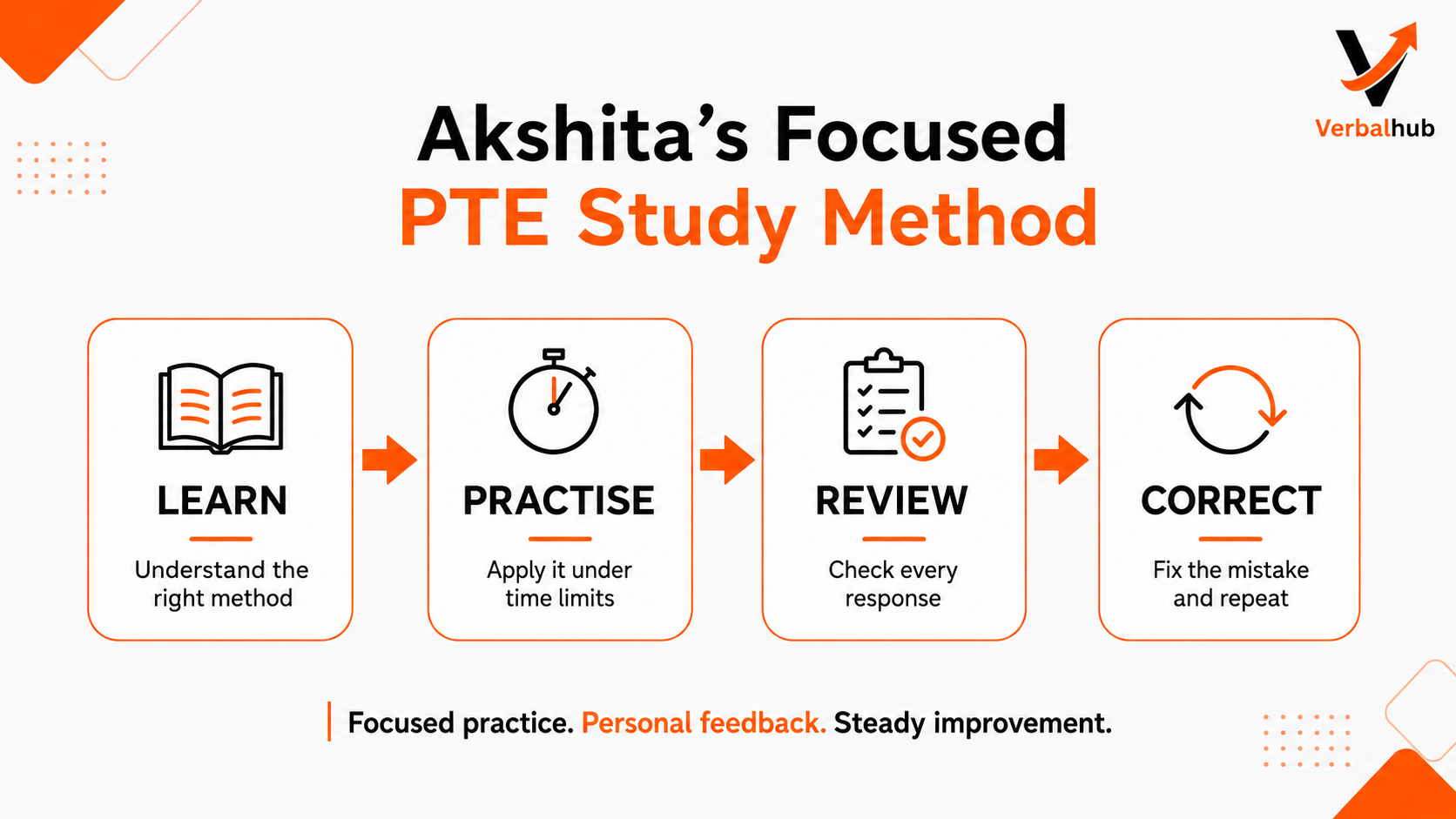
Akshita's PTE preparation followed a practical four-step method:
PREPARATION FRAMEWORK
Learn the method → Practise it → Review the response → Correct the mistake
Learn the method → Practise it → Review the response → Correct the mistake
This process kept her from repeating the same errors.
After every practice session, her trainer helped her understand:
- What she had done well
- Where the response had gone wrong
- Why the mistake had happened
- How the mistake could affect her score
- What she should change in her next attempt
This type of review made her daily practice more focused.
Her PTE coaching plan included:
- One-on-one trainer support
- A study plan based on her performance
- Speaking response reviews
- Writing corrections
- Section-wise practice
- Timed exercises
- Mock-test analysis
- Error tracking
- Regular doubt-clearing sessions
How Akshita Prepared for PTE Speaking
PTE Speaking can be challenging even for students who use English every day.
The student must listen, understand, organise a response and speak into a microphone—all within a limited time. Frequent pauses, uneven speed and unclear word endings can affect performance.
Akshita's trainer worked with her on:
- Fluency
- Pronunciation
- Speaking pace
- Natural pauses
- Sentence stress
- Clear word endings
- Microphone use
- Confidence while speaking
Her practice covered important PTE Speaking tasks, including:
- Read Aloud
- Repeat Sentence
- Describe Image
- Retell Lecture
- Answer Short Question
- Summarize Group Discussion
- Respond to a Situation
The last two question types were introduced for PTE Academic tests taken after 7 August 2025. Students appearing for PTE in 2026 should include both tasks in their preparation.
Akshita's responses were checked individually. She was not simply told to "speak more fluently." Her trainer showed her where she was pausing, rushing or losing clarity.
This helped her make small but useful changes to the way she spoke.
How She Improved Her PTE Writing
Good PTE Writing does not require complicated words or long sentences.
A clear, relevant and grammatically correct response is usually easier to read and less likely to contain mistakes.
Akshita worked on:
- Sentence formation
- Grammar
- Spelling
- Vocabulary
- Organisation of ideas
- Linking words
- Word limits
- Final proofreading
Her preparation covered:
- Summarize Written Text
- Write Essay
The trainer showed her how to build a clear response using a simple structure.
Templates were used only to organise the answer. Akshita still had to understand the topic, choose suitable ideas and write accurate sentences.
This approach helped her avoid answers that sounded memorised or did not match the question.
How She Worked on PTE Reading
Many students treat PTE Reading as a vocabulary test. However, vocabulary alone is not enough.
Students also need to recognise grammar patterns, word combinations, paragraph flow and connections between ideas.
Akshita's Reading practice focused on:
- Vocabulary in context
- Grammar clues
- Common collocations
- Sentence connections
- Paragraph order
- Question selection
- Time management
She practised tasks such as:
- Reading and Writing: Fill in the Blanks
- Reorder Paragraphs
- Reading: Fill in the Blanks
- Multiple-Choice Questions
Her trainer taught her to look at the words before and after each blank, check the grammar of the sentence and think about the overall meaning.
She also learnt not to spend too much time on one difficult question. Moving on at the right time helped her protect the rest of the section.
How She Prepared for PTE Listening
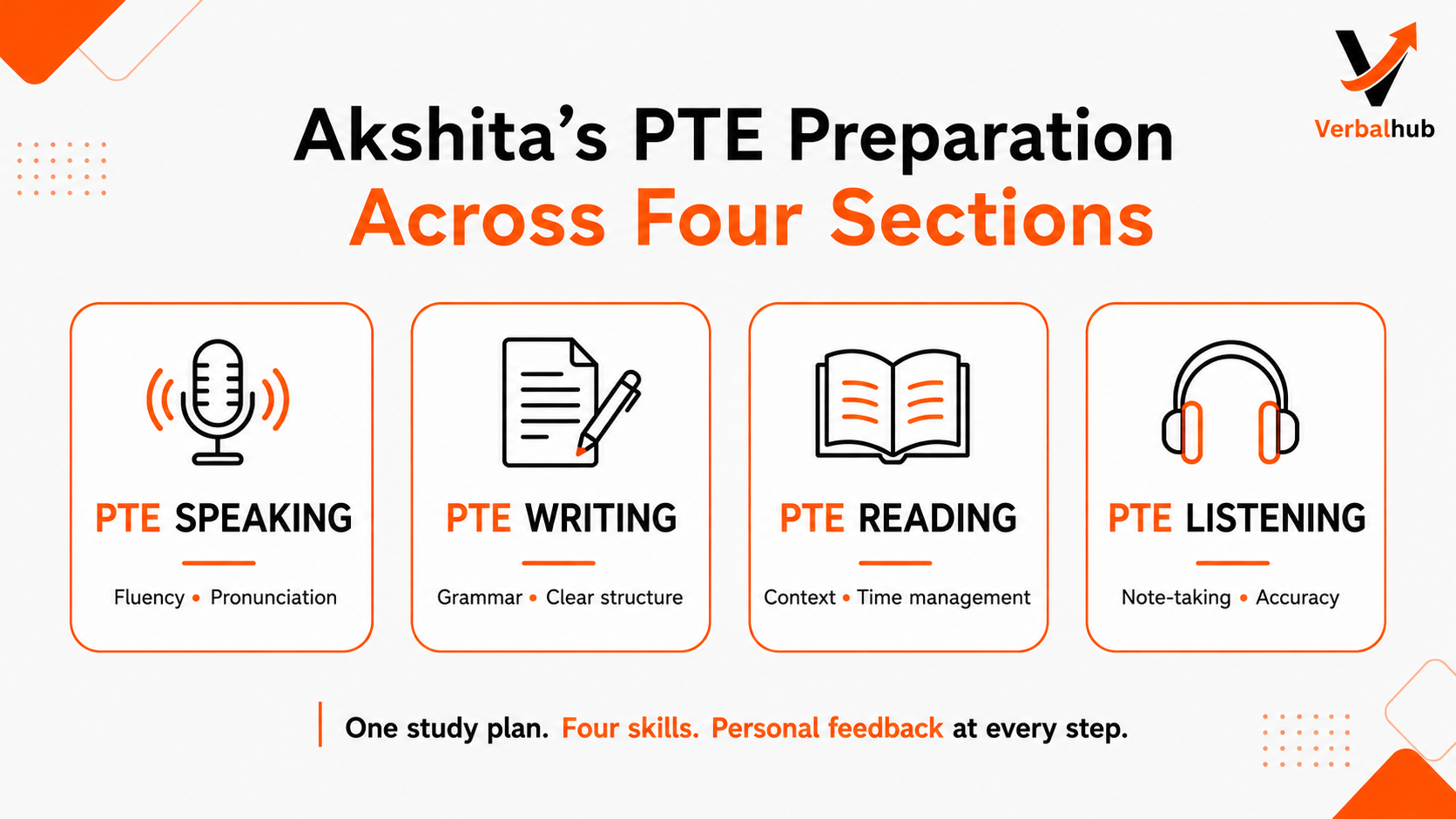
PTE Listening is not only about understanding an audio recording.
Several listening tasks also check spelling, grammar, memory, attention and note-taking.
Akshita worked on:
- Listening for the main idea
- Picking out important details
- Taking short and useful notes
- Remembering key words
- Checking spelling
- Staying focused during longer recordings
Her practice included:
- Summarize Spoken Text
- Listening: Fill in the Blanks
- Highlight Incorrect Words
- Write from Dictation
Her trainer identified small mistakes that could easily go unnoticed, such as missing articles, confusing singular and plural forms or spelling a familiar word incorrectly.
Regular dictation practice improved her attention and accuracy. She also learnt to focus on meaning instead of trying to remember every word from the recording.
Why Personalised PTE Coaching Worked for Akshita
Two students can receive the same mock score but have completely different problems.
One may need daily Repeat Sentence practice. Another may need help with spelling or Reading Fill in the Blanks. A third may understand the tasks but perform poorly because of weak time management.
A fixed study plan cannot address all these situations.
With personalised PTE coaching, Akshita's trainer could:
- Spend more time on her weaker tasks
- Review her individual responses
- Track repeated mistakes
- Change the practice plan when needed
- Adjust the speed of the classes
- Assign homework based on her progress
- Clear doubts during the preparation process
This individual attention made her preparation more relevant. She did not have to follow the same lesson plan as every other student.
The Role of Mock Tests in Her PTE Preparation
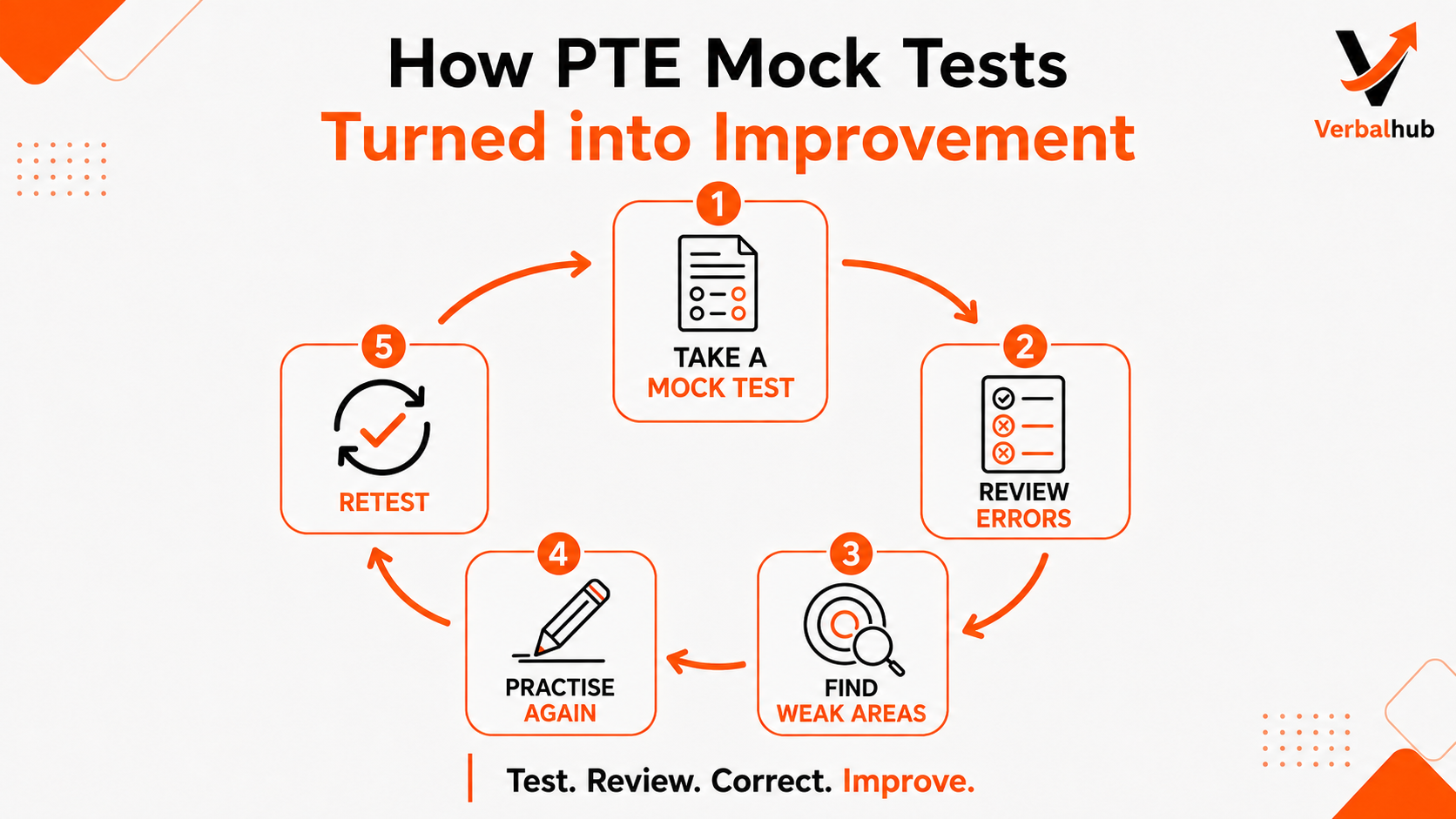
Mock tests were an important part of Akshita's preparation, but taking a test was only the first step.
After each test, her trainer reviewed:
- Section-wise performance
- Frequently repeated mistakes
- Time spent on different tasks
- Accuracy under pressure
- Changes needed before the next test
A low mock score was not treated as a failure. It was used to decide what Akshita should practise next.
This approach helped turn every mock test into a learning tool.
What PTE Students Can Learn from Akshita
Akshita's journey offers several useful lessons for students preparing for PTE Academic.
Identify the exact problem
Do not stop at statements such as "my Speaking is weak."
Ask what is actually affecting the score. Is it pronunciation, fluency, pace, hesitation, vocabulary or microphone use?
A clear diagnosis leads to better practice.
Review your mistakes
Solving more questions will not help if the same mistakes keep returning.
Keep a simple error log with:
- Question type
- Mistake made
- Reason for the mistake
- Correct method
- Next practice date
Practise within time limits
Untimed practice helps you learn a task. Timed practice helps you perform it during the test.
Both are necessary.
Do not depend completely on templates
A template can give your response a basic structure. It cannot replace relevant content, correct grammar or natural language.
Use templates as support—not as ready-made answers.
Prepare for the current test format
PTE Academic now includes Summarize Group Discussion and Respond to a Situation.
Students preparing with old material may miss these tasks. Always check that your course and practice resources follow the latest test format.
Apply the feedback
Feedback is useful only when it changes your next response.
Akshita's willingness to listen, practise again and correct her errors played a major role in her progress.
How VerbalHub Supports PTE Students
VerbalHub's PTE online coaching is designed around the student's current level, target score and preparation time.
The programme includes:
- Personalised PTE preparation plans
- Guidance from experienced PTE trainers
- Live online classes
- One-on-one speaking feedback
- Detailed writing correction
- Section-wise practice exercises
- Timed tests and PTE mock tests
- Performance reviews
- Flexible class timings
- Regular doubt support
The goal is not just to cover the PTE syllabus. The trainer studies the student's performance, finds repeated problem areas and provides practice that addresses those issues.
Students can learn from home while receiving direct guidance throughout their preparation.
Akshita's PTE 76: A Well-Earned Result
Akshita's PTE score of 76 reflects her regular effort, patience and willingness to work on feedback.
Her trainer gave her the plan, practice and direction. Akshita followed the process and continued working on her weaker areas until she became more consistent.
Congratulations, Akshita, on this excellent result.
Her journey is a useful reminder for every PTE aspirant:
KEY TAKEAWAY
You do not always need more practice. You need to know what to practise, how to practise it and what to correct afterwards.
You do not always need more practice. You need to know what to practise, how to practise it and what to correct afterwards.
Frequently Asked Questions
Yes. Pearson places scores from 76 to 84 at the CEFR C1 level, which represents a very high level of English proficiency. Individual universities and visa routes may set their own requirements, so students should check the conditions that apply to them.
Personalised coaching allows the PTE faculty to spend sufficient time to find the student's actual weaknesses. The trainer can review individual responses, track repeated mistakes and adjust the study plan as the student improves.
Yes. VerbalHub offers live online PTE coaching with trainer guidance, section-wise practice, feedback and flexible learning options.
The current PTE Academic format includes two newer Speaking tasks: Summarize Group Discussion and Respond to a Situation. These tasks apply to PTE Academic tests taken after 7 August 2025.
No. Templates may help organise an answer, but students still need correct grammar, relevant content, clear pronunciation and proper task understanding.
Mock-test analysis shows where marks are being lost. It can reveal problems with accuracy, timing, task selection, pronunciation, spelling or grammar and help shape the next stage of preparation.
Start Your PTE Preparation with VerbalHub
Are you preparing for PTE Academic but unsure why your scores are not improving?
A detailed performance review can help you understand your weak areas and build a study plan around your target score.
With VerbalHub's personalised PTE online coaching, you receive focused guidance, regular feedback and practice based on your individual needs.
Speak to a VerbalHub PTE trainer and begin your preparation with a clear plan.