
ISB INTERVIEW SUCCESS STORY
How personalised coaching built clearer answers and stronger interview confidence — mentored by Hasan Raja Sir, MBA Admissions Mentor at VerbalHub.
An ISB interview invitation is a major achievement, but it also brings a new challenge.
A candidate may have strong academic records, valuable work experience and well-written application essays. However, explaining the same journey clearly in front of an interview panel requires a different kind of preparation.
Abhineet Kanodia understood this before his ISB interview. Instead of memorising answers to common MBA interview questions, he worked on understanding his profile, organising his career story and preparing for difficult follow-up questions.
With personalised guidance from Hasan Raja Sir and focused ISB interview coaching at VerbalHub, Abhineet entered the interview with greater clarity and confidence.
Abhineet's ISB interview success story shows that good preparation is not about learning perfect answers. It is about learning how to present real experiences in a clear, honest and convincing way.
Why the ISB Interview Requires Personal Preparation
The ISB application presents a candidate through academic records, professional achievements, essays, recommendations and career goals. The interview looks beyond these written details.
The panel may want to understand:
- Why you want to pursue an MBA
- Why you have selected ISB
- Whether your career goals are realistic
- What you have learned from your work experience
- How you handle failure and pressure
- Whether your achievements are supported by facts
- How you may contribute to the ISB classroom
- Whether your interview answers match your application
This is why general MBA interview preparation is often not enough. Every applicant has a different career path, strength and concern. A candidate changing industries needs a different interview plan from an entrepreneur or someone seeking a leadership role in the same field. Personalised ISB interview coaching helps an applicant prepare for questions connected to his or her actual profile.
The Challenge Abhineet Had to Solve
Abhineet's main task was not to collect more interview questions. He needed to present his personal and professional journey in a way that was easy for the panel to understand.
Like many MBA applicants, he had to connect four important parts of his story:
THE STORY LINE: Past experience → Present position → Need for an MBA → Future career goal
If these parts do not connect, the interview may sound incomplete. A candidate may have good experience but an unclear career goal. Another may know what role he wants but may not explain why an MBA is necessary. Some candidates give a strong reason for pursuing an MBA but a very general answer to “Why ISB?”
Abhineet's preparation focused on building a clear link between his experience, present needs and future direction.
The Four-Phase ISB Interview Preparation Plan
Abhineet's preparation at VerbalHub followed four connected phases:
PREPARATION ROADMAP: Diagnose → Build → Practise → Refine
Each phase had a specific purpose. Diagnosis identified the weak areas. The building phase organised the profile and career story. Practice improved answer delivery. Refinement corrected the remaining gaps before the interview. This step-by-step plan made the preparation focused and measurable.
Phase 1: Diagnose the Real Interview Gaps
The first step was to understand what could affect Abhineet's interview performance. Saying, “I need to improve my interview skills,” is too broad. A useful diagnosis must be more specific.
An applicant may struggle because:
- The career goal is not clear
- The “Why MBA?” answer sounds common
- The “Why ISB?” response is based on website information
- Leadership examples lack details
- Answers are too long
- Achievements are not supported by numbers
- The candidate becomes nervous during follow-up questions
- Interview answers do not match the application essays
- Strengths and weaknesses sound rehearsed
Hasan Sir reviewed Abhineet's profile from the interviewer's point of view. The aim was to identify questions that could naturally arise from his education, work experience, achievements, career decisions and future plans. This diagnosis helped create a personalised ISB interview preparation plan instead of following the same set of questions used for every applicant.
Phase 2: Build a Clear and Believable Career Story
Once the gaps were identified, the next step was to organise Abhineet's story. A strong MBA interview answer should not sound like a speech. It should help the interviewer follow the candidate's journey without confusion.
Abhineet worked on questions such as:
- What have I achieved in my career so far?
- Which experiences influenced my MBA decision?
- What skills have I already developed?
- What skills or exposure do I still need?
- Why is this the right time for an MBA?
- Why does ISB fit my career plan?
- What role do I want after graduation?
- How does that role connect with my previous experience?
The answers had to be personal and practical. For example, “I want to improve my leadership skills” is not enough. A stronger answer explains which leadership challenges the candidate has faced, what he could not handle effectively and how management education can help him prepare for larger responsibilities.
Similarly, “ISB has excellent faculty and a strong alumni network” is too general. A better response connects ISB with the applicant's actual career needs.
Phase 3: Practise Through One-on-One Mock Interviews
Understanding your story is important, but speaking about it under pressure is another skill. This is where one-on-one ISB interview coaching played an important role.
During mock interview sessions, Abhineet practised explaining his profile without relying on memorised scripts. The sessions focused on:
- Introducing himself clearly
- Explaining important career decisions
- Supporting achievements with examples
- Handling leadership and teamwork questions
- Discussing failures without becoming defensive
- Answering “Why MBA?” and “Why ISB?”
- Explaining short-term and long-term career goals
- Responding to unexpected follow-up questions
- Keeping answers direct and well structured
- Maintaining a calm and professional tone
The purpose of a mock interview was not to predict every question. It was to understand how Abhineet thought, where his answers became unclear and how he responded when the conversation moved in an unexpected direction.
Phase 4: Refine the Answers and Remove Weak Habits
The final phase focused on correction. After each mock session, Hasan Sir reviewed the quality of Abhineet's answers.
The feedback examined whether the answer addressed the exact question, whether the main point was clear, whether the example contained enough detail and whether the response matched the application.
Small corrections made a major difference. An answer did not need to become longer. It needed to become clearer. The aim was to remove unnecessary details, strengthen weak examples and help Abhineet communicate his thoughts with confidence.
Hasan Raja Sir's Contribution to Abhineet's Preparation
Hasan Raja Sir's role was not limited to asking a list of common ISB interview questions.
As an IIM Kozhikode alumnus, MBA admissions mentor and senior verbal expert at VerbalHub, he focused on the thinking behind each answer.
Two candidates may struggle with the same question for completely different reasons. One candidate may not have a clear career goal. Another may have a clear goal but may not explain it properly. A third may give a good answer but fail when the interviewer asks for evidence. The correction must match the actual problem.
Hasan Sir helped Abhineet:
- Review his profile from an interviewer's point of view
- Identify gaps in his career story
- Connect past experience with his future goal
- Build personal answers for “Why MBA?” and “Why ISB?”
- Select strong examples for leadership and teamwork questions
- Prepare for challenging follow-up questions
- Improve answer structure and verbal communication
- Remove memorised and general responses
- Present achievements with clarity
HASAN SIR'S TEACHING PRINCIPLE: "Do not prepare a perfect script. Prepare a clear story that you can explain honestly."
This personal approach made the interview preparation practical and result-oriented.
Why VerbalHub's Personalised Guidance Helped
Every ISB applicant has a different story. A fixed interview course may cover common questions, but it cannot fully address the concerns hidden inside an individual profile.
At VerbalHub, personalised ISB interview coaching begins with the applicant's own journey. The preparation may include:
- Detailed profile assessment
- Application and essay review
- Career-goal clarification
- Personalised interview questions
- One-on-one mock interviews
- Feedback on answer quality
- Communication improvement
- Practice for difficult questions
- Interview-day guidance
- Final profile-based revision
This helps the applicant understand not only what to say but also why the answer matters.
One applicant. One story. One personalised interview plan.
Why One-on-One ISB Interview Coaching Is Result-Oriented
Group interview sessions can help candidates understand common MBA questions. However, one-on-one ISB interview coaching allows the mentor to focus on the exact profile of one applicant.
The mentor can check whether the career goal matches the work experience, whether an answer is supported by a real example, whether the application and interview responses are consistent and whether a particular response may invite a difficult follow-up question.
Personal coaching does not make the ISB interview easier. It makes the preparation more relevant. Instead of spending time on questions that have little connection with the profile, the candidate works on areas that could directly affect interview performance.
How Abhineet Improved His Interview Answers
One of the most useful changes in Abhineet's preparation was learning to structure his examples.
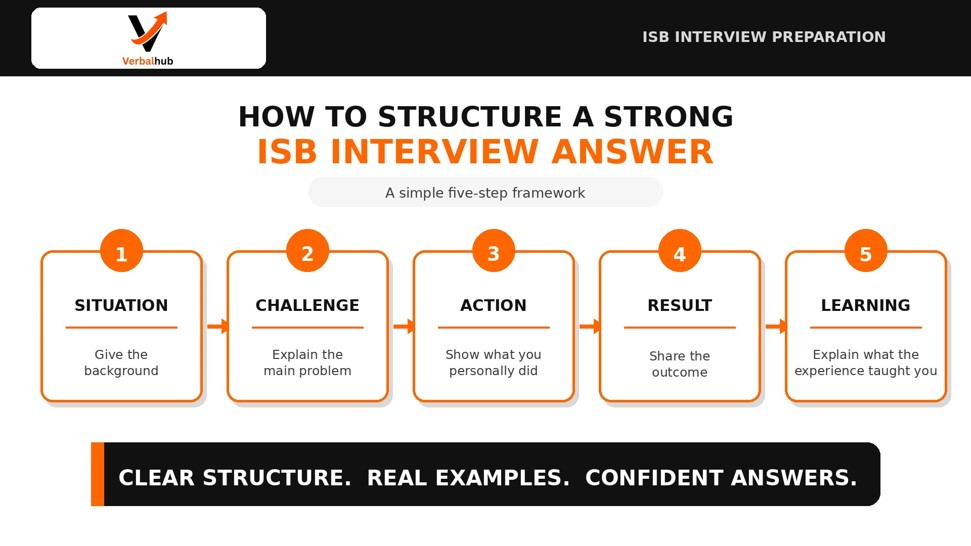
For experience-based questions, he used a simple flow:
ANSWER STRUCTURE: Situation → Challenge → Action → Result → Learning
This structure helped him avoid two common mistakes. The first is spending too much time explaining the background. The second is describing the team's achievement without explaining the candidate's own contribution.
A strong answer should show what happened, what made the situation difficult, what action the candidate personally took, what result followed and what the candidate learned. This made Abhineet's answers more focused and easier to follow.
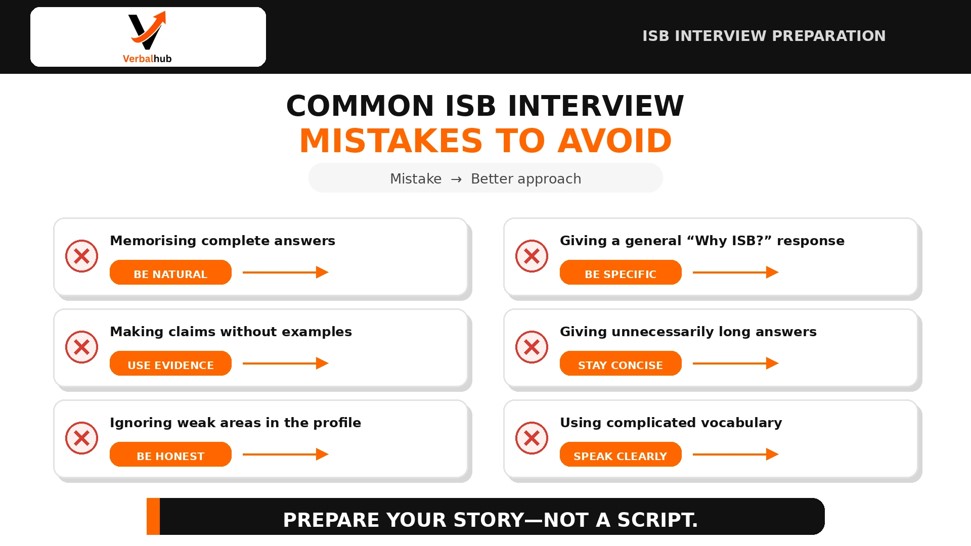
Common ISB Interview Mistakes to Avoid
Memorising Complete Answers
Memorised answers often sound unnatural. Prepare the message and example, but use normal spoken language.
Giving a General “Why ISB” Answer
Your reasons should connect ISB with your career needs and future goals.
Making Claims Without Examples
If you describe yourself as a leader or problem-solver, support the claim with a real situation.
Giving Long Answers
Start with the main point. Add details only when they strengthen the answer.
Ignoring Weak Parts of the Profile
Prepare honest explanations for low grades, career gaps, frequent job changes or limited leadership experience.
Using Complicated Vocabulary
Clear and simple language is more effective than impressive words that do not sound natural.
Five Lessons ISB Applicants Can Learn From Abhineet
1. Know Every Part of Your Application
Any detail can lead to a question, so be ready to discuss all of it.
2. Connect Your Career History, MBA Need and Future Goal
The panel should be able to follow one continuous story, not three disconnected pieces.
3. Support Important Claims With Real Examples
A claim without an example is easy to forget and easy to doubt.
4. Practise Follow-Up Questions Instead of Only Opening Answers
The real test often begins after your first response, not during it.
5. Use Feedback to Improve Clarity, Structure and Confidence
Small, repeated corrections build a noticeably stronger interview performance.
Final Thoughts
Abhineet's ISB interview success was not based on memorising dozens of answers. It came from following a clear four-phase learning plan:
THE ROADMAP: Diagnose the gaps → Build the career story → Practise through mock interviews → Refine every answer
Hasan Raja Sir's personalised mentoring helped Abhineet understand his profile, organise his experiences and communicate his goals with greater clarity. VerbalHub's one-on-one ISB interview coaching made the preparation focused, personal and result-oriented.
A successful MBA interview is not about presenting a perfect personality. It is about presenting your real journey in a way that is clear, honest and believable.
Before your ISB interview, ask yourself:
“Can I clearly explain what I have done, why I need an MBA and where I want to go next?”
If your answer is clear and supported by real experiences, you are already moving in the right direction.
Start Your ISB Interview Preparation With VerbalHub
If you are looking for personalised ISB interview coaching, one-on-one MBA interview preparation or guidance from an experienced MBA admissions mentor, VerbalHub can help you prepare around your profile and career goals.
Work directly with Hasan Raja Sir for profile-based interview questions, mock interviews, answer correction and personal feedback.
START YOUR ISB INTERVIEW PREPARATION
Visit www.verbalhub.com to discuss your ISB interview preparation with Hasan Raja Sir.
Interview and admission outcomes may vary according to the applicant's profile, application quality, preparation and final interview performance.