XAT Preparation 2027: Exam Dates, Syllabus, Strategy, Mock Tests, Cut-Off and Top Colleges

How Should You Prepare for XAT 2027?
Start your XAT Preparation 2027 at least five to six months before the exam, which is expected in early January 2027. Build strong basics in Verbal, Quant and DI, but give special weekly time to Decision Making because it decides ranks. Solve XAT previous-year papers early, and begin full-length mock tests around October 2026.
| Key Takeaways | |
|---|---|
|
If you are planning XAT Preparation 2027, you have picked an exam that rewards clear thinking more than raw speed. The Xavier Aptitude Test, conducted by XLRI Jamshedpur, is the gateway to XLRI and more than 150 other B-schools, and it tests something CAT does not: your judgement, through the Decision Making section.
This guide covers everything in one place — the expected XAT Exam 2027 schedule, eligibility, the full XAT syllabus 2027, section-wise strategy, timeline-based study plans, mock test routines, score vs percentile trends, XLRI cut-offs and a fact-checked list of top colleges accepting XAT score. I have written it the way I would explain things to a student sitting across the table: what to do, when to do it, and what to avoid.
One honest note before we begin. As of July 2026, the official XAT 2027 notification is awaited. Wherever a date, fee or pattern detail is not yet confirmed, it is clearly marked as expected or based on the previous cycle. Always cross-check time-sensitive details on xatonline.in before acting on them.
Table of Contents
- XAT Exam 2027: Complete Overview
- XAT Important Dates 2027
- XAT Eligibility 2027
- XAT Registration 2027
- XAT Admit Card 2027
- XAT Exam Pattern 2027
- XAT Syllabus 2027
- How to Prepare for XAT 2027
- XAT Preparation Strategy by Timeline
- XAT Self-Study Plan 2027
- XAT Daily Study Plan
- XAT Preparation for Working Professionals
- Section-Wise XAT Preparation Strategy
- XAT Time Management Strategy
- XAT Mock Test 2027
- How to Analyse an XAT Mock Test
- XAT Sample Papers and Previous-Year Questions
- XAT Score vs Percentile 2027
- XAT Cut-Off 2027
- Top Colleges Accepting XAT 2027: Fees, Percentile and Packages
- Best Colleges Other Than XLRI Accepting XAT Scores
- XAT Colleges by Percentile Range
- How to Select the Right XAT College
- XAT Answer Key 2027
- XAT Result 2027
- XAT Coaching: Is It Worth It?
- How to Choose the Best XAT Coaching
- XAT Online Coaching and Preparation
- Common XAT Preparation Mistakes
- Final 30-Day XAT Revision Plan
- XAT Exam-Day Guidelines
- Frequently Asked Questions About XAT 2027
- Final XAT Preparation Roadmap for 2027
1. XAT Exam 2027: Complete Overview

XAT (Xavier Aptitude Test) is a national-level MBA entrance exam conducted by XLRI Jamshedpur on behalf of XAMI (Xavier Association of Management Institutes). It has run for over 65 years, which makes it one of India's oldest management entrance tests. Around one lakh candidates register for it every year.
Students take the XAT Exam 2027 for three main reasons. First, it is the only route to XLRI Jamshedpur and XLRI Delhi-NCR. Second, its score is accepted by 150+ institutes, including XIM University, IMT Ghaziabad, MICA, GIM Goa, TAPMI and many more. Third, it is held about five to six weeks after CAT, so serious MBA aspirants get a genuine second shot in the same admission season without starting preparation from zero.
What makes XAT different is its design. It carries a full Decision Making section on managerial and ethical situations, it penalises leaving too many questions unattempted, and its Verbal section leans towards dense reading and critical reasoning. Good XAT exam preparation, therefore, is not just CAT preparation with a new label.
| Particular | Details (based on XAT 2026; XAT 2027 to be confirmed) |
|---|---|
| Exam name | XAT — Xavier Aptitude Test |
| Conducting body | XLRI Jamshedpur (for XAMI) |
| Level and mode | National; computer-based test (CBT) |
| Expected exam date | First Sunday of January 2027 — tentative |
| Duration | 180 minutes (170 min Part 1 + 10 min GK) in XAT 2026 |
| Questions | 95 in XAT 2026 (VALR 26, DM 21, QADI 28, GK 20) |
| Marking | +1 correct; −0.25 wrong; −0.10 per unattempted question beyond 8; no negative marking in GK |
| Score accepted by | XLRI and 150+ B-schools |
| Attempts | No limit on number of attempts |
| Official website | xatonline.in |
Leading programmes available through XAT include XLRI's PGDM in Business Management (BM) and Human Resource Management (HRM), XLRI's General Management Programme for experienced professionals, XIM University's MBA-BM, MICA's PGDM-C (with MICAT), IMT Ghaziabad's PGDM, GIM Goa's PGDM, TAPMI's PGDM, and one-year and two-year programmes at Great Lakes, IMI, IRMA, FORE, LIBA, Welingkar, K J Somaiya, BIMTECH, XIME and IFMR GSB (Krea University).
2. XAT Important Dates 2027
The official XAT 2027 notification is awaited as of July 2026. XLRI usually releases the notification and opens registration in mid-July, so keep checking xatonline.in from July 2026 onwards. The table below maps XAT Important Dates 2027 based on the previous cycle.
Source note: timeline modelled on the XAT 2026 cycle (registration July–December 2025, exam 4 January 2026, XLRI cut-offs released 30 January 2026). Last verified: July 2026. Treat every 2027 date as expected until XLRI confirms it.
| Event | Expected date (tentative) | Official status | What you should do |
|---|---|---|---|
| XAT 2027 notification | Mid-July 2026 | Awaited | Read the pattern and eligibility carefully; note any changes |
| Registration opens | Mid-July 2026 | Awaited | Register early; keep documents and photo ready |
| Registration closes | Early December 2026 | Awaited | Do not wait for the last week; server load causes errors |
| Admit card release | Late December 2026 | Awaited | Download, print two copies, verify every detail |
| XAT Exam Date 2027 | First Sunday of January 2027 (likely 3 January 2027) | Tentative | Freeze your revision and mock schedule around this date |
| Answer key and response sheet | Within about a week of the exam | Awaited | Calculate your raw score; raise objections if valid |
| XAT Result 2027 | Second half of January 2027 | Awaited | Download the scorecard; start college applications |
| XLRI GD-PI shortlist and interviews | January–March 2027 | Awaited | Prepare interview material and GK notes early |
3. XAT Eligibility 2027
XAT Eligibility 2027 is expected to remain simple and inclusive, based on the previous cycle.
Academic qualification: a bachelor’s degree of at least three years’ duration, in any discipline, from a recognised university. No minimum percentage has been prescribed for taking XAT itself, though individual colleges may set their own academic criteria for admission.
XAT age limit: there is no upper age limit for XAT.
Final-year students: those completing their degree by the deadline XLRI specifies (usually June of the admission year, i.e., June 2027) can apply. Admission stays provisional until you submit proof of graduation.
Working professionals: fully eligible. Work experience is not required for XAT, but XLRI and several colleges give it weight during selection. Experienced candidates can also look at XLRI’s General Management Programme.
Number of attempts: unlimited. Many students take XAT in their final year and again after a year of work.
International applicants: NRI and foreign candidates can apply through XAT or, where the college permits, through GMAT. Check each institute’s admission page for its exact policy.
One practical caution: eligibility to sit for XAT is not the same as eligibility for every programme. MICA needs MICAT in addition to XAT, IRMA runs its own selection stages, and some colleges accept XAT only for specific programmes. Verify the programme page of each college before you apply.
4. XAT Registration 2027
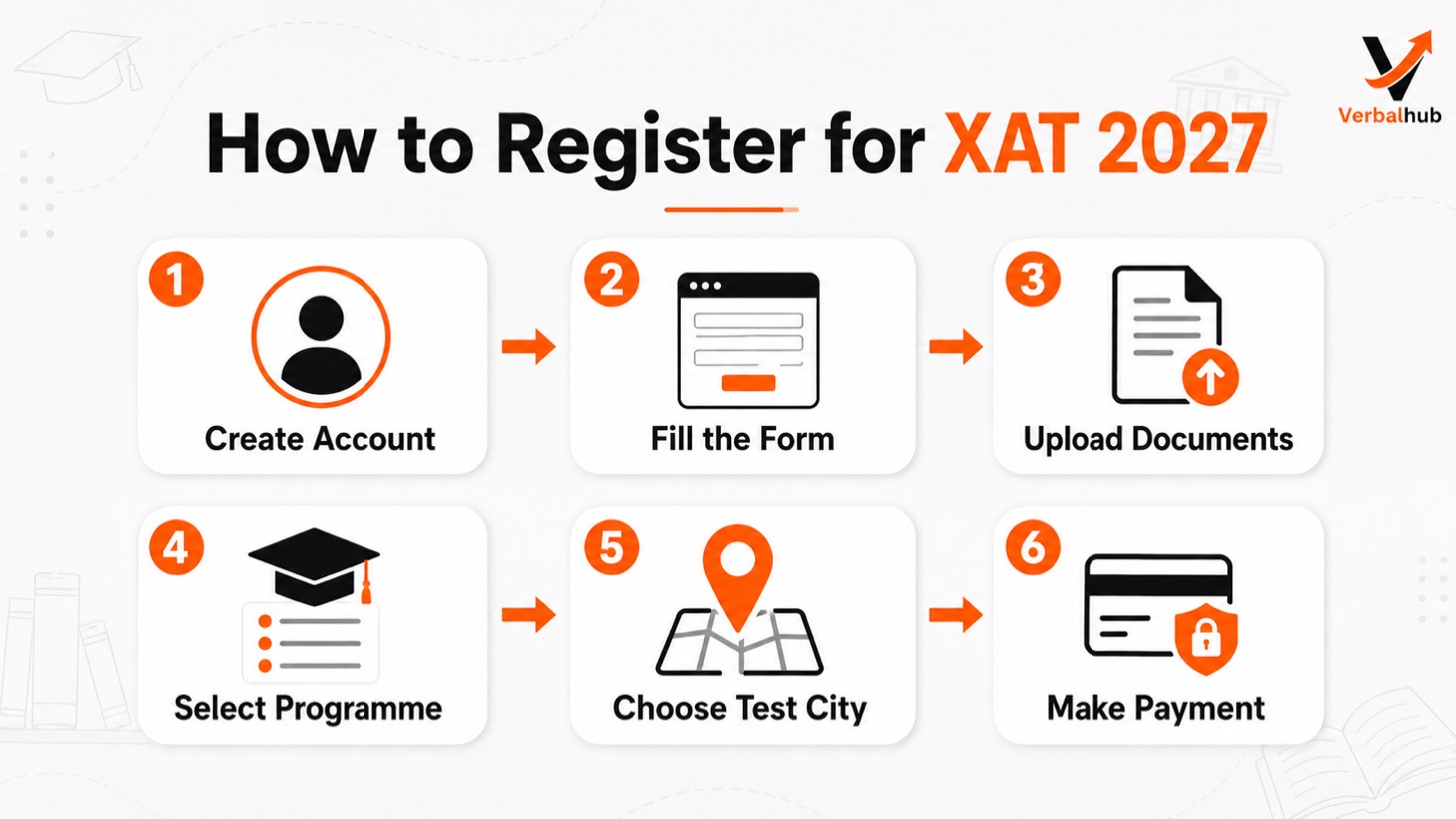
XAT Registration 2027 will happen online at xatonline.in once the notification is out. The process is straightforward if you prepare your documents first. Here is the step-by-step process based on the previous cycle.
- Visit xatonline.in and click on the XAT 2027 registration link. Sign up with your name, email and mobile number to generate a XAT ID and password.
- Log in and fill the application form: personal details, academic records (Class 10, Class 12, graduation), and work experience if any.
- Upload a recent passport-size photograph and signature in the specified size and format.
- Select the programmes you want to apply for. XLRI programmes can be selected within the XAT form itself (an additional fee applies per XLRI programme). Other colleges need separate applications on their own websites.
- Choose your test-city preferences. Pick two or three cities you can actually travel to comfortably.
- Pay the XAT registration fees online. In the XAT 2026 cycle the fee was around ₹2,200, with roughly ₹200 extra per XLRI programme (tentative for 2027 — confirm in the notification).
- Download and save the confirmation page and fee receipt as PDF.
Documents to keep ready: scanned photo and signature, Class 10 and 12 marksheets, graduation marksheets or final-year enrolment proof, valid photo ID, and work-experience details with dates.
Common form-filling mistakes to avoid: entering marks as CGPA where percentage is asked (or the reverse), mismatched name spelling versus your ID proof, casual photo uploads that get rejected, choosing far-off test cities, forgetting to tick XLRI programmes inside the XAT form, and waiting until the final two days when payment gateways slow down.
5. XAT Admit Card 2027
The XAT Admit Card 2027 (hall ticket) is expected in the last ten days of December 2026, based on the previous cycle. It will not be posted; you must download it from xatonline.in.
How to download the XAT admit card: log in with your XAT ID and password, open the admit card link, verify every detail on screen, then download and print at least two colour copies. Keep a PDF backup on your phone and email.
Details to check the moment you download it: name spelling (must match your photo ID), photograph and signature, date of birth, test centre name and full address, reporting time, and exam-day instructions. If anything is wrong, contact the XAT helpdesk immediately through the contact details in the admit card — do not wait until exam week.
Carry to the test centre: printed admit card, one original valid photo ID (Aadhaar, passport, driving licence, voter ID or PAN as permitted), and any documents the notification asks for. Visit the centre location on Google Maps beforehand, and if it is in another city, plan travel and stay at least a week in advance.
6. XAT Exam Pattern 2027
The XAT Exam Pattern 2027 has not been officially announced yet. XLRI made notable changes in the 2026 paper, so the safest planning base is the XAT 2026 pattern, described below and clearly marked as such.
In XAT 2026, the paper had 95 questions across four sections, with a total XAT exam duration of 180 minutes. Part 1 (170 minutes) covered Verbal Ability & Logical Reasoning, Decision Making, and Quantitative Ability & Data Interpretation, with no sectional time limits inside Part 1 — you could move between these three sections freely. Part 2 (10 minutes) was the General Knowledge section. The essay was removed from the test and shifted to XLRI’s later selection stages.
Source note: XAT 2026 pattern as conducted on 4 January 2026 (xatonline.in; corroborated by IMS, Careers360 and other exam portals). Last verified: July 2026. XAT 2027 pattern is expected to be similar but is not confirmed.
| Section | Questions (XAT 2026) | Time | Counted in percentile? |
|---|---|---|---|
| Verbal Ability & Logical Reasoning (VALR) | 26 | Part 1 — 170 min shared | Yes |
| Decision Making (DM) | 21 | Part 1 — 170 min shared | Yes |
| Quantitative Ability & Data Interpretation (QADI) | 28 | Part 1 — 170 min shared | Yes |
| General Knowledge (GK) | 20 (12 current affairs + 8 static) | Part 2 — 10 min | No — used by XLRI at the final selection stage |
| Total | 95 | 180 minutes | Percentile from 75 Part-1 questions |
XAT Marking Scheme
- +1 mark for every correct answer in VALR, DM and QADI.
- −0.25 for every wrong answer in these three sections.
- −0.10 per question for every unattempted question beyond eight — this is XAT’s unique penalty, so leaving 25–30 questions blank quietly costs you real marks.
- GK has no negative marking, and its score does not affect your percentile.
XAT vs CAT: What Actually Differs
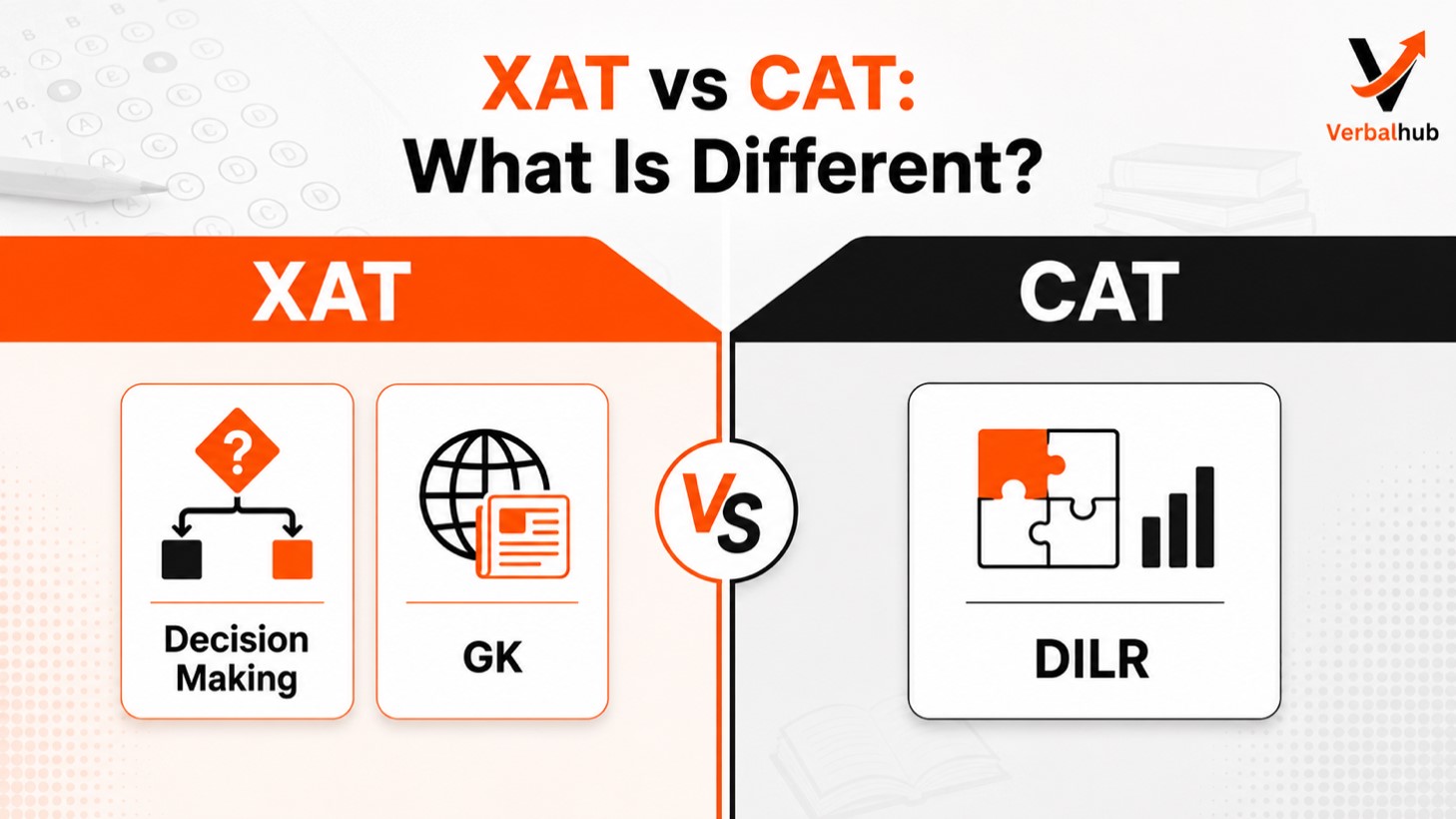
| Point | XAT (2026 pattern) | CAT (2025 pattern) |
|---|---|---|
| Conducting body | XLRI Jamshedpur | An IIM (rotates) |
| Unique section | Decision Making | None comparable |
| GK | Yes, separate 10-min section | No GK section |
| Sectional timing | No sectional limit within Part 1 | Strict 40-minute sectional limits |
| Unattempted penalty | Yes, −0.10 beyond 8 skips | No |
| Question count / time | 95 questions / 180 min | 68 questions / 120 min |
| Quant flavour | Arithmetic, algebra, geometry with tricky DI | Similar areas; DILR is a separate section |
In short: CAT tests speed under sectional pressure; XAT tests judgement, patience with dense text, and smart question selection across one long sitting. Your CAT base helps enormously, but XAT-specific practice — especially DM and the skip-penalty maths — is non-negotiable.
7. XAT Syllabus 2027
XLRI does not publish a fixed topic list, so the working XAT Syllabus 2027 is built from previous papers. The good news: topics have stayed stable for years. Here is the section-wise syllabus with question types, difficulty and priorities.
7.1 Verbal Ability and Logical Reasoning (VALR)
Main topics: Reading Comprehension (4–5 passages; philosophy, economics, psychology, culture, science), critical reasoning (assumption, inference, strengthen/weaken), para jumbles, para completion, poem or abstract-passage questions, vocabulary in context, fill in the blanks, analogies.
Question types: RC dominates (roughly 60% of the section); the rest is verbal logic. Difficulty: moderate to high — XAT passages are denser and more abstract than CAT’s. Preparation priority: high; sectional cut-off applies at XLRI.
| Expert Tip | |
|---|---|
| XAT often includes a short poem or philosophical excerpt. Practise by reading one editorial or essay daily and writing a two-line summary of its central claim and tone. The habit of compressing abstract text is exactly what XAT RC rewards. |
7.2 Decision Making (DM)
Main topics: business and managerial dilemmas, ethical situations, HR and employee conflicts, stakeholder trade-offs, financial and data-based decisions, small analytical caselets.
Question types: caselets of 3–5 questions each — choose the best action, the most/least appropriate option, order of preference, or the decisive factor. Difficulty: moderate, but answer options are deliberately close; two options often look right. Preparation priority: highest — DM is XAT’s rank decider, and no other exam prepares you for it.
| Expert Tip | |
|---|---|
| In DM, the best answer usually balances the interests of all stakeholders, sticks to stated facts, and avoids extreme action. Options that punish harshly, reward unfairly, delay decisions indefinitely or bring in outside assumptions are typically wrong. After every set, write one sentence explaining why each rejected option harms a stakeholder or breaks a stated condition. |
7.3 Quantitative Ability and Data Interpretation (QADI)
Main topics: arithmetic (percentages, profit-loss, ratio, time-speed-distance, time & work), algebra (equations, inequalities, functions, logarithms), geometry and mensuration, number system, probability and P&C, and DI sets based on tables, charts, caselets and data sufficiency-style logic.
Question types: standalone quant questions mixed with 2–3 DI sets. Difficulty: moderate to high; XAT quant is generally rated a notch above CAT, with geometry and arithmetic favourites. Preparation priority: high; QADI usually has the most questions and a sectional cut-off at XLRI.
| Expert Tip | |
|---|---|
| Maintain a ‘first-90-seconds’ rule in QADI practice: if you cannot see the solution path within 90 seconds, mark and move. XAT quant hides three or four very hard questions that exist mainly to eat your time. |
7.4 General Knowledge (GK)
Main topics: current affairs of roughly the last 8–12 months (business, economy, appointments, awards, sports, national and international events) plus static GK (history, geography, polity, books, science basics).
Question types: direct one-liner MCQs; 20 questions in 10 minutes in XAT 2026. Difficulty: unpredictable — some sitters, some obscure. Preparation priority: medium; it does not affect percentile, but XLRI considers it at the final selection stage, so do not ignore it.
| Section | Core topics | Weight (XAT 2026) | Priority |
|---|---|---|---|
| VALR | RC, critical reasoning, para jumbles, vocabulary in context | 26 questions | High |
| DM | Ethical, managerial and analytical caselets | 21 questions | Highest |
| QADI | Arithmetic, algebra, geometry, numbers, modern maths, DI sets | 28 questions | High |
| GK | Current affairs + static GK | 20 questions (not in percentile) | Medium |
8. How to Prepare for XAT 2027
If you searched ‘How to Prepare for XAT 2027’, here is the whole method in one line: diagnose, build concepts, practise by section, master DM through previous papers, then simulate the exam repeatedly and fix what the mocks expose. Now the same thing as a working XAT preparation strategy, stage by stage.
Diagnostic test (Week 1). Take one full XAT previous-year paper untimed-scored or one free XAT mock test. Do not judge the score; map your accuracy per section. This decides where your hours go.
Concept building (Months 1–2 of your plan). Finish quant fundamentals chapter by chapter, build a daily reading habit for VALR, and learn the logic of DM by reading solved caselets before attempting fresh ones.
Section practice (Months 2–4). Solve topic-wise sets with a timer. Target accuracy first (75%+), then speed. Start a weekly GK routine of 30–40 minutes.
PYQs (from Month 3). Solve at least the last 8–10 years of XAT previous year question papers, DM sets twice over. PYQs teach you XAT’s option style better than any book.
Sectional tests (Months 3–4). One or two XAT sectional tests per week per weak area, each followed by written analysis.
Full-length mocks (October to December 2026). 12–20 full mocks in exam-day conditions, roughly one to two per week, increasing frequency in December.
Revision (final 3–4 weeks). No new topics. Formula sheets, error log, DM rules you have written for yourself, and current-affairs revision.
Whatever your start date, protect two non-negotiables every single week: at least two DM caselets and at least three hours of quant. Consistency in these two beats every clever shortcut.
9. XAT Preparation Strategy by Timeline
Students land on this page in July with six months, in October with three, and sometimes in December with thirty days. Each situation has a workable plan — but the shorter the runway, the more ruthlessly you must prioritise DM, PYQs and mocks.
| Plan | Daily hours | Mocks | Best suited for |
|---|---|---|---|
| 6 months (Jul–Dec) | 2–3 | 15–20 | Freshers starting from basics; working professionals |
| 3 months (Oct–Dec) | 3–4 | 10–14 | CAT aspirants extending to XAT; students with decent basics |
| 60 days (Nov–Dec) | 4–5 | 8–10 | Strong CAT-level preparation already done |
| 30 days (Dec) | 5–6 | 6–8 | Only as a conversion sprint on an existing CAT base |
9.1 XAT Preparation in 6 Months (July–December 2026)
Months 1–2 (Jul–Aug): complete quant concepts (arithmetic + algebra first), daily 30–45 minutes of reading, two solved DM caselets weekly, weekly GK digest. Around 15 hours a week.
Months 3–4 (Sep–Oct): finish geometry, numbers and modern maths; timed RC and DI sets; start XAT PYQs (two sections a week); one sectional test weekly; first full mock by mid-October.
Month 5 (Nov): one full mock weekly plus two sectional tests; finish 8–10 years of PYQs; DM accuracy drive — re-solve every DM set you got wrong.
Month 6 (Dec): two mocks weekly, full analysis after each; final 30-day revision plan (Section 30); GK current-affairs compilation for the year.
9.2 XAT Preparation in 3 Months (October–December 2026)
Weeks 1–4: rapid concept revision in quant (skip exotic topics; arithmetic, algebra, geometry cover most of the paper); daily RC passage; three DM caselets a week; diagnostic mock in week 2.
Weeks 5–8: PYQs become the core — one full past paper weekly, solved timed; two sectional tests weekly; weekly full mock from week 6; 30 minutes GK on weekends.
Weeks 9–12: two mocks weekly; error-log driven revision; DM and QADI question-selection drills; taper in the final four days.
Around 22–25 hours a week makes this plan realistic. Yes, you can prepare for XAT in 3 months — provided your English reading level and basic maths are not starting from zero.
9.3 XAT Preparation in 60 Days
Days 1–15: diagnostic mock; revise only weak quant chapters; daily DM caselet; alternate-day RC pair; start PYQs immediately (last 6 years minimum).
Days 16–35: full mock every 5 days with two-hour analysis; sectional tests on off days; GK — one monthly current-affairs digest per sitting.
Days 36–55: mock every 3–4 days; re-solve all logged errors; lock your attempt order and skip rules (Section 14).
Days 56–60: light revision, formula sheets, one final easy-paced mock, sleep schedule aligned to the morning slot.
9.4 XAT Preparation in 30 Days
A 30-day XAT preparation plan works only as a bridge from CAT. Do not attempt to ‘cover the syllabus’; convert what you already know into XAT marks.
Week 1: two PYQ papers timed; learn DM logic through 15+ solved caselets; note XAT’s marking quirks and design your skip strategy.
Week 2: two mocks; DM + QADI sectional tests; error log running from day one.
Week 3: two to three mocks; revise arithmetic and geometry formulas; GK crash revision (last 10 months of current affairs).
Week 4: one or two easier-paced mocks early in the week; then only revision, error log and rest. Nothing new in the last three days.
| Expert Tip | |
|---|---|
| In every timeline, schedule mock analysis as its own calendar slot, equal in length to the mock itself. A mock without written analysis improves your stamina but not your score. |
10. XAT Self-Study Plan 2027
Can you crack XAT without coaching? Yes — students do it every year, especially those with a CAT base and good self-discipline. A XAT self-study plan needs three things: the right material, a fixed weekly structure, and honest self-assessment through mocks. Where self-study struggles is Decision Making feedback and mock analysis, because there is no one to tell you *why* your reasoning was wrong.
Books and Resources That Are Enough
- Quant: Arun Sharma's 'How to Prepare for Quantitative Aptitude for the CAT' or Sarvesh Verma's 'Quantum CAT' — one book, done fully, is enough.
- Verbal: daily editorials (The Hindu, Indian Express, Livemint, Aeon essays), plus any standard VARC book for CAT; RC practice matters more than grammar books.
- Decision Making: XAT previous year question papers with solutions are the primary and best material; Jabeen Merchant's book on DM is a useful supplement.
- DI/LR: CAT-level DILR material works; add XAT PYQ DI sets for flavour.
- GK: one monthly current-affairs magazine or compilation plus a static GK capsule; 30–40 minutes weekly.
- Official: XAT releases past question papers and answer keys — download them from the official site; they are free and gold.
A Simple Weekly Self-Study Structure
| Day | Focus (2.5–3 hours/day) |
|---|---|
| Monday | Quant concepts + 20 practice questions |
| Tuesday | 2 RC passages timed + verbal logic set |
| Wednesday | 2 DM caselets + written option-elimination notes |
| Thursday | Quant/DI sets timed |
| Friday | 1 sectional test + analysis |
| Saturday | PYQ paper or full mock (alternate weeks) + analysis |
| Sunday | Error-log revision + GK hour + rest |
Signs you may need external help: your mock percentile has been flat for four or more mocks; DM accuracy stays under 55% despite PYQ practice; you cannot explain your own errors after analysis; or your study weeks keep collapsing without accountability. That is when structured XAT classes or a mentor add real value — not because self-study is inferior, but because feedback loops shorten the correction cycle.
11. XAT Daily Study Plan
A XAT daily study plan works when it fits your actual day, not an ideal one. Here are two honest templates — pick one and protect it.
Two-Hour Daily Plan (working professionals / college with heavy schedule)
| Slot | Time | Task |
|---|---|---|
| Morning | 30 min | One RC passage or one DM caselet with review |
| Evening | 60 min | Quant/DI — one topic or one timed set |
| Night | 30 min | Error log update, flashcards, or 15 min GK |
Four-Hour Daily Plan (full-time preparation)
| Slot | Time | Task |
|---|---|---|
| Morning | 90 min | Quant concepts + practice set |
| Midday | 60 min | VALR — 2 RCs + verbal logic |
| Evening | 60 min | DM caselets or DI sets (alternate days) |
| Night | 30 min | Analysis, error log, GK |
Weekday vs weekend: keep weekdays for skill-building blocks like the above; keep one weekend slot fixed for a mock or PYQ paper and another for its analysis and weekly revision. A weekly revision hour every Sunday — re-solving the week’s wrong questions — compounds faster than any new material.
12. XAT Preparation for Working Professionals

XAT preparation with a job is completely doable — XLRI actually values work experience in selection. What fails working professionals is not time, it is unrealistic planning. Ten to fourteen focused hours a week, sustained from July to December, will beat thirty-hour weeks that collapse by September.
Mornings over nights: 45–60 minutes before work, when your mind is fresh, for quant or DM. Nights are for lighter work — reading, GK, flashcards.
Weekday target: 1.5–2 hours a day, four to five days a week. Accept that one weekday will regularly be lost to work; plan for it instead of feeling guilty.
Weekends: one full mock or PYQ paper plus two hours of analysis on one day; concept-clearing and sectional practice on the other. Protect at least six weekend hours.
Commute time: RC reading, GK podcasts, formula revision or reviewing DM solutions on your phone. Thirty minutes each way is five hours a week — a real resource.
Mock scheduling: book mocks for the same day and time slot as the actual exam (Sunday morning) so your body clock adapts.
Burnout control: one fully free evening a week, and no all-nighters in December. A tired mind is disastrous in DM, where judgement is the whole game.
| Expert Tip | |
|---|---|
| Tell your manager (if feasible) that you have an exam on the first Sunday of January and plan leave for the last three or four days of December. Those protected final days are worth more than scattered leave in October. |
13. Section-Wise XAT Preparation Strategy
This is where XAT section-wise preparation gets specific. For each section: method, question selection, traps, practice frequency and accuracy targets.
13.1 Verbal Ability and Logical Reasoning
Method: read daily (editorials, essays, philosophy-adjacent writing); practise 8–10 RC passages weekly under time; drill critical reasoning separately because XAT loves inference and assumption questions.
Question selection: scan all passages first for one you find readable; attempt your best passages fully rather than every passage partially.
Common traps: extreme-language options (‘always’, ‘never’), answers true in general but not stated in the passage, and tone questions answered from your own opinion.
Practice frequency: daily reading + 3–4 timed verbal sessions weekly. Accuracy target: 65–75% with 16–20 attempts (based on recent papers).
| Expert Tip | |
|---|---|
| For XAT poems and abstract passages, first identify the speaker’s attitude (celebrating, mourning, questioning, warning). Half the options die once the tone is fixed. |
13.2 Decision Making — Prepare It Like a Separate Subject
XAT Decision Making preparation deserves its own routine because DM is roughly 28% of your scored paper and has no equivalent in CAT. It is learnable — that is the encouraging part. The same reasoning patterns repeat across years.
Method: start with 15–20 solved PYQ caselets, studying why the official answer wins. Then attempt fresh sets, always writing one line per rejected option. Re-solve wrong sets after a week.
The working rules that emerge: stick strictly to facts given in the caselet; prefer options fair to all stakeholders; prefer solutions that address the root cause; avoid extreme, one-sided or indefinitely-delayed actions; and in ethical dilemmas, the ethically sound but practical option beats both the profitable-but-shady and the saintly-but-unworkable ones.
Common traps: importing outside assumptions, choosing the emotionally satisfying option, and rushing the last questions of a set (they are often the easiest). Practice frequency: minimum 2–3 caselets weekly from month one; daily in the last six weeks. Accuracy target: 70%+ — top scorers treat DM as their banker section.
| Expert Tip | |
|---|---|
| Build a personal ‘DM rulebook’. Every time an official solution surprises you, write the underlying principle in one sentence. By December, your 25–30 self-written rules become your most valuable revision page. |
13.3 Quantitative Ability and Data Interpretation
Method: arithmetic and geometry first — they dominate XAT quant; then algebra and numbers; DI sets twice a week with a timer. Learn to read DI data before reading the questions.
Question selection: two passes. Pass one: everything you can start within 90 seconds. Pass two: return to marked questions. Never romance a question for five minutes.
Common traps: heavy-calculation DI sets placed early to trap the diligent, and 2–4 deliberately brutal questions that even 99-percentilers should skip. Practice frequency: 4–5 sessions weekly; one timed mixed set every week from month two. Accuracy target: 70%+ with 16–20 attempts (recent-paper benchmark).
13.4 General Knowledge
Method: 30–40 minutes weekly through the year (monthly current-affairs digests), plus a static GK capsule in November–December. Focus areas: business and economy news, appointments, awards, sports, summits, books and authors.
Question selection: with no negative marking, attempt all 20. Never leave a GK question blank. Practice frequency: weekly, rising to daily 20-minute revision in the final month.
Why bother if it is not in the percentile: XLRI uses GK at the final selection stage, and the same preparation feeds your GD-PI rounds anyway.
14. XAT Time Management Strategy
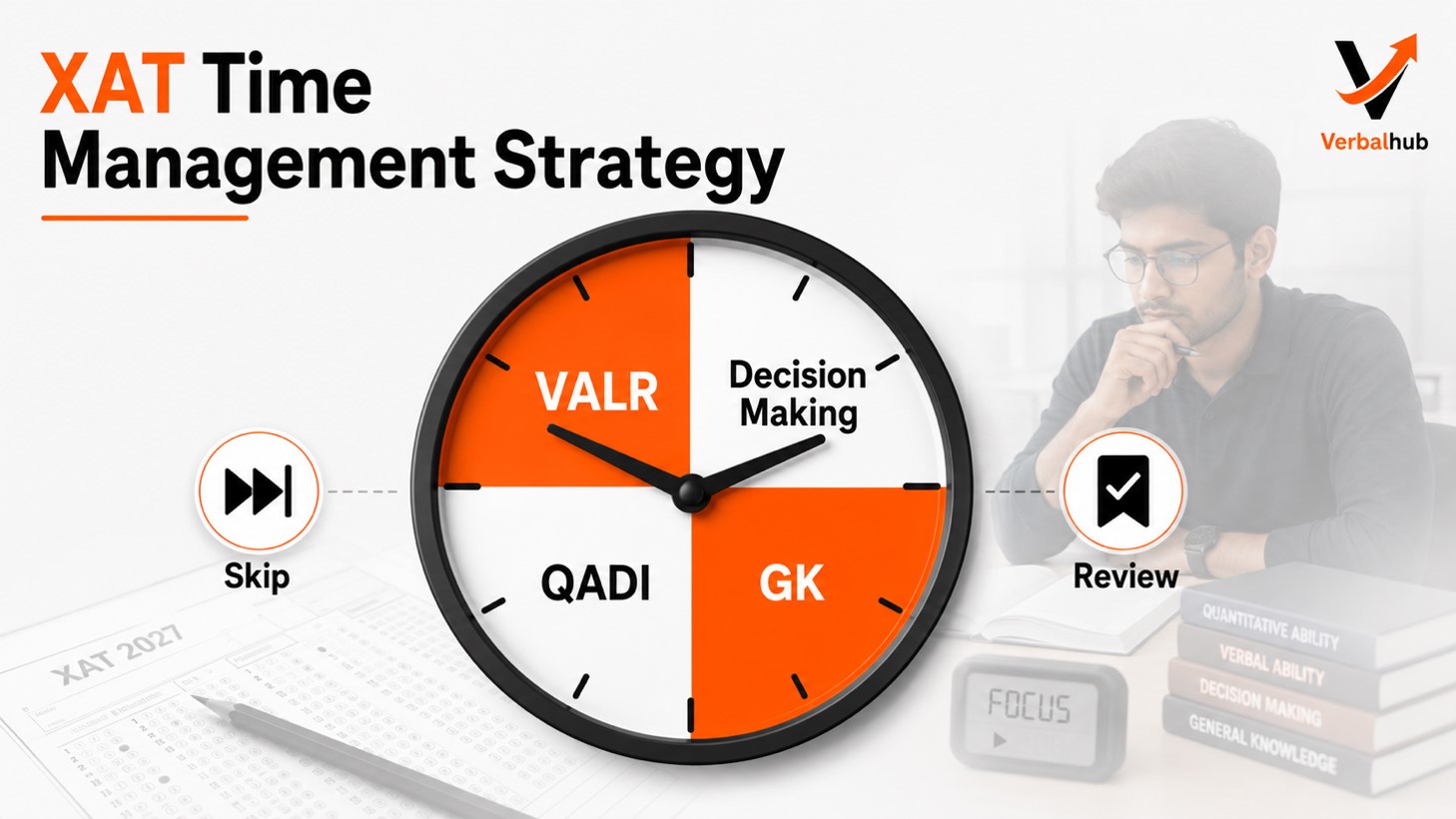
XAT’s format — 170 shared minutes for three sections, plus a penalty for excess skips — makes XAT time management strategy a genuine scoring skill. There is no single correct attempt order; there is a correct process for finding yours.
Baseline allocation to test first: roughly 45–50 minutes VALR, 45–50 minutes DM, 60–65 minutes QADI, keeping 10 minutes as a floating buffer for a final sweep.
Attempt order: most students do well starting with their strongest section to bank marks and confidence. Common orders are DM → VALR → QADI and VALR → DM → QADI. Test at least two different orders across your first four mocks, compare scores and stress levels, then freeze one by mid-November. Do not copy a topper’s order blindly.
Skip rules: hard skip anything with no visible path in 90 seconds; mark-and-return for ‘know-how-but-long’ questions. Because of the −0.10 penalty beyond 8 unattempted, plan to attempt around 65–75 of the 75 scored questions, using intelligent guesses (after eliminating two options) on borderline ones rather than mass-guessing everything.
Speed vs accuracy: XAT rewards accuracy disproportionately. Cutting attempts from 70 to 62 while raising accuracy from 60% to 75% increases your score. Track both numbers in every mock.
Final ten minutes: stop starting new hard questions. Sweep marked questions, make elimination-based guesses on near-misses, and count your unattempted total so the skip penalty does not ambush you.
| Expert Tip | |
|---|---|
| In your last five mocks, write your planned time checkpoints on paper before starting (e.g., ‘60 min gone — must be finishing section 1’). Checking against pre-committed checkpoints prevents the slow-motion time leak that ruins Part 1. |
15. XAT Mock Test 2027
A XAT mock test is the closest thing to the real exam you can buy or download, and mocks are where preparation becomes performance. Concepts get you to 80 percentile; mock-driven strategy is what pushes you past 95.
- Why mocks matter for XAT specifically: the shared 170-minute format, the skip penalty, and DM stamina cannot be practised through topic sets. Only a full length XAT mock test recreates the decisions the exam forces.
- When to start: first mock 10–12 weeks before the exam (around mid-October 2026 for a January exam), even if preparation feels incomplete. Early mocks are diagnostic, not judgemental.
- How many: 12–20 full mocks for a 5–6 month plan; 8–12 for shorter timelines. Beyond ~20, analysis quality drops and returns diminish.
- Full-length vs sectional: both, with different jobs — see the table below.
- Free vs paid: free XAT mock tests (including the official XAT mock released before the exam) are good for interface familiarity and an extra data point. A paid XAT mock test series earns its fee only through XAT-style DM questions, realistic difficulty, percentile benchmarking against a large test-taker pool, and detailed solution + analytics reports.
- What a good XAT mock test series should provide: the current pattern (95 questions, 180 minutes as of XAT 2026), DM caselets written in XAT's style (not CAT LR rebranded), question-wise time analytics, percentile prediction, and written or video solutions that explain elimination, not just the right answer.
| Aspect | Full-length mock | Sectional test |
|---|---|---|
| Purpose | Strategy, stamina, attempt order, skip management | Depth and speed in one section |
| Frequency | Weekly (Oct), up to twice weekly (Nov–Dec) | 2–3 per week on weak areas |
| Duration | 180 minutes + equal analysis time | 40–60 minutes + 30 min analysis |
| When it matters most | Last 10 weeks | Months 2–4 of preparation |
| Not sure where your XAT preparation stands? | |
|---|---|
| Take a free diagnostic mock and speak with a VerbalHub mentor to build a practical study plan based on your available time, current accuracy and target colleges. No pressure, no fake urgency — just an honest reading of where you are and what to fix first. [ Take a Free XAT Mock Test ] [ Book a Free Demo Class ] [ Get Your XAT 2027 Study Plan ] |
16. How to Analyse an XAT Mock Test

XAT mock test analysis is a fixed ritual, not a vibe check. Run these steps after every mock, in order, and log the outputs. This is how mock scores actually improve.
- Record the raw numbers: score, attempts, correct, wrong, unattempted, and skip-penalty deduction, section by section.
- Compute accuracy per section (correct ÷ attempts). Anything under 65% means a selection or concept problem, not a speed problem.
- Audit time: from the analytics, list every question where you spent over 3 minutes. Was the time justified by marks?
- Audit question selection: find easy questions you skipped and hard ones you attempted. This gap is usually worth more marks than any new chapter.
- Classify every error: concept error (didn't know), application error (knew, applied wrongly), reading error (misread), or decision error (shouldn't have attempted / wrong option after correct elimination).
- Re-solve every wrong and lucky-right question without the timer.
- Update the XAT error log (template below) and extract 2–3 specific actions for the next mock — e.g., 'cap any DI set at 12 minutes', 'attempt all option-elimination DM questions'.
- Check the unattempted count against the penalty rule and adjust your guessing policy if you left more than ~10 blank.
| Field (per question) | Example entry |
|---|---|
| Q no. / Section | Q41 / QADI |
| Topic | Time & work |
| My answer vs correct | B vs D |
| Error type | Application — set up equation with wrong efficiency ratio |
| Time spent | 4 min 10 sec |
| Should I have attempted? | Yes, but after pass 1 |
| Fix / rule | Re-do efficiency-ratio setups; revise chapter examples 6–9 |
Review the full error log every Sunday and before every mock. Students who maintain a written XAT error log routinely convert the same 8–10 recurring mistakes into 8–10 extra marks — which, in XAT, can be five percentile points.
17. XAT Sample Papers and Previous-Year Questions
If you buy nothing else, get the XAT previous year question papers. XLRI is unusually transparent — it has released question papers and answer keys, and XAT PYQ with solutions are widely available. For Decision Making, PYQs are not just practice material; they are the syllabus.
How many years: the last 8–10 years for DM and VALR; the last 5–6 years are sufficient for QADI (older quant papers had a different flavour).
Timed vs untimed: first pass untimed for learning (especially DM — study every official answer); second pass timed, full papers, in exam conditions. Do both passes for at least the last five years.
Sample papers vs actual papers: an XAT sample paper (institute-made) is fine for extra volume, but actual papers teach XAT’s option-writing style, which imitators rarely capture. Prioritise genuine papers.
How to review solutions: for every DM question, read the reasoning even when you were right — being right for the wrong reason is a hidden risk. For quant, note the fastest method, not just a working one.
Reliable sources: the official XAT website’s released papers and answer keys first; established prep platforms’ compilations second. Avoid random PDFs with unverified answer keys — a wrong key in DM quietly teaches you wrong judgement.
| Expert Tip | |
|---|---|
| Keep the two most recent XAT papers unseen until December, then attempt them as dress-rehearsal mocks in the exact 180-minute format. They are your truest percentile predictors. |
18. XAT Score vs Percentile 2027
XAT score vs percentile confuses students every year, so let us keep it clean. Your raw score comes from the 75 scored questions (VALR + DM + QADI in the 2026 pattern). Your percentile tells you the share of test-takers you beat. GK is excluded. The raw score needed for a percentile shifts each year with paper difficulty and the candidate pool — which is why any table, including this one, is indicative only and never a guarantee.
| Percentile | Indicative raw score (XAT 2026 trend) | What it broadly means |
|---|---|---|
| 99+ | 40+ marks | XLRI-competitive territory |
| 95 | 30–32 marks | XLRI possible (profile-dependent); strong calls elsewhere |
| 90 | 23–25 marks | XIM, IMT, MICA (with MICAT), IMI range |
| 80 | 17–19 marks | GIM, TAPMI, Great Lakes, K J Somaiya, LIBA range |
| 70 | 13–15 marks | FORE, Welingkar, BIMTECH, XIME, IFMR GSB range |
Source note: score-percentile mapping compiled from XAT 2026 result-season analyses by major prep portals; approximate and rounded. Last verified: July 2026. XAT 2027 equivalents will differ with paper difficulty — treat these as planning estimates, not promises.
Notice how compressed the scale is: in XAT, five to seven raw marks can move you ten percentile points. That is why accuracy, DM strength and skip management matter more here than attempt-maximising. A good score in XAT is simply the score that clears your target college’s cut-off — for XLRI, plan for 95+ percentile; for the strong non-XLRI set, 80–93 covers most doors.
On XAT percentile predictors: they are fine for a rough post-exam estimate from the answer key, but their college suggestions are marketing-tinted. Use the official response sheet, compute your raw score yourself, compare against recent trends, and wait for the official result before making decisions.
19. XAT Cut-Off 2027
The XAT Cut Off 2027 will be announced only after the exam, college by college. What we can do now is read the official 2026 numbers, which are the best available guide. XLRI released its XAT 2026 cut-offs on 30 January 2026, and notably, the BM cut-off came down from earlier years.
XLRI XAT Cut-Off (XAT 2026 — Official, Approximate)
| Programme | Candidate profile | Overall percentile (approx.) |
|---|---|---|
| PGDM-BM | Male (engineering / non-engineering) | ≈ 94 |
| PGDM-BM | Female / third gender | ≈ 88 |
| PGDM-HRM | Male | ≈ 90–92 |
| PGDM-HRM | Female / third gender | ≈ 84–87 |
Source note: XLRI XAT 2026 interview-shortlist cut-offs as published on the XLRI website and last verified: July 2026. XAT 2027 cut-offs are not yet announced and will vary with the paper.
Sectional cut-offs are real at XLRI. You must clear minimum percentiles in QADI, VALR and DM separately, in addition to the overall figure. Historically, BM weighs QADI more, HRM weighs VALR and DM more. This is exactly why a lopsided ‘quant-only’ preparation fails at XLRI.
Profile-based variation is official policy: XLRI publishes different cut-offs by gender and academic stream (engineer/non-engineer), as shown above.
Overall vs sectional: the overall cut-off gets you counted; the sectional cut-offs get you shortlisted. Missing one section by a single percentile can void a 97 overall.
Cut-off vs selection: clearing the cut-off earns an interview call, not a seat. Final selection blends XAT score, GD-PI, academics, work experience and (at XLRI) your GK and essay performance in later stages.
Indicative Cut-Offs at Other Leading XAT Colleges (Recent Cycles)
| College | Indicative overall percentile (recent cycles) |
|---|---|
| XIM University (MBA-BM) | 90+ |
| IMT Ghaziabad (PGDM) | 88–92 |
| MICA (PGDM-C, with MICAT) | 80–90 (XAT is one input; MICAT and interviews weigh heavily) |
| IMI New Delhi (PGDM) | 88–92 |
| GIM Goa / TAPMI / Great Lakes | 80–90 |
| K J Somaiya / LIBA / IRMA | 78–88 |
| FORE / Welingkar / BIMTECH / XIME / IFMR GSB | 65–85 |
Source note: consolidated from institute admission pages and prep-portal cut-off trackers for the 2025–26 admission season; ranges are indicative and change yearly. Last verified: July 2026. Always confirm on each college’s official admission page.
20. Top Colleges Accepting XAT 2027: Fees, Percentile and Packages
Here is the section most students scroll to — top colleges accepting XAT score, with fees and placements in one view. Three reading rules first. One, all figures below are from the latest publicly available data (mostly the 2025 placement season and 2025–27 fee schedules) and are rounded; verify on official pages before applying. Two, ‘average package’ and ‘highest package’ are very different animals — judge a college by its average or median, never its highest. Three, fees shown are total programme fees; hostel, mess and other charges are usually extra unless stated.
| College / Programme | Indicative XAT percentile | Total programme fee (approx.) | Avg. package (year) | Highest (year) |
|---|---|---|---|---|
| XLRI Jamshedpur — PGDM BM/HRM (2 yr) | 94+ (BM), 88+ (HRM)* | ₹28–31 lakh | ₹29–32 lakh per annum (2025) | ₹75–89 lakh per annum (2025) |
| XIM University, Bhubaneswar — MBA-BM (2 yr) | 90+ | ₹24–26 lakh | ₹19–20 LPA (2025) | ₹30+ LPA (2025) |
| IMT Ghaziabad — PGDM (2 yr) | 88–92 | ₹21–24 lakh | ₹17–18 LPA (2025) | ₹60+ LPA (2025) |
| MICA Ahmedabad — PGDM-C (2 yr; MICAT reqd.) | 80–90 + MICAT | ₹22–24 lakh | ₹19–20 LPA (2025) | ₹35+ LPA (2025) |
| IMI New Delhi — PGDM (2 yr) | 88–92 | ₹20–22 lakh | ₹16–17 LPA (2025) | ₹40+ LPA (2025) |
| GIM Goa — PGDM (2 yr) | 85–90 | ₹19–21 lakh | ₹14–16 LPA (2025) | ₹35+ LPA (2025) |
| TAPMI Manipal — PGDM (2 yr) | 85–88 | ₹17–19 lakh | ₹13–15 LPA (2025) | ₹30+ LPA (2025) |
| Great Lakes Chennai — PGPM (1 yr) / PGDM (2 yr) | 80–85 | PGPM ~₹19 lakh; PGDM ~₹17 lakh | ₹15–18 LPA PGPM (2025) | ₹35+ LPA (2025) |
| K J Somaiya, Mumbai — MBA (2 yr) | 80–85 | ₹17–19 lakh | ₹12–13 LPA (2025) | ₹27+ LPA (2025) |
| IRMA Anand — PGDM (RM) (2 yr) | 78–85 | ₹15–17 lakh | ₹13–14 LPA (2025) | ₹25+ LPA (2025) |
| FORE School, New Delhi — PGDM (2 yr) | 75–85 | ₹17–19 lakh | ₹11–13 LPA (2025) | ₹25+ LPA (2025) |
| LIBA Chennai — PGDM (2 yr) | 78–85 | ₹16–18 lakh | ₹11–12 LPA (2025) | ₹20+ LPA (2025) |
| Welingkar (WeSchool) Mumbai — PGDM (2 yr) | 75–85 | ₹14–16 lakh | ₹10–12 LPA (2025) | ₹25+ LPA (2025) |
| BIMTECH Greater Noida — PGDM (2 yr) | 70–80 | ₹14–15 lakh | ₹9–11 LPA (2025) | ₹22+ LPA (2025) |
| XIME Bangalore — PGDM (2 yr) | 65–75 | ₹12–13 lakh | ₹8–9 LPA (2025) | ₹18+ LPA (2025) |
| IFMR GSB, Krea University — MBA (2 yr) | 70–80 | ₹15–17 lakh | ₹10–12 LPA (2025) | ₹22+ LPA (2025) |
Every college in this table accepted XAT scores for the programme shown in the 2026 admission cycle. Acceptance policies can change by programme and year — for example, MICA requires MICAT plus CAT/XAT/GMAT, Great Lakes’ one-year PGPM has work-experience requirements that its two-year PGDM does not, and IRMA’s programme is a specialised rural-management PGDM. Confirm ‘2027 intake accepts XAT’ on each official admission page before applying.
On ROI: compare total cost (fee + living) against the average or median package and the placement report’s fine print (batch size covered, percentage placed, CTC composition). A programme with a lower fee and a solid average package is often a smarter buy than a pricier one with a similar average — and never compute ROI from the highest package, which reflects one outlier offer.
21. Best Colleges Other Than XLRI Accepting XAT Scores

Roughly 95% of XAT takers will not join XLRI — the maths of 400-odd seats against a lakh of candidates guarantees it. So a serious aspirant researches colleges other than XLRI accepting XAT with the same energy as XLRI itself. The non-XLRI XAT colleges above include several institutes that beat some IIMs on specific outcomes.
By career interest: HR → XLRI HRM first, then XIM University’s HRM programme and IMI; Marketing/advertising/media → MICA (a genuine national leader in its niche); Finance/BFSI → TAPMI (strong banking focus) and IMT; General management → XIM, IMT, GIM, Great Lakes, IMI; Rural and development management → IRMA; Analytics-leaning programmes → check XIM and Great Lakes offerings.
Separate applications are mandatory: your XAT form covers XLRI programme choices only. Every other college needs its own application, with its own fee and its own deadline — many close in December–January, some before the XAT result. Maintain a deadline sheet from November 2026.
College-specific tests: MICA requires MICAT (usually two attempts per season) plus interviews. IRMA and a few others run additional assessment stages. Budget preparation time for these.
Programme-specific acceptance: a college may accept XAT for its flagship PGDM but not for a niche programme, or vice versa. Read the exact programme’s eligibility line.
Compare on substance: fees and scholarships, average and median placements with batch size, location’s internship ecosystem (Mumbai/Delhi/Bangalore campuses convert internships faster), batch profile, and alumni presence in your target industry.
22. XAT Colleges by Percentile Range
This is a realistic mapping of XAT colleges by percentile — XAT colleges for 90 percentile, 80 percentile and 70 percentile included. One warning before the table: a percentile does not guarantee admission anywhere. Shortlists depend on sectional scores, academics, category, gender, work experience and interview performance.
| Percentile range | Possible colleges (indicative) | Application caution | What to check |
|---|---|---|---|
| 95+ | XLRI BM/HRM, XIM, IMT, IMI, MICA (with MICAT) | XLRI sectional cut-offs can eliminate high overall scorers | Sectional percentiles; profile weightages |
| 90–95 | XIM, IMT, IMI, MICA, GIM, TAPMI | XLRI possible for some profiles (female/non-engineer per official policy) | Programme-wise cut-off history; deadlines that pre-date results |
| 80–90 | GIM, TAPMI, Great Lakes, K J Somaiya, LIBA, IRMA, MICA (profile-dependent) | Calls vary sharply with academics and work-ex | Median package and % placed, not just averages |
| 70–80 | FORE, Welingkar, BIMTECH, IRMA (some cycles), IFMR GSB | Fee-to-outcome ratio needs hard scrutiny here | 3-year placement consistency; recruiter list quality |
| 60–70 | XIME, select newer XAMI/associate institutes | Only join where verified placement data justifies the fee | Ask for the official audited placement report; consider a reattempt |
If you land below 70 percentile with XLRI-level ambitions, a focused reattempt (with the 30-day conversion lessons already banked) is often a better investment than a weak-ROI seat. If you have solid work experience, also weigh XLRI’s General Management Programme and one-year options in later years.
23. How to Select the Right XAT College
College selection is a five-figure-per-month decision dressed up as a rank list. Judge every XAT MBA college on outcomes and fit, not brochures. Here is what actually matters, roughly in order.
- Total cost vs median outcome: programme fee + hostel + living, compared against the median (or average) package and percentage of batch placed. This single ratio filters out most bad choices and identifies the best XAT college for ROI in your range.
- Placement report quality: insist on batch size, % placed, median CTC, and sector split. A report that only headlines the highest package is hiding something.
- Programme specialisation: MICA for communications, TAPMI for BFSI, IRMA for rural management, XLRI/XIM for HR — a specialised fit can beat a generically ‘higher-ranked’ college for your career.
- Batch size: a large batch and a small batch with similar recruiter lists mean very different per-student opportunity.
- Recruiters and roles: look at roles offered (sales vs strategy vs analytics), not just company logos.
- Location: metro campuses convert live projects and internships faster; internships increasingly convert to PPOs.
- Alumni network and age: older institutes (XLRI 1949, LIBA, Welingkar) have senior alumni who open doors a five-year-old college cannot.
- Accreditation and rankings: AACSB/AMBA/EQUIS/NBA accreditation and a stable NIRF trend signal institutional health.
- Deadlines: several strong colleges close applications before XAT results. A great score is useless for a form you never filled.
Quick checklist before accepting any offer: verified 3-year placement data · total cost computed including living · median-package ROI acceptable · programme matches career goal · spoke to at least two current students or recent alumni · scholarship/loan terms understood · exit options if placements dip.
24. XAT Answer Key 2027
XLRI is one of the few conductors that releases the question paper, your response sheet and an answer key. Based on the previous cycle, expect the XAT Answer Key 2027 within about a week of the exam, i.e., early-to-mid January 2027 (tentative).
- Log in at xatonline.in with your XAT ID and download the answer key and your response sheet.
- Calculate your raw score with the official marking scheme: +1 correct, −0.25 wrong, −0.10 per unattempted beyond eight (per the 2026 scheme).
- Compare your raw score against recent score-vs-percentile trends (Section 18) for a rough percentile estimate — treat it as an estimate only.
- If you find a genuinely wrong key or an ambiguous question, file an objection within the notified window, with supporting reasoning. There may be a small fee per challenge depending on the cycle’s rules.
- Wait for the final key — the result is computed on the final key, not the provisional one, and accepted objections benefit everyone.
25. XAT Result 2027
The XAT Result 2027 is expected in the second half of January 2027, based on the previous cycle (the XAT 2026 result and XLRI cut-offs arrived by end-January 2026). Download the XAT scorecard from xatonline.in using your login; it is not sent by post.
The scorecard shows: section-wise raw scores and percentiles, the overall percentile (computed from VALR, DM and QADI), and your GK score reported separately.
Score vs percentile on the card: colleges shortlist on percentiles; XLRI additionally applies sectional percentile cut-offs.
After the result, in this order: save multiple copies of the scorecard → complete pending non-XLRI applications immediately (some windows stay open briefly post-result) → track shortlists on each college’s portal and email → start GD-PI-WAT preparation the same week, because XLRI and others begin interviews from February–March 2027.
Scorecard validity: XAT scores are generally used for the immediately following admission cycle; a few institutes state their own validity rules — check individually.
26. XAT Coaching: Is It Worth It?

Honest answer: XAT coaching is genuinely useful for some students and genuinely unnecessary for others. The exam is beatable through self-study — the syllabus is finite, PYQs are public, and thousands self-prepare successfully. Coaching earns its fee when it compresses your learning time and gives feedback you cannot generate alone, most of all in Decision Making and mock analysis.
| Factor | Self-study | Coaching / mentor-led course |
|---|---|---|
| Cost | ₹3,000–8,000 (books + mock series) | ₹15,000–60,000+ depending on format |
| Flexibility | Total | Fixed schedules (live) or flexible (recorded) |
| Concept building | Good, if you can self-explain | Faster for weak fundamentals |
| Decision Making | PYQs + self-built rulebook; slower feedback | Guided reasoning and instant ‘why option B fails’ feedback |
| Mock analysis | Depends entirely on your discipline | Mentor-reviewed, pattern-spotting across mocks |
| Accountability | Self-imposed | External — the biggest hidden benefit for busy people |
| Best for | Strong basics, prior CAT prep, self-driven students | First-time aspirants, working professionals, students stuck on a plateau |
Who likely benefits from XAT classes: students starting from weak fundamentals, working professionals who need structure more than content, anyone whose mock percentile has plateaued for a month, and students whose DM accuracy will not cross 55–60% alone. Who probably does not need it: disciplined students with a solid CAT preparation who can follow the plans in this guide and analyse their own mocks honestly. Online vs offline: online wins on flexibility and recorded revision; offline wins on peer pressure and routine — choose by your own weakness, not by trend.
27. How to Choose the Best XAT Coaching
‘Best XAT coaching’ is not a universal title any institute can honestly claim — the right question is which coaching for XAT 2027 fits your gaps, schedule and budget. Evaluate on evidence.
- Faculty: who actually teaches (not who appears in the ad), their experience with XAT specifically, and whether you can attend their demo class before paying.
- Decision Making coverage: demand to see the DM curriculum. If DM is a two-lecture afterthought, walk away — this is the clearest quality test for a XAT coaching institute.
- Class format: live vs recorded, batch size, weekend options for professionals, and whether recordings remain accessible.
- Mock quality: current pattern, XAT-style DM, analytics depth, percentile pool size. Ask for one sample mock.
- Personal feedback: are mock reviews one-to-one or a mass video? Individual analysis is where fees become results.
- Doubt support: response time and mode (live sessions, chat, forum) — verify with current students if possible.
- Fees and validity: total cost, what mocks/material are included, validity till the exam, and refund terms in writing.
- Reviews and verified results: favour named, verifiable student outcomes and independent reviews over anonymous testimonials and vague ‘toppers’ walls’.
Where does VerbalHub fit? VerbalHub offers mentor-led XAT preparation with structured classes, dedicated Decision Making practice, and mock tests with individual analysis — the areas where guided preparation adds the most value over self-study. Attend a demo class first and compare it against the checklist above like you would for any institute; a course should win your fee on merit, not on this paragraph.
28. XAT Online Coaching and Preparation
XAT online coaching has matured from recorded-video dumps into full preparation systems, and for working professionals and students in non-metro cities it is usually the practical choice. But XAT preparation online has honest limitations too — knowing both sides helps you buy well.
Benefits: zero commute, recorded lectures for revision, flexible pacing, access to good faculty regardless of your city, and usually lower fees than classroom programmes.
Limitations: discipline is entirely on you, doubt resolution can lag if support is weak, and home environments fight your attention span.
Live vs recorded: live online XAT classes give accountability and real-time doubts; recorded courses give flexibility. The strongest format for most people is hybrid — live strategy and DM sessions plus recorded concept lectures.
Features a XAT online course must have: the current pattern in its mocks, DM taught as a full module, scheduled live doubt sessions, a mentor who reviews your mock analytics individually, and lecture validity till exam day.
Self-discipline system: fixed daily slots on your calendar, camera-on live classes, a visible weekly target sheet, and a study partner or mentor check-in each week.
How to evaluate support before paying: ask a question through their public channel and time the response; ask to see a sample mock-analysis report; talk to one current student.
VerbalHub’s online XAT preparation follows the live, mentor-led model with mock analysis and doubt support built in. Book a free demo and judge it against the checklist above.
29. Common XAT Preparation Mistakes
These are the mistakes seen every single cycle, each with its correction. Fixing even three of these is often worth more than a new book.
- Treating XAT exactly like CAT. Correction: from day one, add DM practice, poem/abstract RC, and skip-penalty-aware mock strategy; keep CAT prep as the base, not the whole plan.
- Ignoring Decision Making until December. Correction: two to three caselets weekly from month one; DM rewards accumulated pattern-recognition, not cramming.
- Delaying PYQs to ‘after the syllabus’. Correction: start PYQs by month three; they teach the syllabus’s real shape, especially in DM and VALR.
- Taking mocks without analysis. Correction: block analysis time equal to mock time; no analysis, no next mock — make it a rule.
- Chasing overall percentile while ignoring sectional cut-offs. Correction: track section-wise percentiles in every mock; lift any section that sits below ~80 before polishing your strength further.
- Over-attempting to ‘beat’ the skip penalty. Correction: the −0.10 penalty is smaller than −0.25 wrong answers; attempt ~65–75 questions with elimination-based guesses on borderline ones, never blind mass-guessing.
- Poor question selection. Correction: run the 90-second rule and two-pass method in every mock until it is muscle memory; audit selection in every analysis.
- Starting GK in the last week. Correction: 30–40 minutes weekly from months in advance; current affairs of 8–12 months cannot be crammed in three days, and XLRI does look at GK later.
- (Bonus) Practising only on your strong section because it feels good. Correction: allocate hours by marks-recoverable, not by comfort — your weakest scored section usually holds your cheapest marks.
30. Final 30-Day XAT Revision Plan
The last month before XAT 2027 (roughly December 2026) is for conversion, not coverage. Here is the week-by-week XAT revision strategy — your last-month XAT preparation on one page.
| Week | Main focus | Tests | Revision | Expected outcome |
|---|---|---|---|---|
| Week 1 | Close remaining weak topics; DM daily | 2 full mocks + 2 sectionals | Error log; formula sheets started | Stable attempt order and time checkpoints |
| Week 2 | Question selection drills; GK current-affairs sprint | 2 full mocks + 1 sectional | Re-solve all November errors | Accuracy 70%+ in two of three sections |
| Week 3 | Strategy polish; both unseen recent PYQs as mocks | 2–3 mocks (incl. PYQ papers) | DM rulebook; static GK capsule | Mock scores within your target-percentile band |
| Week 4 | Confidence and rest; light daily touch of each section | 1 easy-paced mock early in the week | Formula sheets, error log, GK skim only | Fresh mind, fixed strategy, exam-day logistics done |
Keep sleep fixed to a schedule that makes a 9–10 am exam start feel normal. No new material after Day 24 — new topics in the last week create anxiety and zero marks. Two days before the exam: admit card printed, ID ready, centre route checked, and one full read of your error log and DM rulebook.
31. XAT Exam-Day Guidelines
Documents: printed admit card (two copies), one original valid photo ID, and anything else the admit card lists. Pack the night before.
Reporting: reach 60–90 minutes before the reporting time; biometric and document checks queue up fast. Eat a normal breakfast — 180 minutes is long.
Opening minutes: read on-screen instructions fully; confirm the paper structure matches what you prepared for; then run your rehearsed plan, not a new one.
Attempt strategy: the order and time checkpoints you froze in mocks. Bank easy questions first across your first pass.
Difficult questions: every paper plants a few demoralisers early. Skipping them is the plan working, not failing.
Guessing: eliminate two options before guessing; keep total unattempted around 8–10 so the skip penalty stays trivial; never blind-guess in the −0.25 sections. Attempt all GK questions — no negative marking there.
Stress: if you freeze, put the mouse down, take three slow breaths, and restart with the easiest question on screen. Thirty seconds of reset saves ten minutes of panic.
Final minutes: sweep marked questions, close elimination guesses, and confirm your unattempted count. In the GK part, move fast — 20 questions in 10 minutes leaves no time to deliberate.
Frequently Asked Questions About XAT 2027
XAT 2027 is expected on the first Sunday of January 2027 — likely 3 January 2027 — going by XLRI’s consistent pattern (XAT 2026 was held on 4 January 2026). The official XAT 2027 notification is awaited as of July 2026; registration usually opens in mid-July. Confirm the final date on xatonline.in once the notification releases.
Different, and in some ways yes. XAT’s Verbal is more abstract, its quant is usually a notch tougher, and Decision Making has no CAT equivalent. But XAT gives more time per question and no sectional time limits within Part 1 (as of 2026), which many students find kinder. With XAT-specific practice — mainly DM and PYQs — a CAT-level aspirant adapts within four to six weeks.
Yes, if your basics are not starting from zero. October to December is enough for rapid concept revision, 8–10 years of PYQs, and 10–14 mocks at 22–25 hours a week. The three-month plan in Section 9.2 lays it out week by week. Without any maths or reading base, six months is the honest recommendation.
Two to three focused hours daily over five to six months, or four to five hours on a three-month runway. Consistency beats intensity: 2 hours daily for 150 days outperforms weekend-only marathons. Working professionals should target 1.5–2 weekday hours plus 6+ weekend hours, using the schedules in Sections 11 and 12.
Twelve to twenty full-length mocks with proper analysis is the sweet spot for a five-to-six-month plan; eight to twelve for shorter timelines. Start around mid-October, weekly at first, up to twice weekly in December. Beyond twenty, analysis quality collapses — and a mock without analysis is just three hours of cardio.
It feels difficult initially because options are deliberately close, but DM is the most learnable XAT section. The reasoning patterns — stakeholder fairness, sticking to stated facts, avoiding extreme actions — repeat across years. Students who solve 8–10 years of DM PYQs and maintain a rulebook routinely reach 70%+ accuracy and treat DM as their banker section.
No — self-study with PYQs and a good mock series succeeds every year. Coaching or a mentor adds value if your fundamentals are weak, your DM accuracy is stuck, your mock percentile has plateaued, or you need external accountability alongside a job. Section 26 gives the honest comparison; choose based on your gaps, not fear.
For quant, DI and core verbal — largely yes; the same standard books work. They are not sufficient for Decision Making (use XAT PYQs and a DM-specific resource), abstract/poem-based RC (practise from past XAT papers), or GK (use current-affairs digests). So: CAT books as the base, XAT PYQs as the essential top-up.
Plan for a 95+ overall percentile with balanced sections — in XAT 2026 terms, roughly 30+ raw marks. XLRI’s official 2026 cut-offs sat around 94 percentile for BM (male) and lower for other profiles, with mandatory sectional cut-offs in VALR, DM and QADI. Since cut-offs move yearly, target comfortably above the recent line, not on it.
The exam itself does not impose them, but XLRI and several colleges apply sectional percentile cut-offs while shortlisting — XLRI officially publishes them for QADI, VALR and DM, varying by programme and profile. A 96 overall with one weak section can miss the XLRI shortlist. Track section-wise percentiles in every mock, not just the total.
No. The XAT percentile is calculated only from Verbal Ability & Logical Reasoning, Decision Making, and QADI. The GK score is reported separately and has no negative marking. However, XLRI considers GK at the final selection stage, and GK preparation doubles up for your GD-PI rounds — so give it a steady 30–40 minutes weekly, not zero.
More than 150 institutes. The headline names: XLRI Jamshedpur and Delhi-NCR, XIM University, IMT Ghaziabad, MICA (with MICAT), IMI New Delhi, GIM Goa, TAPMI, Great Lakes, K J Somaiya, IRMA, FORE, LIBA, Welingkar, BIMTECH, XIME and IFMR GSB. Section 20 lists indicative percentiles, fees and packages for each; verify each college’s 2027 acceptance on its official page.
Strong non-XLRI options include XIM University (90+ percentile range), IMT Ghaziabad and IMI (88–92), MICA for marketing and media (with MICAT), GIM, TAPMI and Great Lakes (80–90), and K J Somaiya, LIBA, IRMA, FORE, Welingkar, BIMTECH and IFMR GSB across the 65–88 band. Each needs a separate application with its own deadline — several close before results.
Yes. Around 80–85 percentile, realistic and genuinely good options include GIM Goa, TAPMI, Great Lakes, K J Somaiya, LIBA and IRMA, with MICA possible for strong MICAT performers. Calls depend on your academics, work experience and category, so apply to six to eight colleges across the 75–90 band rather than betting on two.
No — acceptance is programme-specific. A college may take XAT for its flagship PGDM but use different criteria for executive, one-year or specialised programmes; MICA additionally requires MICAT; Great Lakes’ one-year PGPM has work-experience conditions its two-year PGDM does not. Always read the eligibility line of the exact programme and intake year before applying.

33. Final XAT Preparation Roadmap for 2027
Here is the whole XAT preparation roadmap on one page — the sequence that turns July 2026 into an admission offer in mid-2027.
- Diagnostic (now): one PYQ paper or free mock; map section-wise accuracy and set your baseline.
- Syllabus (Months 1–2): quant fundamentals, daily reading, DM logic through solved caselets, weekly GK.
- Section practice (Months 2–4): timed topic sets, accuracy before speed, sectional tests on weak areas.
- Decision Making (throughout): 2–3 caselets weekly minimum, PYQ-driven, personal rulebook growing every week.
- PYQs (Months 3–5): 8–10 years solved, DM twice over; the two latest papers preserved for December.
- Mocks (Oct–Dec 2026): 12–20 full-length XAT mocks, one to two per week, exam-day conditions.
- Analysis (after every mock): the eight-step review and error log from Section 16 — non-negotiable.
- Revision (Dec 2026): the 30-day plan — conversion, not coverage; strategy frozen by mid-December.
- Exam (early Jan 2027, expected): execute the rehearsed plan; manage skips and the GK sprint.
- Applications (Nov 2026–Feb 2027): XLRI via the XAT form; separate applications elsewhere with a deadline tracker; GD-PI prep from result week.
XAT rewards exactly the qualities an MBA is supposed to build — judgement, patience, prioritisation and honest self-review. Start where you are, follow the timeline that matches your runway, and let the mocks tell you the truth every week. The XAT 2027 study plan above has everything you need; the only missing input is your first study session, today.
| Ready to start your XAT 2027 preparation properly? | |
|---|---|
| Take a free XAT mock test to get your baseline, then talk to a VerbalHub mentor about a study plan built around your timeline, current accuracy and target colleges. Structured classes, dedicated Decision Making practice and analysed mocks — see whether it fits you in one free demo. [ Take a Free XAT Mock Test ] [ Talk to an XAT Mentor ] [ Explore VerbalHub XAT Online Coaching ] |



Our Teachers

Dr. G Ravindra Babu
Quant Faculty
Ph. D in Mathematics Asian International University|| Mathematics Professor at Gitam University || Ex-Mathematics Professor SRM University Amaravathi || MBA in finance Acharya Bangalore B School || GMAT Quant 51, CAT Quant 99.58 %tile, GRE Quant 170 || 21 Different Teaching Certification || Believe in “Education is the mother of leadership”
view details

Dr. Rengarajan Parthasarathy
CAT Faculty
Ph. D in Mathematics from YCM University|| Mathematics Professor at Symbiosis International|| Author of Business Ethics || Ex-CAT Exam Syllabus Advisor in IIM || MBA & MPM from Symbiosis International (Deemed University) || College Topper in Mathematics in Ferguson College || Six Scholarships in Mathematics || 15 Years CAT Coaching, GMAT Coaching and GRE Coaching Experience|| UGC NET Qualified || GMAT Q51, V38 & CAT Q 99.31 & DILR 99.38 %tile, GRE Quant 170 || Believe in “Higher Education Shapes The World.”
view details

Dr. Nisha Tejpal
Verbal & AWA Faculty
Ph. D in English || Published a paper in English in ‘Research Journal of Philosophy and Social Sciences’ || MCA and B.Ed CCS University || A subject expert in Verbal Teaching || 10,000 Plus Essays Analysis || CTET and NET Qualified || More than 15 years of Experience || A writer, Author and Poet || Believe in “Think Beyond the Universe”
view details

Dhrithi Khattar
Verbal Faculty
A subject expert in Verbal Aptitude || More than 15 years of Experience || MBA in HR& Marketing & MA in Economics || Active Member of Hindu Alumni Association || Functional Member of Delhi ||Management Association (DMA) || Operational Member of All India Management Association (AIMA) ||The President of Key Club ||An active member of the French Club ||Gold Seal from California Scholarship Federation.
view details
M. U. Mir
DILR & Quant Faculty
A subject expert in Quantitative Aptitude Training || GMAT Q 51 & CAT DILR 99.75 %tile || GATE 2020 Qualified || M. Tech & B. Tech University Toper (1st Rank) || Awarded by Gov of Odisha, Bihar and J& K for the project Magnetic Floating Model || Ex-Quant Subject Expert in Arihant Publication || An Educationist and Social Worker || Believe in “Education is power”
view details

C. S. Rajawat
CAT Faculty
M. A in Mathematics CCS University|| M. Tech from SRM University || Visiting Mathematics Faculty CCS University ||Experience of 11 Years of CAT Coaching || District Topper in 10th & 12th || Best Teacher Awardee in 2021 & 2022 || CAT Quant 99.43 %tile || Discovered a new Theorem based on HCF in Math || Founder of C. S. Classes ||Believe in “Teaching and Training is an Art.”
view details

Dr. S.K. Singh
PTE/IELTS/CELPIP Expert
Ph. D. English Dr. B. R. Ambedkar University || Delhi & Center Government School Mentor || Founder of Entrepreneur & Learning Startup || IELTS & CELTA Certified from British Council || PTE Certified from Pearson...
view detailsRishabh Arora
PTE/IELTS/CELPIP Expert
MBA in HR International Institute of Management Sciences || PTE Certified from Pearson Test of English|| IELTS & CELTA Certified from British Council || BCA from Integral University || PTE 87 in 2017, IELTS 8.5 in 2018
view details
Jyoti Joshi
IELTS Trainer
Master in English (MA) and Bachelor in Education (B.Ed) || Certified Trainer || IELTS Speaking 9.0 Band holder || Believe in “Great teacher can inspire hope, ignite the imagination, and instill a love of learning”
view details
Surbhi Arora
IELTS / PTE Expert
English Language Expert || More than 3 years of Experience || M.A plus B. Ed Delhi University ||Author, Writer & Classical Singer|| Believe in “Language Language Learning & Teaching is Fun”
view details

Dilip Kumar Rathore
Quant Trainer
A business developer and genius in mathematics || Highly experienced || Master in Maths || well-verse in IT || Believe in “The art of teaching is the art of assisting discover”
view details

Imaam Hasan
Communication Expert
Master in English || Journalist and writer || Certified IELTS & PTE Trainer || A social educater and influencer || Believe in “Education is the movement from darkness to light”
view details