The GMAT Focus Edition rewards more than hard work. It rewards reasoning quality, decision-making, and consistency under pressure. For ambitious applicants targeting M7, Ivy League, ISB, and top Indian B-schools, the smartest path is not random practice. It is a Verbal-First strategy that builds the logic engine needed for Verbal, Data Insights, and Quant alike.
The Ultimate GMAT Focus Edition Strategy Guide (2026): Master the Verbal-First Approach
The best GMAT Focus strategy for 2026 is a Verbal-First approach: build elite reasoning ability first, then transfer that precision to Data Insights and Quant. Because the GMAT now equally weights Verbal, Quant, and Data Insights, strong logic, decision-making, and review discipline drive faster score gains.
The modern GMAT is no longer a test you can conquer through scattered preparation. It is a tightly designed reasoning exam built to measure how well you interpret information, evaluate arguments, make decisions under time pressure, and maintain accuracy across changing question formats. GMAC describes the current GMAT as an assessment of higher-order reasoning and data literacy, and its three sections contribute equally to the final score.

That is why VerbalHub’s Verbal-First philosophy matters.
This is not a branding angle. It is a serious exam strategy. A student who learns to read arguments sharply, eliminate traps calmly, and identify logical gaps precisely is not just preparing for Verbal. That student is also building the thinking style needed for Data Insights and for smarter Quant execution. In the GMAT Focus era, logic is the master skill.
For working professionals and high-achieving students, this matters even more. Your preparation time is limited. Your margin for inefficiency is small. You need a system that creates score lift through transfer, not just through topic coverage. That is exactly what a Verbal-First GMAT strategy does.
Why the Verbal-First Approach Works in 2026
The current GMAT is 2 hours 15 minutes long and contains 64 questions across three 45-minute sections:
- Quantitative Reasoning: 21 questions
- Verbal Reasoning: 23 questions
- Data Insights: 20 questions
The total score ranges from 205 to 805, and each section contributes equally to that score.
This has a direct strategic implication: the best GMAT students do not prepare in isolated silos. They build the deepest transferable skill first.
That transferable skill is reasoning discipline.
A strong Verbal foundation develops:
- critical thinking
- trap recognition
- precision with wording
- attention control
- calm decision-making
- structured elimination
These are not “language-only” skills. They are exam-wide performance skills.
A candidate who can break down a Critical Reasoning question effectively becomes better at:
- identifying what truly matters in a DI prompt
- reading tables and graphs without distortion
- spotting insufficiency in Data Sufficiency
- avoiding careless misreads in Quant
- making faster, more defensible decisions under time pressure
This is why VerbalHub’s premium positioning around GMAT Verbal leadership has strategic depth. The strongest GMAT preparation does not begin with volume. It begins with how you think.
GMAT Focus Edition 2026 vs Legacy GMAT: What Has Changed?
A more modern exam structure
The GMAT Focus Edition is not simply a shorter version of the old exam. It reflects a shift toward business-relevant reasoning, data interpretation, and streamlined assessment design. GMAC states that the updated exam is designed for a more data-rich and technologically advanced world.
Key differences that matter
- Three sections instead of four
The current GMAT includes:
- Quantitative Reasoning
- Verbal Reasoning
- Data Insights
The legacy exam included Integrated Reasoning and Analytical Writing Assessment as separate components. Those are no longer part of the current section structure.
- Verbal is more reasoning-centric
The modern Verbal section focuses on Critical Reasoning and Reading Comprehension. The old Sentence Correction component is gone, making the section more aligned with argument analysis and comprehension precision.
- Data Insights is fully score-relevant
Many students underestimate DI. That is a costly mistake. Data Insights is not an auxiliary skill bucket. It is a full scoring pillar and includes:
- Data Sufficiency
- Multi-Source Reasoning
- Table Analysis
- Graphics Interpretation
- Two-Part Analysis
- The score scale is different
The current GMAT uses a 205–805 score scale. GMAC also notes that current GMAT Focus scores and legacy GMAT scores are not directly comparable because they are not on a common scale.
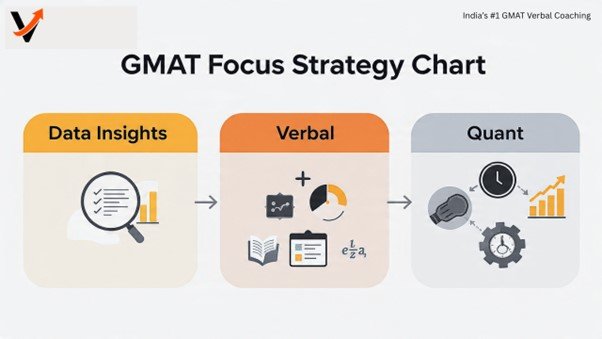
Section-Wise GMAT Focus Strategy
Quantitative Reasoning Strategy
Quant tests more than formulas. It tests whether you can think efficiently, choose the right path, and stay composed under pressure.
What strong candidates do differently
- They look for structure before calculation
- They do not over-solve
- They know when to use logic, estimation, or back-solving
- They review their errors by decision pattern, not only by chapter
How to improve Quant faster
Build concept compression
Do not just finish arithmetic, algebra, and number properties. Build short, reusable frameworks:
- ratio thinking
- equation translation
- divisibility logic
- common trap patterns
- geometry shortcuts
Train the opening 20–30 seconds
Before solving, ask:
- What is this question really testing?
- Is there a shorter path?
- Is exact solving necessary?
Use a premium review system
Label every mistake:
- concept gap
- rushed setup
- careless arithmetic
- wrong method choice
- panic under timing
- misread condition
That type of review creates better score growth than mindless repetition.
Verbal Reasoning Strategy
Verbal is where elite GMAT preparation should begin.
Why Verbal should lead your prep
The section teaches you to:
- separate evidence from conclusion
- identify hidden assumptions
- read for meaning, not just words
- eliminate tempting but imprecise options
- stay disciplined under pressure
Those same skills improve DI and even Quant decision-making.
Critical Reasoning strategy
In CR, your job is not to choose the smartest-sounding option. Your job is to choose the option that performs the exact logical task required by the question.
For every CR question, identify:
- Conclusion
- Evidence
- Assumption
- Gap
- Question type
The strongest candidates know that most wrong answers fail because they are:
- too broad
- too narrow
- outside the scope
- partly true but logically irrelevant
- emotionally convincing but structurally weak
Reading Comprehension strategy
RC is not a memory test. It is a structure test.
Read for:
- author’s purpose
- viewpoint shifts
- contrast markers
- passage organization
- scope boundaries
The real VerbalHub-style RC discipline is this: do not read to remember every detail. Read to understand how the passage is built.
Best review questions after a Verbal set
- Did I misread the task?
- Did I get trapped by an option that was only partially correct?
- Did I lose focus while reading?
- Was my elimination process too weak?
Data Insights Strategy
Data Insights is one of the biggest score separators on the modern GMAT.
It contributes equally to the total score and tests how well you interpret and evaluate information in realistic business-style formats.
Why DI is difficult for many students
Because they treat it as a math section. It is not. It is a reasoning-plus-interpretation section.
Students lose DI points because they:
- misread qualifiers
- fail to connect information across tabs
- confuse interpretation with computation
- solve more than the question requires
Best DI approach
- Read precisely
DI punishes loose reading.
- Separate interpretation from solving
Many questions can be unlocked before serious calculation starts.
- Treat Data Sufficiency as a logic test
Do not automatically solve for exact values. Ask whether the information is enough.
- Build familiarity with visuals
You must become comfortable with:
- tables
- graphs
- multi-tab layouts
- data comparison patterns
This is where Verbal-First preparation becomes powerful. Students trained in precise reading and logical evaluation usually improve faster in DI.
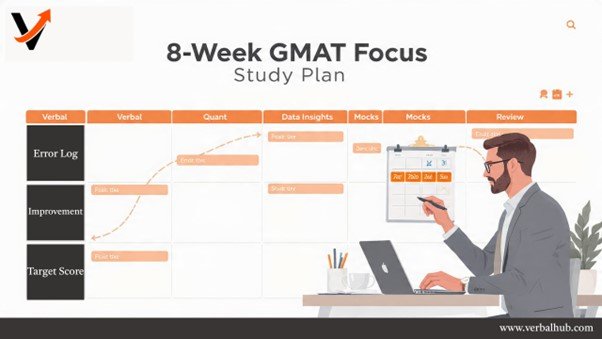
8-Week GMAT Focus Study Plan for Busy Professionals
GMAC offers official planning guidance, including a 6-week preparation planner. For a working professional, an 8-week system is often more realistic because it allows time for review, reinforcement, and mock calibration.
Week 1: Diagnostic and Planning
- take a full diagnostic
- identify section strengths and weaknesses
- set target score and target schools
- start CR and RC foundations
- create an error log
Week 2: Verbal Foundation
- Critical Reasoning types
- Reading Comprehension structure drills
- light Quant maintenance
- intro DI familiarity
Week 3: Quant Efficiency
- arithmetic and algebra refresh
- number properties
- timed Quant sets
- continued Verbal maintenance
- Data Sufficiency basics
Week 4: Data Insights Integration
- Table Analysis
- Graphics Interpretation
- Multi-Source Reasoning
- mixed Verbal + DI practice
Week 5: Mixed Practice Blocks
- timed section sets
- one full mock this week
- deep review of wrong answers
- identify top recurring trap patterns
Week 6: Adaptive Control
- pacing drills
- guess-and-move discipline
- section order strategy
- error reduction work
Week 7: Mock Intensive
- two full mocks
- review by pattern
- sharpen weak areas
- preserve Verbal accuracy daily
Week 8: Final Calibration
- no random new topics
- revise frameworks
- keep DI and CR sharp
- stabilize sleep, timing, and confidence
Suggested weekly schedule
- Monday to Friday: 90 minutes daily
- Saturday: 3 hours
- Sunday: 3–4 hours plus review
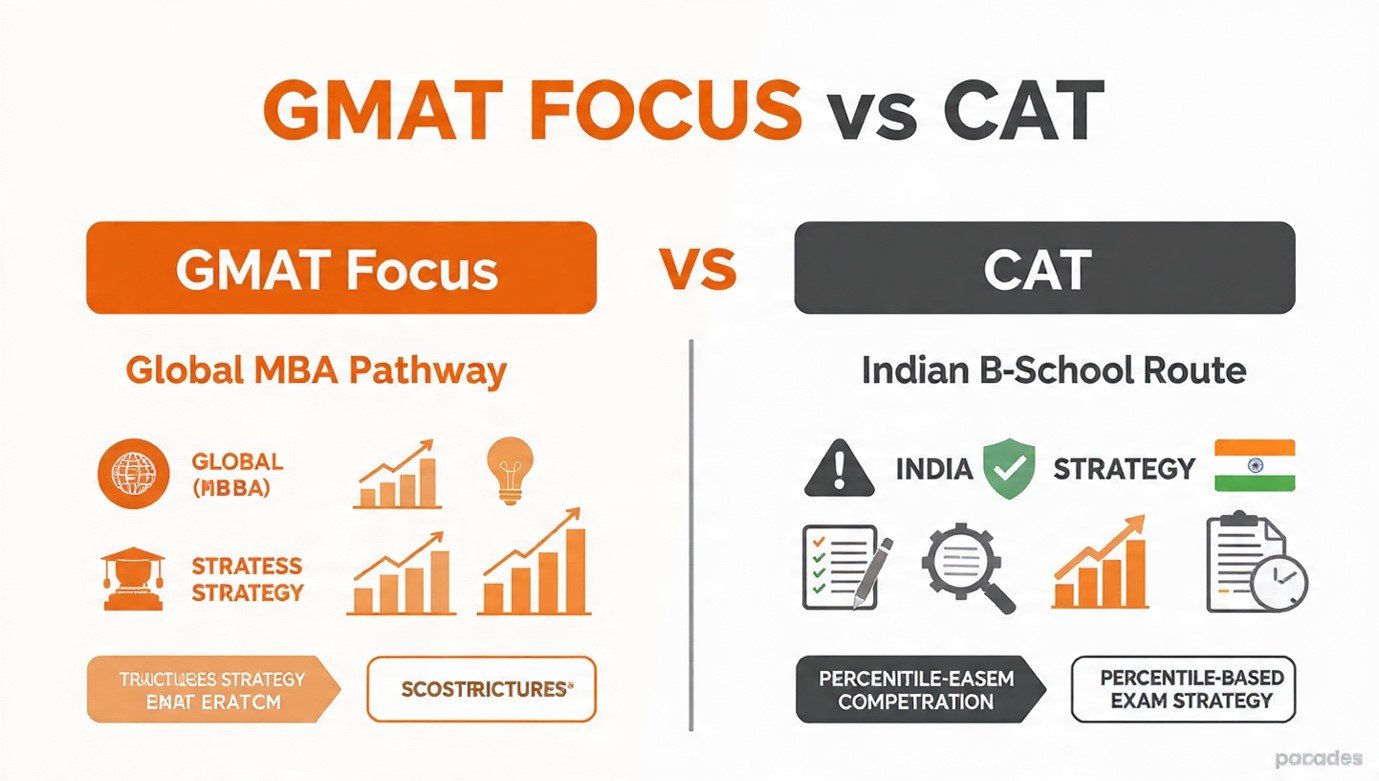
GMAT Focus vs CAT for Indian Aspirants
GMAT and CAT are both high-level aptitude exams, but they serve different strategic goals.
| Feature | GMAT Focus Edition | CAT |
|---|---|---|
| Main Use | Global MBA, MiM, ISB, some Indian B-schools | Primarily Indian MBA admissions |
| Sections | Quant, Verbal, Data Insights | VARC, DILR, QA |
| Duration | 2 hours 15 minutes | About 2 hours |
| Scoring | 205–805 | Percentile-based |
| Verbal Nature | CR + RC, reasoning-heavy | RC + verbal aptitude in CAT style |
| Data Component | Dedicated Data Insights | DILR |
| Best Fit | Applicants seeking flexibility, international reach, and GMAT-accepting schools | Applicants focused on IIMs and India-centric MBA pathways |
Common Mistakes to Avoid in GMAT Focus Preparation
Treating Verbal as secondary
That mindset is outdated. Verbal is now one of the best starting points for total-score growth.
Ignoring Data Insights early
DI is equally weighted, so delaying it weakens your overall preparation.
Doing too many questions without enough review
Top scores come from analysis, not just exposure.
Preparing Quant like a school exam
GMAT Quant rewards efficiency and decision quality, not over-solving.
Using mocks only for score checking
Mocks should diagnose:
- timing drift
- trap frequency
- weak question families
- careless error rate
- section-level decision quality

Take the First Step With a Free GMAT Focus Diagnostic
If you want a serious GMAT preparation plan built around your strengths, weaknesses, and target schools, start with VerbalHub’s Free GMAT Focus Diagnostic Test & 1:1 Strategy Session.
You will get:
- a realistic starting-point assessment
- section-wise performance insight
- score-blocker analysis
- a custom roadmap for Verbal, Quant, and Data Insights
- expert guidance on the right prep strategy for your target score
Book Your Free GMAT Focus Diagnostic Test & 1:1 Strategy Session
FAQ: GMAT Focus 2026
Start with a full diagnostic test, then build a study plan around your real weaknesses. A strong first step is to begin with Verbal reasoning discipline, because that improves performance in Critical Reasoning, Reading Comprehension, Data Insights, and review quality across the exam.
A working professional should use a structured weekly plan with short weekday sessions and longer weekend blocks. The key is consistency, targeted review, and mock-based calibration rather than random practice volume.
Improve Data Insights by training precise reading, better sufficiency logic, and stronger interpretation of tables, graphics, and multi-source prompts. Treat DI as a reasoning section, not just a calculation section.
It is not simply harder or easier. It is shorter and more streamlined, but it is also more reasoning-focused and more directly aligned with decision-making and data literacy. Scores on the current GMAT and the legacy GMAT should not be directly compared.
GMAT is often better for candidates targeting ISB, global MBA programs, or flexibility across schools and countries, while CAT is more suitable for applicants focused mainly on the Indian B-school ecosystem, especially the IIM route.



Our Teachers

Dr. G Ravindra Babu
Quant Faculty
Ph. D in Mathematics Asian International University|| Mathematics Professor at Gitam University || Ex-Mathematics Professor SRM University Amaravathi || MBA in finance Acharya Bangalore B School || GMAT Quant 51, CAT Quant 99.58 %tile, GRE Quant 170 || 21 Different Teaching Certification || Believe in “Education is the mother of leadership”
view details

Dr. Rengarajan Parthasarathy
CAT Faculty
Ph. D in Mathematics from YCM University|| Mathematics Professor at Symbiosis International|| Author of Business Ethics || Ex-CAT Exam Syllabus Advisor in IIM || MBA & MPM from Symbiosis International (Deemed University) || College Topper in Mathematics in Ferguson College || Six Scholarships in Mathematics || 15 Years CAT Coaching, GMAT Coaching and GRE Coaching Experience|| UGC NET Qualified || GMAT Q51, V38 & CAT Q 99.31 & DILR 99.38 %tile, GRE Quant 170 || Believe in “Higher Education Shapes The World.”
view details

Dr. Nisha Tejpal
Verbal & AWA Faculty
Ph. D in English || Published a paper in English in ‘Research Journal of Philosophy and Social Sciences’ || MCA and B.Ed CCS University || A subject expert in Verbal Teaching || 10,000 Plus Essays Analysis || CTET and NET Qualified || More than 15 years of Experience || A writer, Author and Poet || Believe in “Think Beyond the Universe”
view details

Dhrithi Khattar
Verbal Faculty
A subject expert in Verbal Aptitude || More than 15 years of Experience || MBA in HR& Marketing & MA in Economics || Active Member of Hindu Alumni Association || Functional Member of Delhi ||Management Association (DMA) || Operational Member of All India Management Association (AIMA) ||The President of Key Club ||An active member of the French Club ||Gold Seal from California Scholarship Federation.
view details
M. U. Mir
DILR & Quant Faculty
A subject expert in Quantitative Aptitude Training || GMAT Q 51 & CAT DILR 99.75 %tile || GATE 2020 Qualified || M. Tech & B. Tech University Toper (1st Rank) || Awarded by Gov of Odisha, Bihar and J& K for the project Magnetic Floating Model || Ex-Quant Subject Expert in Arihant Publication || An Educationist and Social Worker || Believe in “Education is power”
view details

C. S. Rajawat
CAT Faculty
M. A in Mathematics CCS University|| M. Tech from SRM University || Visiting Mathematics Faculty CCS University ||Experience of 11 Years of CAT Coaching || District Topper in 10th & 12th || Best Teacher Awardee in 2021 & 2022 || CAT Quant 99.43 %tile || Discovered a new Theorem based on HCF in Math || Founder of C. S. Classes ||Believe in “Teaching and Training is an Art.”
view details

Dr. S.K. Singh
PTE/IELTS/CELPIP Expert
Ph. D. English Dr. B. R. Ambedkar University || Delhi & Center Government School Mentor || Founder of Entrepreneur & Learning Startup || IELTS & CELTA Certified from British Council || PTE Certified from Pearson...
view detailsRishabh Arora
PTE/IELTS/CELPIP Expert
MBA in HR International Institute of Management Sciences || PTE Certified from Pearson Test of English|| IELTS & CELTA Certified from British Council || BCA from Integral University || PTE 87 in 2017, IELTS 8.5 in 2018
view details
Jyoti Joshi
IELTS Trainer
Master in English (MA) and Bachelor in Education (B.Ed) || Certified Trainer || IELTS Speaking 9.0 Band holder || Believe in “Great teacher can inspire hope, ignite the imagination, and instill a love of learning”
view details
Surbhi Arora
IELTS / PTE Expert
English Language Expert || More than 3 years of Experience || M.A plus B. Ed Delhi University ||Author, Writer & Classical Singer|| Believe in “Language Language Learning & Teaching is Fun”
view details

Dilip Kumar Rathore
Quant Trainer
A business developer and genius in mathematics || Highly experienced || Master in Maths || well-verse in IT || Believe in “The art of teaching is the art of assisting discover”
view details

Imaam Hasan
Communication Expert
Master in English || Journalist and writer || Certified IELTS & PTE Trainer || A social educater and influencer || Believe in “Education is the movement from darkness to light”
view details