Online & Classroom SNAP Coaching in Kerala — Kochi · Trivandrum · Calicut
60 questions. 60 minutes. Three sections. One chance to hit the score that gets you into SIBM Pune, SCMHRD, or SIIB. This guide gives you every topic, every weightage, and the exact preparation system that separates 97th-percentile attempts from the rest.
Most SNAP aspirants from Kochi, Trivandrum, and Calicut don't fail because of weak content knowledge — they fail because they prepare the wrong way. Random mock attempts without analysis. Skipping LR in favour of familiar Quant. No real feedback loop. VerbalHub's SNAP coaching in Kerala is built to fix exactly that.
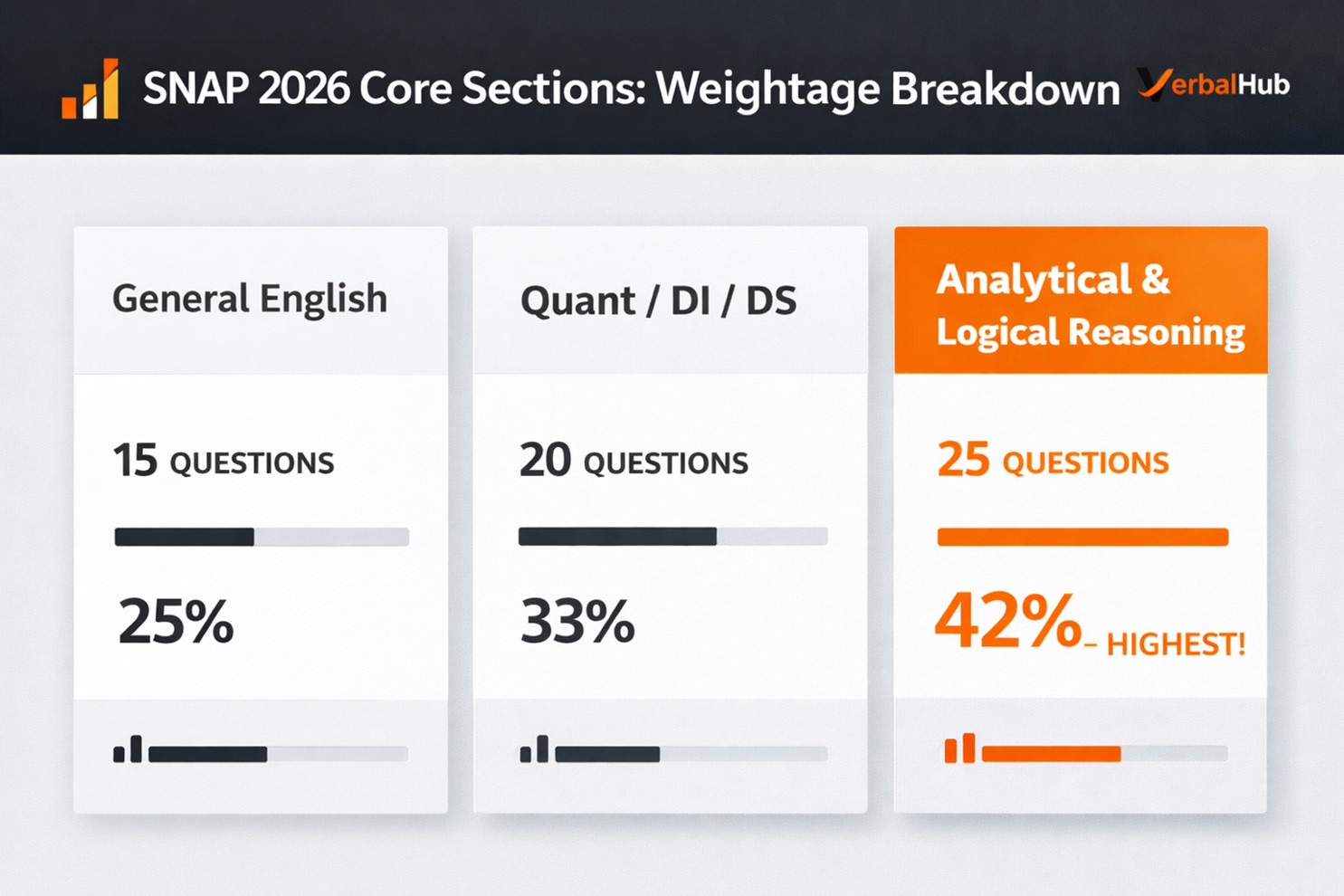
The paper is simple on paper: Logical Reasoning (25 Qs, 42%), Quant/DI/DS (20 Qs, 33%), General English (15 Qs, 25%). −0.25 negative marking per wrong answer. What's not simple is mastering the speed, selection, and accuracy that 97+ percentile actually demands.
→ Book Free Demo — Access our 400+ mock ecosystem: verbalhub.com
SNAP 2026 Core Sections: Weightage Breakdown
Before you open a study plan, ask a sharper question: where are the fastest marks in this paper? In a 60-minute exam with negative marking, not all sections are equal — and not all questions within sections deserve equal time.
The official SNAP structure has three sections with a 15 + 25 + 20 split. Logical Reasoning dominates with 42% of the total paper. Each correct answer earns 1 mark; each wrong attempt costs 0.25.
| Section | Questions | Weightage | Scoring Potential |
|---|---|---|---|
| General English | 15 | 25% | Quick marks if vocabulary, grammar, and short RC are sharp |
| Quant / DI / DS | 20 | 33% | Strong zone for arithmetic-focused, selective students |
| Analytical & Logical Reasoning | 25 | 42% — Highest! | Biggest rank differentiator in the entire paper |
A 97+ percentile profile isn't built by maximising attempts — it's built by clean execution in LR, selective accuracy in Quant, and speed conversion in English. Most students who plateau at 85–90 percentile are misallocating time in Quant while under-investing in LR.
What this means strategically
- LR is non-negotiable — with 42% of the paper, it cannot be treated as secondary prep
- Quant rewards selection over speed — solve what you know fast; skip what you don't
- English should be your confidence zone — 15 questions in under 12 minutes with 11–13 correct
- Mock analysis matters more than theory after Week 6 — pattern recognition beats re-reading
→ Want a section-wise strategy session built around your level? Book Free Demo:verbalhub.com
High-Weightage Topics in SNAP Logical Reasoning (25 Questions)
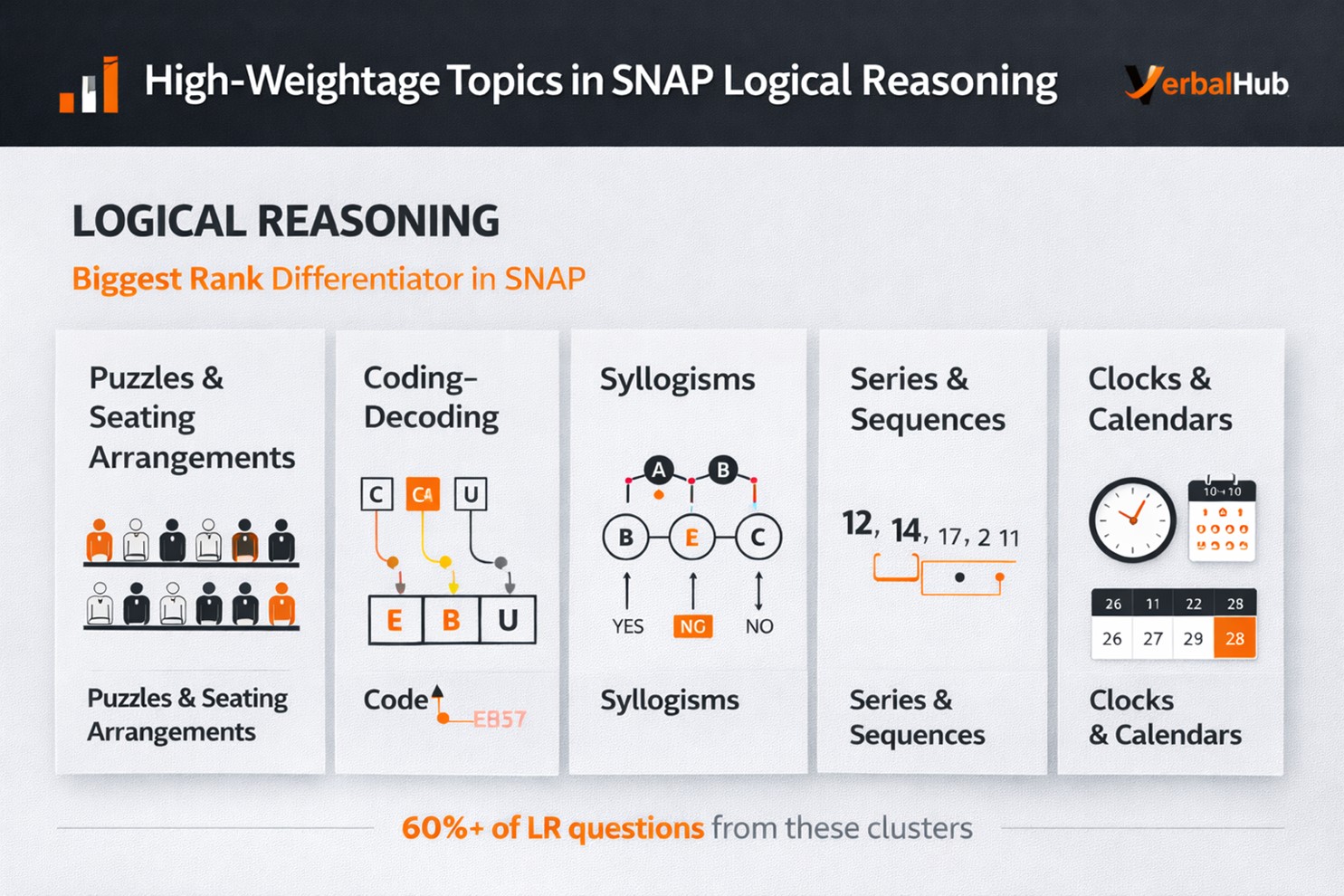
The most important SNAP 2026 LR topics are puzzles and seating arrangements, coding-decoding, syllogisms, series and sequences, and clocks/calendars. Together these account for 60%+ of LR questions. Linear arrangements alone can contribute 8–10 questions.
| Section | Trending Focus Areas (60%+ Questions) | Pro Tips for 20+ Marks |
|---|---|---|
| Logical Reasoning | Puzzles/seating arrangements, coding-decoding, syllogisms, series/sequences, clocks/calendars | Solve 50 sets daily. Linear arrangements (8–10 Qs). Build speed by pattern, not by memory. |
Why LR is SNAP's biggest rank differentiator
SNAP tests trained speed under pressure. LR gives you the highest question count, which means your rank can move sharply depending on how many puzzles and arrangements you crack in under 90 seconds each. The goal isn't to 'know' LR — it's to become mechanically fast at the patterns that keep recurring.
The five LR areas that deserve the most preparation time
- Puzzles and Seating Arrangements — The backbone of SNAP LR. Linear, circular, and floor-based arrangements reward daily drill. 8–10 questions typically come from this cluster.
- Coding-Decoding — Fast, pattern-based, and highly trainable. Once you've seen 100 variations, new ones rarely surprise you.
- Syllogisms — Excellent speed-scoring potential when your Venn diagram logic is tight and automatic.
- Series and Sequences — Low-to-medium difficulty patterns that become highly profitable once you recognise recurring formats.
- Clocks and Calendars — Reliable, often straightforward, and a dependable source of 2–3 clean marks per attempt.
VerbalHub's LR strategy for SNAP prep
- Build topic clusters before mixing question types
- Practice under 30–45 second decision pressure from Week 3 onward
- Train yourself to abandon a puzzle within 90 seconds if it's not opening
- Maintain an error log — most SNAP LR errors are pattern traps, not concept gaps
- Take sectional LR tests after every 3–4 topic cycles to solidify speed
→Our 400+ mock ecosystem includes dedicated LR sectionals with post-attempt analysis. Book Demo:verbalhub.com
SNAP Quant/DI/DS: Arithmetic & Data Mastery (20 Questions)
SNAP Quant is not CAT Quant. It rewards clean arithmetic, fast interpretation, and smart question selection — not deep theoretical problem-solving. Most scoring opportunities live in arithmetic and simple DI.
| Section | Trending Focus Areas | Pro Tips |
|---|---|---|
| Quant / DI | Arithmetic (percentages, TSD, profit/loss, ratios, averages), geometry/mensuration, DI sets (tables, pie charts, mixed visuals) | Vedic math for TSD/ratios. Approximate first, calculate only when necessary. Skip ego battles with lengthy problems. |
What actually scores in SNAP Quant
Arithmetic is the core scoring engine. Prioritise these areas:
- Percentages and percentage change
- Profit, loss, and discount
- Ratio and proportion
- Time, speed, and distance
- Time and work
- Averages and weighted averages
- Simple data tables and pie charts
- Mixed DI sets with 2–3 questions per set
Accuracy strategy for 97+ percentile in Quant
- Solve arithmetic questions first — fastest ROI
- Do not let any one Quant question take more than 90 seconds
- Train mental calculation daily — even 10 minutes compounds fast
- Use approximation wherever the answer options allow it
- Practice DI question selection, not just DI calculation
→ WVerbalHub's Kerala batches train Quant speed discipline through speed sheets and timed mock review. Book Demo:verbalhub.com
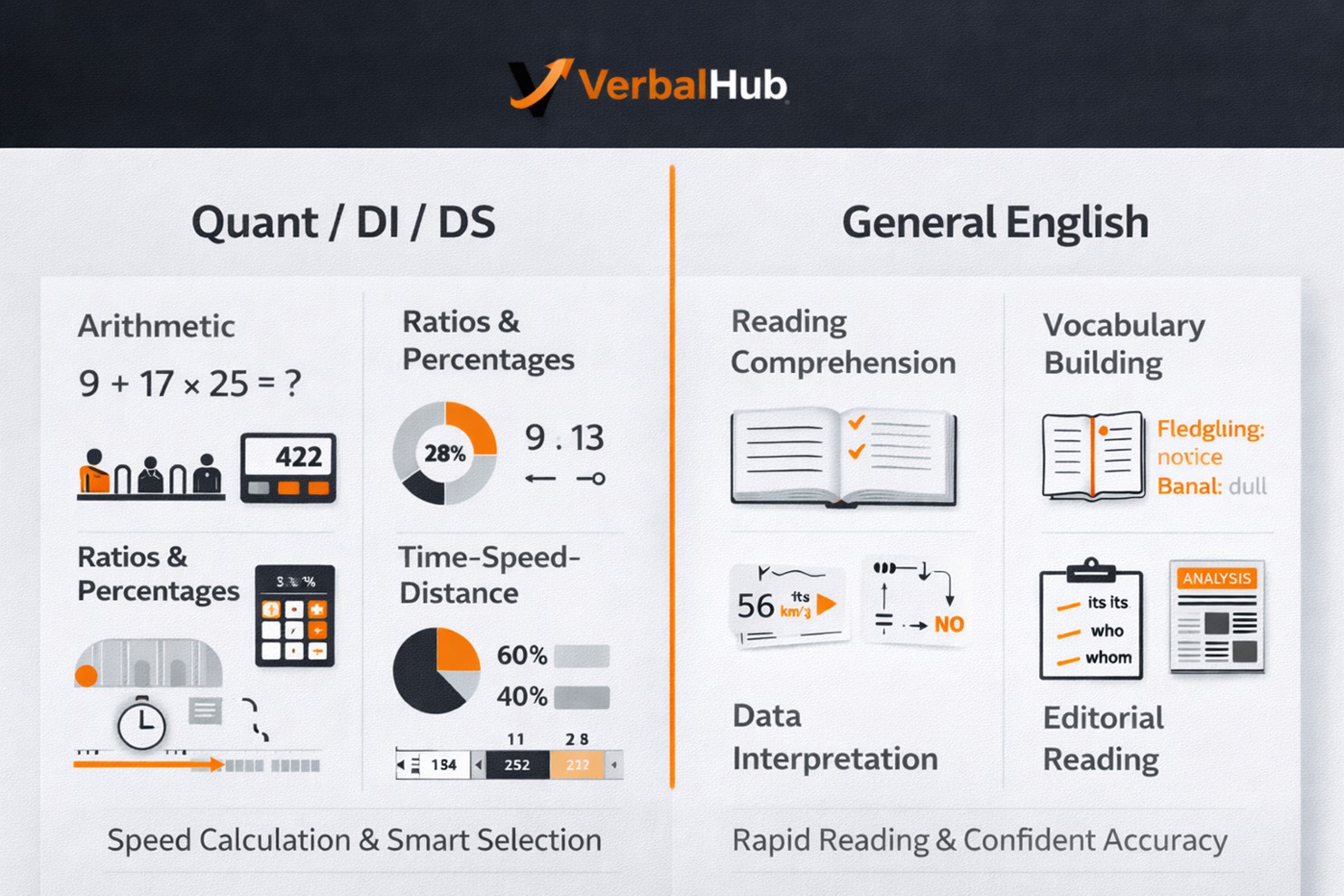
General English Syllabus: Vocabulary & RC Power-Up
SNAP English looks compact at 15 questions, but disciplined aspirants can finish it in 10–12 minutes with 11–13 accurate answers. Underprepared students spend 20+ minutes and still score only 7–8. The difference is method, not intelligence.
| Section | Trending Focus Areas | Pro Tips |
|---|---|---|
| General English | RC / Reading Comprehension, grammar rules, vocabulary building, verbal reasoning / critical reasoning | Read 2 Hindu editorials daily. Maintain a vocab notebook. Practice short RC under a 3-minute timer. |
What to prioritise in SNAP English prep
- Reading Comprehension — SNAP RC passages are shorter and faster-paced than CAT. Train for speed-reading, not deep literary analysis. 3 minutes per passage is a realistic target.
- Grammar Rules — Sentence correction, subject-verb agreement, and usage errors repeat predictably. 5 clean rule clusters cover 80% of what appears.
- Vocabulary — Synonyms, antonyms, and contextual word usage appear consistently. Not heavy, but each correct answer is a free mark if your vocabulary is trained.
- Verbal Reasoning — These questions reward calm, logical reading. The best answer is often the choice that depends on the least number of assumptions.
The English habit that compounds over 6 months
- 2 Hindu editorials daily — for reading speed and vocabulary exposure, not current affairs
- One vocabulary notebook — 10 new words reviewed daily, not just added
- Short RC practice under a timer — accuracy first, then speed
- Grammar rule revision every Friday — 20 minutes keeps patterns sharp
- Mixed English quiz every day in the final 6 weeks
SNAP English isn't about knowing words — it's about knowing words fast enough to convert them into marks within a 60-minute paper. Speed and accuracy here buy you extra time in LR, where your percentile is actually decided.
Why High-Speed Accuracy Is the Core Trend in SNAP 2026
The exam itself is designed around compression: 60 questions, 60 minutes, three sections, negative marking. That structure rewards candidates who make fast decisions without careless errors — not those who simply know the most content.
What high-speed accuracy actually means in practice
- You don't attempt everything blindly — you filter fast
- You identify easy questions within 15 seconds of reading
- You minimise re-reading by improving first-pass comprehension
- You know when to skip a puzzle early instead of staying stuck
- You preserve your score against negative marking by making disciplined decisions.
How many mocks should you take for SNAP 2026?
A serious aspirant should plan for 25–30 quality mocks minimum. What matters far more than the number is the quality of the analysis process. 10 deeply analysed mocks will outperform 40 mocks retaken without reviewing patterns.
Recommended 6-month preparation timeline
- Months 1–2: Concept building — arithmetic fundamentals, core LR types, grammar rules, vocabulary system
- Months 3–4: Sectional tests + timed drills — move from comfort to timer pressure, topic by topic
- Months 5–6: Full mocks + analysis + attempt strategy — refine selection instincts, eliminate recurring errors
→ See how VerbalHub's 400+ mock ecosystem builds high-speed accuracy. Book Free Demo:verbalhub.com
SNAP Syllabus vs. Other Exams: CAT and NMAT Comparison
Many Kerala students prepare for more than one MBA entrance exam. That's smart — if you understand exactly where the exams overlap and diverge. One of the most common preparation mistakes is approaching SNAP as if it were simply a shorter version of CAT.
Q: Is SNAP easier than CAT?
A: SNAP is shorter and more speed-focused. CAT is broader and more stamina-intensive. SNAP content is generally less complex, but the 60-minute pressure with negative marking creates its own unique challenge.
Q: How is SNAP different from NMAT?
A: SNAP has 60 questions in 60 minutes with −0.25 marking. NMAT has 108 questions in 120 minutes with no negative marking. The speed demand is comparable; the penalty structure is different.
| Exam | Structure | Speed Demand | Difficulty Style | Best Overlap Benefit |
|---|---|---|---|---|
| SNAP | 60 Q / 60 min · LR-heavy · −0.25 | Very High | Short, fast, selection-based | Speed training and sectional balance |
| CAT | Longer, stamina-heavy, VARC-deep | High, more layered | Deeper VARC and harder problem-solving | Concept depth and exam maturity |
| NMAT | 108 Q / 120 min · No negative marking | Very High | Speed + section consistency | Vocabulary, reasoning basics, timed fluency |
The smart multi-exam strategy
- Use CAT prep for concept depth — especially in Quant fundamentals and reading ability
- Use NMAT for timed fluency — the no-negative-marking environment is great for speed-building
- Use SNAP mocks for high-speed execution under pressure — nothing else replicates the 60/60 format
Actionable SNAP 2026 Preparation Plan
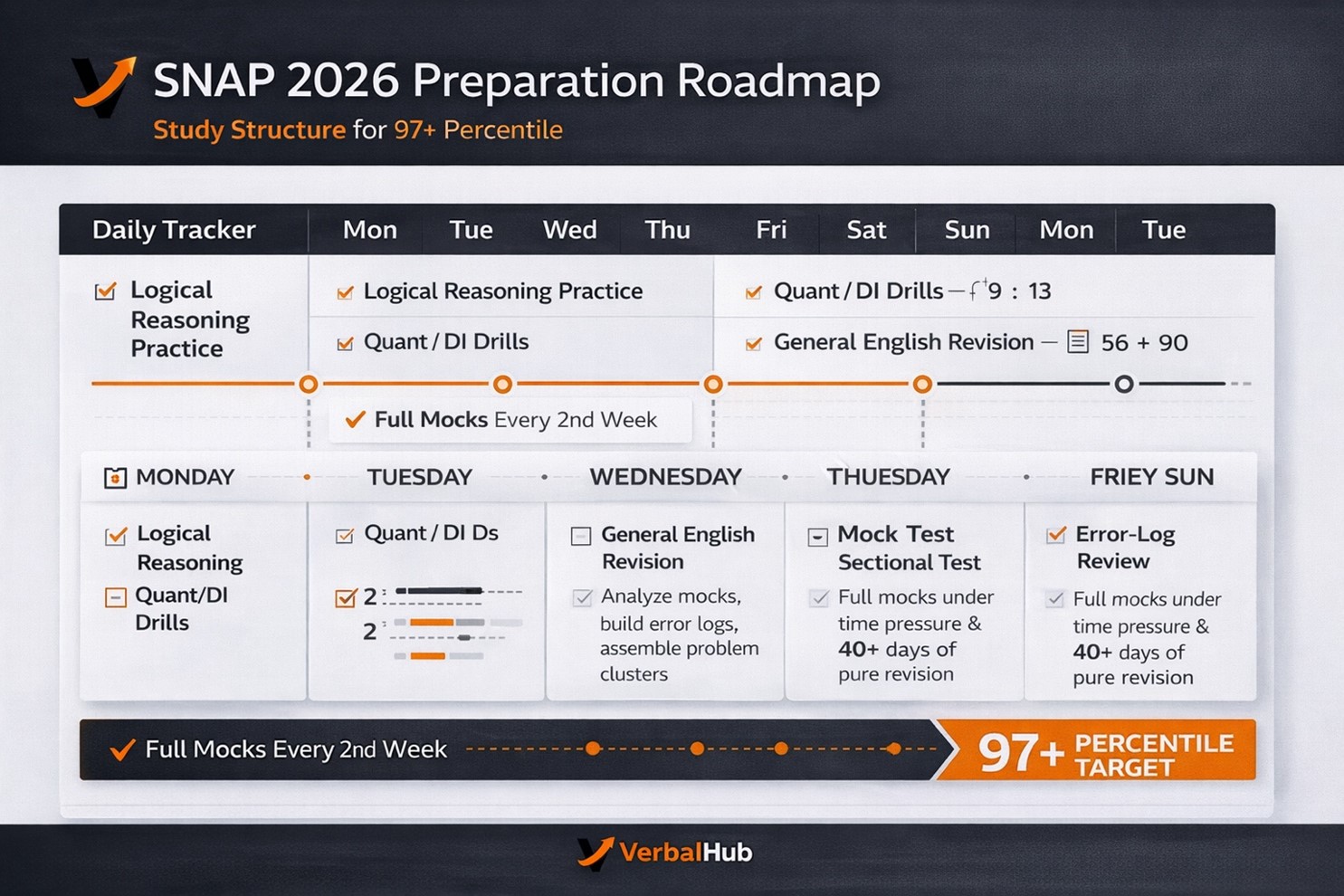
A syllabus without a schedule is just a list. Here's how to turn the SNAP 2026 section-wise topics into a working week-by-week system that builds toward 97+ percentile.
Daily study plan (weekdays — 2.5 to 3 hours)
- 45 min: Logical Reasoning — topic drill or timed set
- 45 min: Quant/DI — arithmetic or DI interpretation practice
- 30 min: General English — RC + grammar or vocabulary
- 30 min: Mock review or error-log correction
- 15–30 min: Vocabulary revision or mental math
Weekend plan (4 to 5 hours)
- 1 full sectional test or complete mock — timed, no breaks
- Detailed post-attempt analysis — identify patterns, not just wrong answers
- Weak-topic revision based on that week's errors
- Speed drill practice on your slowest section
Weekly structure that works
- Monday: Arithmetic + vocabulary building
- Tuesday: LR puzzles + grammar rules
- Wednesday: Data Interpretation + RC practice
- Thursday: Coding-decoding + arithmetic revision
- Friday: Syllogisms + mixed English practice
- Saturday: Full SNAP mock — timed
- Sunday: Deep analysis + weak area repair
Three-phase preparation model
- Foundation Phase (Months 1–2) — Build clean concepts in arithmetic, core grammar rules, and primary LR types. Chapter tests only — no full mocks yet.
- Timed Practice Phase (Months 3–4) — Move from comfort to timer pressure, topic by topic. Introduce sectional tests. Track time-per-question for the first time.
- Mock Intelligence Phase (Months 5–6) — Full mocks with deep analysis. Focus on selection logic, attempt order, and error pattern elimination. This phase decides the percentile.
Don't ask 'How many hours did I study this week?' Ask: 'How many scoring patterns did I actually master this week?' Hours are inputs. Mastered patterns are outputs. Percentile reflects outputs.
SNAP 2026 Section-Wise Score Targets
A 97+ percentile attempt is built on clean execution across all three sections, not maximum attempts. These are the realistic targets for a serious aspirant:
11–13 General English High accuracy in 10–12 minutes |
12–15 Quant / DI / DS Strong attempts, not maximum attempts |
15–18+ Logical Reasoning Quality over volume; varies by difficulty |
|---|
These targets shift based on test difficulty on exam day, but the principle holds: clean execution beats reckless volume at 97+ percentile.
→ Want your personal score targets based on your current baseline? Talk to a VerbalHub mentor:verbalhub.com
SNAP 2026 Syllabus: Frequently Asked Questions
SNAP 2026 has three official sections: General English (15 questions), Analytical & Logical Reasoning (25 questions), and Quantitative, Data Interpretation & Data Sufficiency (20 questions). Total: 60 questions in 60 minutes with −0.25 negative marking per wrong answer.
The most important SNAP LR topics are puzzles and seating arrangements (8–10 questions), coding-decoding, syllogisms, series and sequences, and clocks/calendars. These account for 60%+ of LR questions. Daily timed practice on these clusters is essential for 20+ marks.
Yes. Analytical & Logical Reasoning has 25 questions — the highest in the paper — and contributes 42% of total weightage. Students who consistently score 18+ in LR are almost always in the 95th percentile and above.
SNAP 2026 has 60 total questions across three sections, to be solved in 60 minutes. Each correct answer carries 1 mark; each wrong answer carries a −0.25 penalty.
SNAP is shorter and more speed-centric, while CAT is broader and more stamina-intensive. SNAP content is generally less complex, but the 60-minute format with negative marking creates its own pressure. They test different skills.
A serious aspirant should plan for 25–30 quality mocks at minimum. The count matters much less than how deeply you review each one. VerbalHub's 400+ mock ecosystem is built around analysis-first preparation.
Yes. SNAP applies −0.25 for each wrong answer. This makes selective attempting — especially in Quant — more important than attempting the maximum number of questions.
The best coaching combines mock-driven practice, section strategy, speed training, and personalised mentor feedback. VerbalHub's SNAP coaching in Kerala is built around 400+ mocks, 1-on-1 mentorship, and online/classroom batches in Kochi, Trivandrum, and Calicut.
Yes — and it's a smart strategy. Arithmetic, vocabulary, RC, and reasoning fundamentals overlap across SNAP, CAT, and NMAT. The key is to add a separate SNAP-specific layer: 60/60 format mock practice, LR speed training, and section-specific attempt strategy.
Focus on short RC under a timer, grammar rule clusters, vocabulary building through daily reading, and verbal reasoning. Reading 2 Hindu editorials daily is the most consistently recommended habit. Aim for 11–13 correct answers in under 12 minutes.
Ready to Build a Real 97+ Percentile SNAP Plan?
Stop preparing randomly. VerbalHub's SNAP coaching in Kerala gives you the system, the mocks, the mentor, and the strategy — whether you're in Kochi, Trivandrum, Calicut, or anywhere online.
What you get at VerbalHub
- 400+ full SNAP mocks with post-attempt analytics
- 1-on-1 mentorship — weekly performance reviews and custom study plans
- Online and classroom batches — Kerala-focused, available across Kochi, Trivandrum, and Calicut
- Section-wise speed training — LR, Quant, and English
- Mock analysis dashboard — track accuracy, pacing, and error patterns
- Repeater-friendly diagnostic plans — identify why your score is stuck and fix it
Searching for any of these?
- Best SNAP coaching in Kerala
- Online SNAP coaching Kerala
- SNAP classes near me in Kochi
- SNAP coaching Trivandrum
- SNAP coaching Calicut
- SNAP section-wise topics weightage

→ Book Free Demo for 400+ Mocks: Verbalhub.com
→ Call for Kerala SNAP coaching: +91-78270-40357



Our Teachers

Dr. G Ravindra Babu
Quant Faculty
Ph. D in Mathematics Asian International University|| Mathematics Professor at Gitam University || Ex-Mathematics Professor SRM University Amaravathi || MBA in finance Acharya Bangalore B School || GMAT Quant 51, CAT Quant 99.58 %tile, GRE Quant 170 || 21 Different Teaching Certification || Believe in “Education is the mother of leadership”
view details

Dr. Rengarajan Parthasarathy
CAT Faculty
Ph. D in Mathematics from YCM University|| Mathematics Professor at Symbiosis International|| Author of Business Ethics || Ex-CAT Exam Syllabus Advisor in IIM || MBA & MPM from Symbiosis International (Deemed University) || College Topper in Mathematics in Ferguson College || Six Scholarships in Mathematics || 15 Years CAT Coaching, GMAT Coaching and GRE Coaching Experience|| UGC NET Qualified || GMAT Q51, V38 & CAT Q 99.31 & DILR 99.38 %tile, GRE Quant 170 || Believe in “Higher Education Shapes The World.”
view details

Dr. Nisha Tejpal
Verbal & AWA Faculty
Ph. D in English || Published a paper in English in ‘Research Journal of Philosophy and Social Sciences’ || MCA and B.Ed CCS University || A subject expert in Verbal Teaching || 10,000 Plus Essays Analysis || CTET and NET Qualified || More than 15 years of Experience || A writer, Author and Poet || Believe in “Think Beyond the Universe”
view details

Dhrithi Khattar
Verbal Faculty
A subject expert in Verbal Aptitude || More than 15 years of Experience || MBA in HR& Marketing & MA in Economics || Active Member of Hindu Alumni Association || Functional Member of Delhi ||Management Association (DMA) || Operational Member of All India Management Association (AIMA) ||The President of Key Club ||An active member of the French Club ||Gold Seal from California Scholarship Federation.
view details
M. U. Mir
DILR & Quant Faculty
A subject expert in Quantitative Aptitude Training || GMAT Q 51 & CAT DILR 99.75 %tile || GATE 2020 Qualified || M. Tech & B. Tech University Toper (1st Rank) || Awarded by Gov of Odisha, Bihar and J& K for the project Magnetic Floating Model || Ex-Quant Subject Expert in Arihant Publication || An Educationist and Social Worker || Believe in “Education is power”
view details

C. S. Rajawat
CAT Faculty
M. A in Mathematics CCS University|| M. Tech from SRM University || Visiting Mathematics Faculty CCS University ||Experience of 11 Years of CAT Coaching || District Topper in 10th & 12th || Best Teacher Awardee in 2021 & 2022 || CAT Quant 99.43 %tile || Discovered a new Theorem based on HCF in Math || Founder of C. S. Classes ||Believe in “Teaching and Training is an Art.”
view details

Dr. S.K. Singh
PTE/IELTS/CELPIP Expert
Ph. D. English Dr. B. R. Ambedkar University || Delhi & Center Government School Mentor || Founder of Entrepreneur & Learning Startup || IELTS & CELTA Certified from British Council || PTE Certified from Pearson...
view detailsRishabh Arora
PTE/IELTS/CELPIP Expert
MBA in HR International Institute of Management Sciences || PTE Certified from Pearson Test of English|| IELTS & CELTA Certified from British Council || BCA from Integral University || PTE 87 in 2017, IELTS 8.5 in 2018
view details
Jyoti Joshi
IELTS Trainer
Master in English (MA) and Bachelor in Education (B.Ed) || Certified Trainer || IELTS Speaking 9.0 Band holder || Believe in “Great teacher can inspire hope, ignite the imagination, and instill a love of learning”
view details
Surbhi Arora
IELTS / PTE Expert
English Language Expert || More than 3 years of Experience || M.A plus B. Ed Delhi University ||Author, Writer & Classical Singer|| Believe in “Language Language Learning & Teaching is Fun”
view details

Dilip Kumar Rathore
Quant Trainer
A business developer and genius in mathematics || Highly experienced || Master in Maths || well-verse in IT || Believe in “The art of teaching is the art of assisting discover”
view details

Imaam Hasan
Communication Expert
Master in English || Journalist and writer || Certified IELTS & PTE Trainer || A social educater and influencer || Believe in “Education is the movement from darkness to light”
view details