
CAT Response Sheet Score Calculator 2026: Calculate CAT Marks, Percentile and IIM Composite Score

The moment the CAT response sheet goes live, everything changes. You can finally stop replaying the exam in your head and start working with actual numbers.
Every aspirant wants answers to the same three questions within the first hour. How many marks did I actually score? What percentile does that convert to? And which IIMs or B-schools might send me a call?
Your response sheet answers the first question exactly. The other two need a little estimation, and that is where a good calculator saves you hours of manual counting and second-guessing.
Quick Answer: A CAT score calculator response sheet tool reads your official candidate response sheet, matches every answer against the provisional answer key, and instantly shows your correct attempts, wrong attempts, section-wise marks and total raw score. It then uses recent CAT trends to estimate your expected percentile and the range of B-schools you can realistically target.
This guide walks you through the entire journey: downloading your response sheet, calculating your CAT marks, understanding percentile and normalization, reading IIM composite scores, and deciding what to do next — whether that is shortlisting colleges or planning a focused three-month retake with VerbalHub CAT Coaching.
Table of Contents
- CAT Response Sheet Score Calculator 2026
- What Is a CAT Score Calculator?
- How to Download the CAT Response Sheet
- How to Use the VerbalHub CAT Score Calculator
- CAT Marking Scheme Explained
- How to Calculate CAT Score Manually from the Response Sheet
- CAT Raw Score, Scaled Score and Percentile
- How CAT Score Normalization Works
- CAT Score vs Percentile 2026
- CAT Sectional Percentile Calculator
- CAT Slot-Wise Score and Difficulty Analysis
- Question-Wise CAT Response-Sheet Analysis
- How Is CAT Percentile Predicted?
- How Accurate Is a CAT Score and Percentile Calculator?
- Why Do Different CAT Calculators Show Different Percentiles?
- What Is a CAT Composite Score?
- How Does an IIM Composite Score Calculator Work?
- Why a 99 Percentile Does Not Guarantee an IIM Call
- CAT Score to IIM and B-School Call Predictor
- What Should You Do After Calculating Your CAT Score?
- CAT Answer-Key Objection Process
- How to Analyse the CAT Response Sheet for a Retake
- Can You Prepare for CAT in Three Months?
- Three-Month CAT Preparation Plan
- Daily CAT Study Plan for Three Months
- How Many CAT Mocks Should You Take in Three Months?
- VerbalHub CAT Crash Course
- VerbalHub CAT Fast Track Course
- VerbalHub CAT Short-Term Course
- CAT Crash Course vs Fast Track Course vs Short-Term Course
- Common Mistakes Students Make After Using a CAT Score Calculator
- Expert Tips for Using a CAT Score Calculator Wisely
- Key Takeaways
- FAQs
- Conclusion
1. CAT Response Sheet Score Calculator 2026
The VerbalHub CAT score calculator exists for one simple reason. Counting 68 answers by hand, applying negative marking correctly, and separating MCQs from TITA questions is slow and easy to get wrong. A calculator does the same job in under a minute, without silly errors.
Once you paste your response-sheet link, the tool is designed to show you:
- Your VARC score, DILR score and QA score
- Your overall raw score out of 204
- Number of correct answers
- Number of incorrect MCQs (the ones costing you marks)
- Number of incorrect TITA questions (no penalty)
- Number of unattempted questions
- Your expected scaled score after normalization
- Sectional percentile estimates for VARC, DILR and QA
- Your overall percentile estimate
- A possible rank range among test takers
- A possible college-call range based on recent shortlisting trends
[ Paste Your CAT Response Sheet Link → Calculate My Score ]
A quick note on privacy: the calculator only needs the public response-sheet URL generated after you log in to the CAT website. You never share your CAT user ID or password with VerbalHub, and no login credentials are asked for or stored.
2. What Is a CAT Score Calculator?
A CAT score calculator is a tool that converts your recorded exam responses into marks. It reads the response sheet the exam authority publishes for every candidate, which lists each question, the option or answer you entered, and the questions you left blank.
The tool compares each of your responses with the official provisional answer key. Correct answers earn marks, wrong MCQs lose marks, wrong TITA answers cost nothing, and blanks cost nothing. Adding it all up gives your raw score, section by section.
Who should use it? Anyone who appeared for CAT and wants clarity before results — first-time takers, repeaters, and even students who just want to know whether a second attempt makes sense.
When does it become useful? The moment the official response sheet and provisional answer key are released, usually within a few days of the exam. Before that, any score talk is guesswork.
What it cannot guarantee: your final scaled score, your exact percentile, or a college call. Those depend on normalization, answer-key changes and how every other candidate performed. A calculator gives you a well-informed estimate, not a result.
3. How to Download the CAT Response Sheet
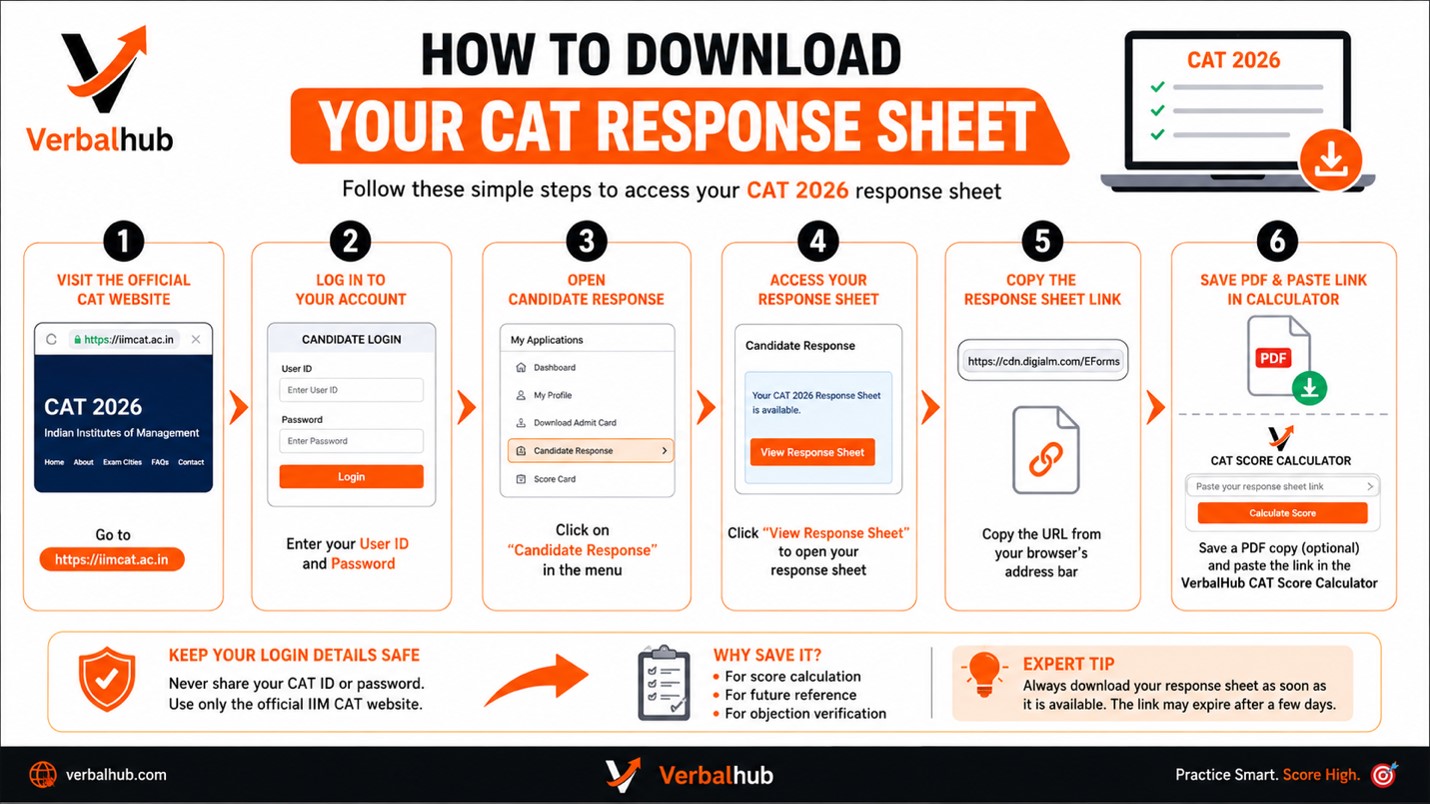
Before any score calculator CAT tool can help you, you need your response sheet. Here is the standard process, based on how recent CAT cycles have worked. Exact screen labels may differ slightly for CAT 2026.
- Go to the official CAT website, iimcat.ac.in.
- Log in with your CAT user ID and password from registration.
- Open the Candidate Response (or similarly named) tab on your dashboard.
- Your response sheet opens, showing every question with your recorded answer.
- Copy the URL of this response-sheet page from your browser’s address bar.
- Save a PDF or HTML copy on your device as a backup.
- Paste the copied link into the CAT response sheet calculator.
Common problems students face, and quick fixes:
- Link not opening: the link may be session-based. Log in again and copy a fresh URL.
- Session expired: CAT login sessions time out quickly. Reopen the site and log in again.
- Blank page: usually a browser cache issue. Try incognito mode or a different browser.
- Mobile browser trouble: the response sheet renders better on a laptop. Switch devices if the page breaks.
- Copied the login-page URL by mistake: the calculator needs the response-sheet page URL, not iimcat.ac.in’s home or login page. Check that the link opens your answers directly.
- Response sheet no longer available: the window is limited. In recent cycles, response sheets have stayed live only for a short period around the objection window.
Expert Tip: Save a local copy of your response sheet on day one — a full-page PDF plus screenshots. Once the official window closes, the sheet disappears, and you will want it later for retake analysis, objection evidence and comparing calculator predictions.
4. How to Use the VerbalHub CAT Score Calculator
Using the tool takes about a minute. Here is the flow:
- Paste your response-sheet link into the input box.
- Select the CAT year — choose CAT 2026 once the exam is done.
- Select your slot (Slot 1, 2 or 3) if the tool asks. Slot matters for percentile estimation.
- Submit and let the tool match your answers with the answer key.
- Check your section-wise marks for VARC, DILR and QA first.
- Check your overall raw score and expected percentile next.
- Download or save the analysis for your records.
- Use the report to shortlist colleges and plan your next preparation step.
One honest note: the exact steps may be updated after IIMs release the official CAT 2026 response-sheet format, since the page structure changes slightly some years. The core process — paste link, pick year and slot, get your report — stays the same.
5. CAT Marking Scheme Explained
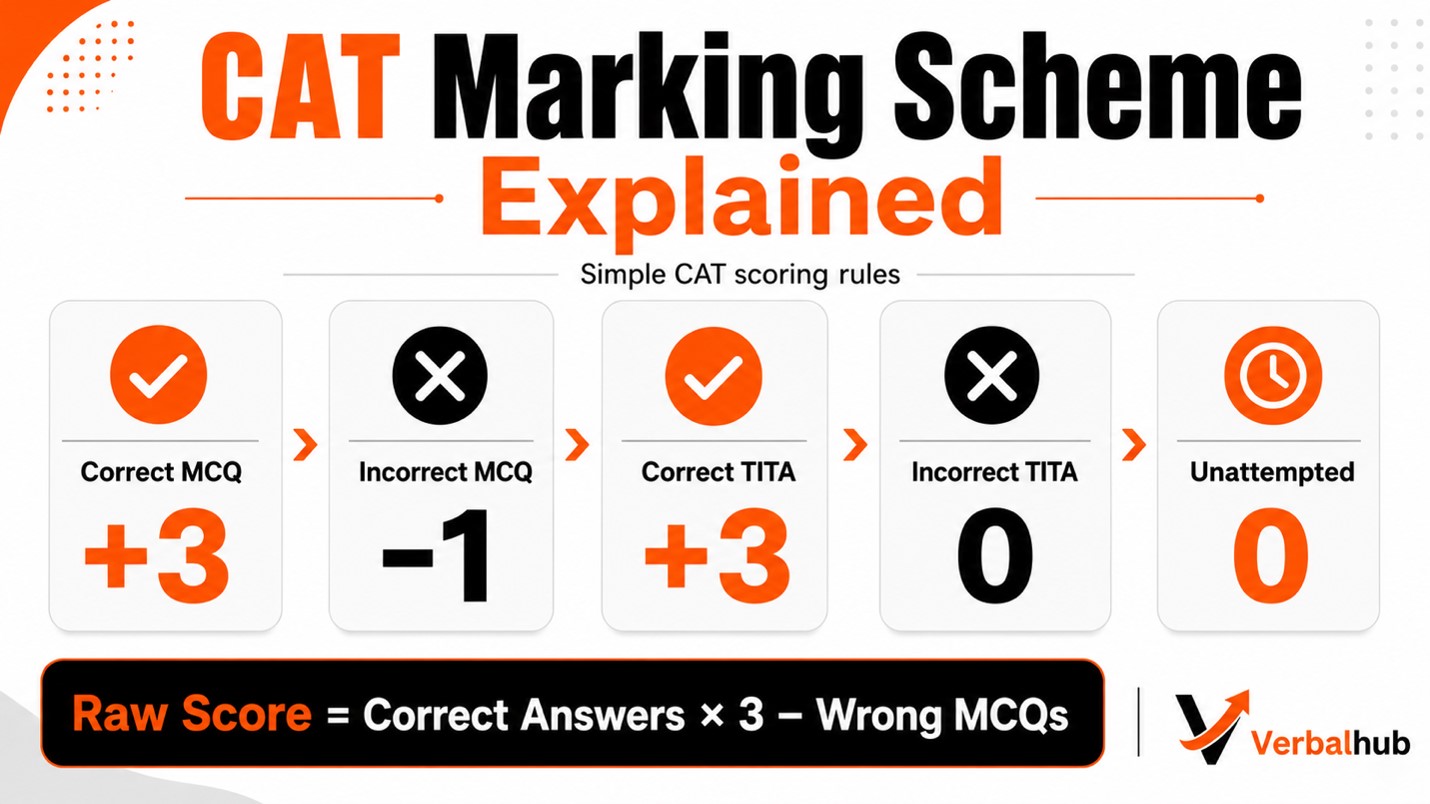
You cannot trust any CAT marks calculator, including your own manual math, unless you know the marking rules. Here is the scheme CAT has followed in recent years, including CAT 2025, and which CAT 2026 is expected to continue (final confirmation comes with the official CAT 2026 notification).
- Correct MCQ: +3 marks
- Incorrect MCQ: −1 mark
- Correct TITA (Type In The Answer) question: +3 marks
- Incorrect TITA question: 0 marks — no negative marking
- Unattempted question: 0 marks
- Cancelled or disputed questions: if a question is dropped after objections, IIMs typically award marks as per the final answer-key policy for that year
The score formula is simple:
Raw Score = (Correct Answers × 3) − (Incorrect MCQs × 1)
A quick example. Say you got 32 questions right, marked 10 MCQs wrong, entered 4 TITA answers wrong, and skipped 22 questions. Your score is (32 × 3) − (10 × 1) = 96 − 10 = 86 marks. The wrong TITA answers and the skipped questions cost you nothing.
| Response Type | Marks |
|---|---|
| Correct MCQ | +3 |
| Incorrect MCQ | −1 |
| Correct TITA | +3 |
| Incorrect TITA | 0 |
| Unattempted | 0 |
For context, the recent CAT paper has 68 questions across three sections — VARC (24 questions, 72 marks), DILR (22 questions, 66 marks) and QA (22 questions, 66 marks) — for a total of 204 marks, per the CAT 2024 and CAT 2025 pattern.
Quick Answer: How is the CAT score calculated? Every correct answer earns +3 marks. Every wrong MCQ costs −1 mark. Wrong TITA answers and skipped questions carry no penalty. Your raw score equals (correct answers × 3) minus (wrong MCQs × 1), calculated section-wise for VARC, DILR and QA, out of a total of 204 marks.
6. How to Calculate CAT Score Manually from the Response Sheet
Even if you use a calculator, do one manual pass. It builds trust in the number and catches answer-key mismatches worth objecting to.
Open your response sheet next to the official answer key for your slot. Go question by question and sort each response into four buckets: correct, wrong MCQ, wrong TITA, unattempted. Then apply the formula section by section.
Here is a realistic worked example:
| Section | Correct | Wrong MCQ | Wrong TITA | Unattempted | Score |
|---|---|---|---|---|---|
| VARC (24 Q) | 14 | 5 | 1 | 4 | (14×3) − 5 = 37 |
| DILR (22 Q) | 8 | 3 | 2 | 9 | (8×3) − 3 = 21 |
| QA (22 Q) | 11 | 4 | 1 | 6 | (11×3) − 4 = 29 |
| Total (68 Q) | 33 | 12 | 4 | 19 | 87 |
So this student’s total raw score is 87 out of 204. Based on CAT 2025 trends, a raw score in the mid-to-high 80s landed near the 99 percentile zone in most slots — a genuinely strong performance despite attempting barely half the paper.
Quick Answer: How do I calculate CAT marks from the response sheet? Download your response sheet from iimcat.ac.in, open the official answer key for your slot, and tally four counts: correct answers, wrong MCQs, wrong TITA answers and blanks. Apply (correct × 3) − (wrong MCQs × 1) for each section. Wrong TITA answers and blanks score zero.
Common Mistake: Do not deduct marks for wrong TITA answers. TITA questions have no negative marking, so treating them like wrong MCQs will understate your score — sometimes by 5 to 10 marks. Your response sheet or the answer key indicates which questions are non-MCQ; separate them before you subtract anything.
7. CAT Raw Score, Scaled Score and Percentile
These three terms confuse more students than any DILR set. Let’s separate them.
Raw score is the marks you earn directly from your answers — the number you or a CAT raw score calculator can compute today from your response sheet.
Scaled score is your raw score after normalization. Because CAT runs in three slots of different difficulty, IIMs statistically adjust scores so that no slot gets an unfair edge. The scaled score is what appears on your official scorecard.
Percentile is your relative rank. A 95 percentile means you performed better than 95 percent of all test takers. It says nothing about your marks in isolation — only about your position in the crowd.
| Factor | Raw Score | Scaled Score | Percentile |
|---|---|---|---|
| Meaning | Marks from your answers | Raw score adjusted for slot difficulty | Your rank relative to all candidates |
| Based on | Answer key + marking scheme | Statistical normalization across slots | Distribution of scaled scores |
| Used for | Self-assessment, predictions | Official scorecard | Shortlisting by IIMs and B-schools |
| Can change after normalization? | No | Yes | Yes |
| Available immediately? | Yes, from the response sheet | No, only with results | No, only estimated until results |
Now the questions everyone asks:
Can the scaled score be lower than the raw score? Yes. If your slot was relatively easy, normalization may pull your score down slightly. In CAT 2023, for instance, coaching analyses noted a few marks being shaved off the easier slot.
Can it be higher? Also yes. Tougher-slot candidates often gain a few marks after scaling.
Which score do IIMs use? The scaled score and, more importantly, the percentiles derived from it — overall and sectional.
Why is percentile more important than raw marks? Because CAT is a relative exam. In a tough year, 78 marks fetched a 99 percentile (CAT 2023); in an easier year, the same percentile needed closer to 85–90 marks. Colleges shortlist on percentile precisely because it stays comparable across years.
Quick Answer: What is the difference between CAT raw score and scaled score? Raw score is the direct total from your answers using +3 and −1 marking. Scaled score is that raw score adjusted through normalization to remove slot-difficulty differences. Your official CAT scorecard shows the scaled score, and your percentile is calculated from it — so the two can differ by a few marks.
Key Takeaway: You control and can compute the raw score today. The scaled score and percentile are estimates until IIMs publish results. Plan with the raw score, but keep a small margin of uncertainty in every prediction built on it.
8. How CAT Score Normalization Works
CAT is conducted in three slots on the same day, and no two question papers are identical. One slot’s DILR might be brutal while another’s is manageable. Comparing raw marks across slots would be unfair, so IIMs normalize.
Think of it like cricket’s DLS method. When rain shortens a match, you cannot compare raw totals directly, so a statistical formula creates a fair equivalent target. Normalization does the same for exam slots: it converts everyone’s performance onto one common scale before percentiles are calculated.
At a broad level, the process works section by section. Score distributions of each slot are compared, and scores are adjusted (scaled) so that candidates of equal ability end up with equivalent scaled scores, whichever slot they wrote. IIMs have described using an equi-percentile style approach in official normalization documents, but the exact internal computation for each year is not published in full detail.
That leads to two honest warnings. First, do not try to hand-calculate your exact scaled score — you do not have the full data or the formula, and neither does any coaching institute. Second, two students with very similar raw scores in different slots can legitimately end up with slightly different scaled scores. That is normalization doing its job, not an error.
Based on recent CAT cycles, the adjustment is usually modest — analyses of CAT 2023–2025 suggest shifts of roughly 2 to 6 marks either way depending on slot difficulty, though this is an observed pattern, not an official figure.
Expert Tip: Stop obsessing over which slot was “lucky”. By the time percentiles are computed, normalization has largely evened things out. Your energy is better spent on sectional analysis and next steps than on slot forums.
Common Mistake: Assuming percentile is simply your marks divided by 204. Percentile is a rank, not a percentage of marks. Scoring 50 percent of the marks in CAT has historically placed candidates well above the 99 percentile, not at the 50th.
9. CAT Score vs Percentile 2026
This is the table everyone scrolls to, so let’s be upfront: final CAT 2026 numbers cannot exist before the exam. What follows is an indicative range built from CAT 2024 and CAT 2025 trends, compiled from expert analyses published by major CAT prep platforms after each exam. Treat it as a compass, not a map. It will be updated after the official CAT 2026 response sheet and results.
| Percentile | Overall Score (indicative) | VARC (indicative) | DILR (indicative) | QA (indicative) |
|---|---|---|---|---|
| 99.9 | 108–122 | 50–58 | 36–44 | 42–50 |
| 99.5 | 95–108 | 44–50 | 30–36 | 36–42 |
| 99 | 80–95 | 38–46 | 25–31 | 30–37 |
| 97 | 66–80 | 33–40 | 21–26 | 25–31 |
| 95 | 56–70 | 28–35 | 17–22 | 21–27 |
| 90 | 44–54 | 23–29 | 13–18 | 16–21 |
| 85 | 37–46 | 19–25 | 11–15 | 13–17 |
| 80 | 31–40 | 16–22 | 9–13 | 10–14 |
Table is indicative, based on CAT 2024–2025 expert analyses (IMS, Career Launcher, TIME, 2IIM and others). Final score may vary after normalization. To be updated after the official CAT 2026 response sheet.
Why does this mapping shift every year? Three reasons. Paper difficulty changes — CAT 2023 was tough, so 99 percentile sat near 77–80 marks; CAT 2024 was easier, pushing it to roughly 85–90. Candidate volume and quality change — close to three lakh candidates have appeared in recent cycles, and a stronger pool raises the bar. And slot-level differences shift the sectional numbers even when the overall paper is similar.
Quick Answer: What CAT score is required for 99 percentile? Based on CAT 2024 and CAT 2025 trends, a raw score of roughly 80–95 out of 204 has corresponded to the 99 percentile, varying by slot and year difficulty. Around 56–70 marks has mapped to 95 percentile, and 44–54 marks to 90 percentile. These are indicative ranges, not guarantees for CAT 2026.
10. CAT Sectional Percentile Calculator
Your overall percentile gets the headlines, but sectional percentiles decide whether your application even enters the room. A CAT sectional percentile calculator estimates your standing in each section separately.
Here is why this matters: almost every IIM applies sectional cutoffs at the shortlisting stage. In recent admission policies, top IIMs have typically asked for roughly 70–85+ percentile in each section for General category candidates (exact figures differ by institute and year — always check the official policy).
Picture a student with a 98.5 overall percentile, built on a 99.7 in QA, 97 in VARC — and 68 in DILR. Despite a stellar overall number, several IIMs would drop this profile at the first filter because DILR misses the sectional bar. One weak section can quietly delete strong overall performance.
| Metric | Meaning | Why It Matters |
|---|---|---|
| VARC percentile | Rank in the Verbal section | Must clear each IIM’s VARC cutoff |
| DILR percentile | Rank in the DILR section | Often the toughest cutoff to clear |
| QA percentile | Rank in the Quant section | Filters candidates weak in maths |
| Overall percentile | Rank on total scaled score | Decides the tier of colleges in play |
So when the calculator shows your report, read the three sectional numbers before you celebrate or panic over the overall one.
11. CAT Slot-Wise Score and Difficulty Analysis
Within hours of each slot, social media fills with “our slot was the hardest” posts. Take those with a big pinch of salt.
Student reactions are unreliable because everyone’s benchmark differs. A quant-strong engineer may call an RC-heavy slot brutal while a literature graduate breezes through it. Panic is also contagious in the first few hours after an exam.
What actually settles the question is response-sheet data. Once thousands of response sheets flow into calculators, attempt rates and accuracy per slot become measurable. In CAT 2025, for example, early student chatter and later attempt-rate data from prediction tools both pointed to Slot 1 being the most demanding, with Slot 2 relatively kinder — which is why 99 percentile estimates differed by roughly 5–7 marks across slots.
And whichever slot you wrote, remember: normalization exists precisely to absorb these differences. A tougher slot generally needs fewer raw marks for the same percentile.
Here is the slot-comparison template we will fill after CAT 2026 concludes and reliable response-sheet data is in:
| Section | Slot 1 | Slot 2 | Slot 3 |
|---|---|---|---|
| VARC difficulty | To be updated after CAT 2026 | To be updated | To be updated |
| DILR difficulty | To be updated | To be updated | To be updated |
| QA difficulty | To be updated | To be updated | To be updated |
| Expected overall difficulty | To be updated | To be updated | To be updated |
12. Question-Wise CAT Response-Sheet Analysis
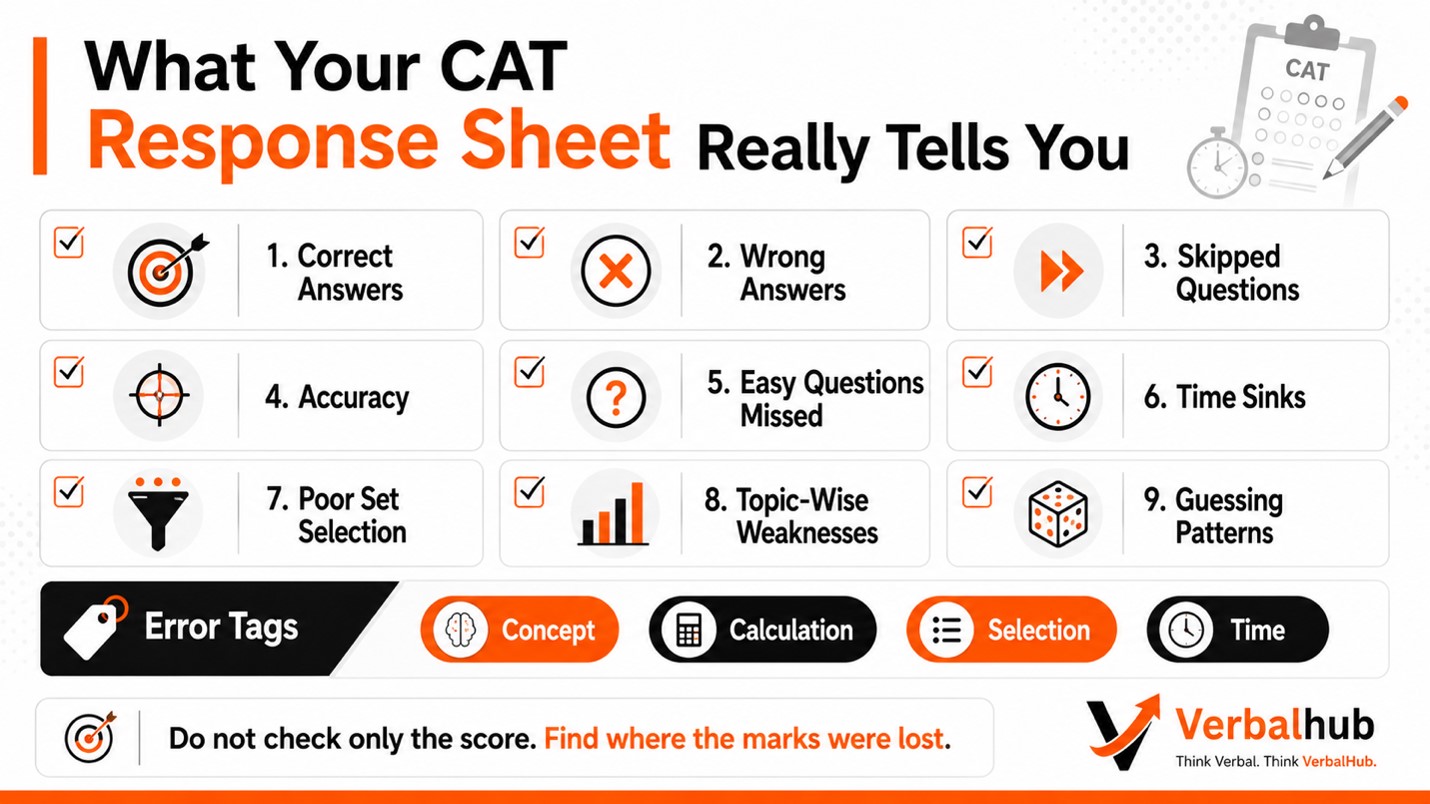
Most students check the total, feel happy or terrible, and close the tab. That is wasting the single most honest dataset you will ever get about your exam behaviour.
Your response sheet, read question by question, tells you:
- Correct answers — where your preparation actually paid off
- Wrong answers — and whether they were concept errors or careless slips
- Unattempted questions — genuine skips versus questions you never reached
- Accuracy — attempts converted to marks, per section
- Easy questions missed — the most painful and most fixable category
- Difficult questions solved — proof of strengths worth doubling down on
- Time sinks — clusters of wrong or blank answers right after a hard set usually mean time damage
- Set selection — did you commit to the wrong DILR set or RC passage?
- Topic-wise strengths and weaknesses — arithmetic fine, geometry leaking marks, and so on
- Guessing patterns — long streaks of wrong MCQs suggest desperate end-of-section guessing
- Objection candidates — questions where your answer looks defensible against the provisional key
Response-sheet analysis checklist:
- Mark every question C (correct), W (wrong) or U (unattempted).
- Tag each W as concept gap, calculation slip, misread, or bad guess.
- Compute accuracy per section: correct ÷ attempted.
- List every easy or moderate question you got wrong or skipped.
- Note which RC passages and DILR sets you chose, and whether better options existed.
- Flag any answer that conflicts with the provisional key and might merit an objection.
- Convert findings into a topic list for revision or retake planning.
Done calculating and not sure how to read the patterns? Share your response-sheet analysis with a VerbalHub mentor for a free review of where your marks actually leaked — section by section.
13. How Is CAT Percentile Predicted?
Until official results arrive, every percentile you see is a prediction. Here is what feeds a good CAT percentile predictor:
- Your raw score — the anchor of every estimate
- Sectional scores — because sectional distributions differ
- Your slot — the same score means different things in different slots
- Slot difficulty estimates — from expert reviews and attempt-rate data
- Number of response sheets collected — a predictor with 40,000 sheets knows the score distribution far better than one with 4,000
- Score distribution shape — where scores cluster decides how much one mark moves your percentile
- Past CAT trends — CAT 2024 and 2025 mappings act as priors
- Normalization assumptions — each tool models scaling slightly differently
This is also why predictions drift for a few days after the response sheet releases. Early estimates lean heavily on last year’s trends; as more sheets pour in, the model recalibrates to this year’s reality. A percentile that moves from 96.8 to 97.4 over three days is normal behaviour, not a glitch.
Quick Answer: How is CAT percentile calculated? Percentile reflects the percentage of candidates who scored below you. Officially, IIMs rank all candidates by scaled score and compute percentile from that rank — roughly (candidates below you ÷ total candidates) × 100. Predictors estimate this before results using your raw score, slot, and score distributions from collected response sheets.
14. How Accurate Is a CAT Score and Percentile Calculator?
Honest answer: accuracy depends on which number you are looking at. Break it down layer by layer:
- Raw score: near-perfect, provided the answer key loaded in the tool matches the official provisional key. This is pure arithmetic.
- Section-wise scores: equally reliable, same reason.
- Scaled-score estimate: approximate. Normalization is done by IIMs with full data; tools can only model it.
- Overall percentile estimate: usually lands within about a percentile point at the top ranges once enough data is in — based on how recent-year predictions have compared with actual results — but this is an observed pattern, not a promise.
- Rank estimate: rougher, since exact candidate counts per score band are unknown before results.
- IIM-call prediction: the least certain layer, because calls depend on composite scores and profiles, not percentile alone.
Why do estimates vary at all?
- The provisional answer key changes — accepted objections can add or drop questions
- Incomplete datasets — predictions from early, small samples are shakier
- Duplicate uploads — the same enthusiastic student uploading five times skews distributions if not cleaned
- Slot assumptions — misjudging a slot’s difficulty shifts everyone in it
- Final normalization — IIMs’ actual scaling can differ from every model
- Different predictor models — each tool weighs history and current data its own way
Bottom line: trust the raw score fully, treat the percentile as a good estimate with a margin of roughly ±0.5 to ±1 percentile at the top end, and treat call predictions as indicative scenarios. No calculator on the internet is 100 percent accurate, and anyone claiming otherwise is selling something.
Quick Answer: How accurate is a CAT score calculator? The raw score it computes from your response sheet is exact, as long as the answer key is current. The percentile is an estimate that typically settles close to the final figure as more response sheets are analysed, but it can shift with answer-key revisions and final normalization. Treat predictions as a reliable range, never a guarantee.
Key Takeaway: Certainty decreases as you move down the chain: raw score → scaled score → percentile → rank → college calls. Make decisions with the certain layers and keep contingency plans for the estimated ones.
15. Why Do Different CAT Calculators Show Different Percentiles?
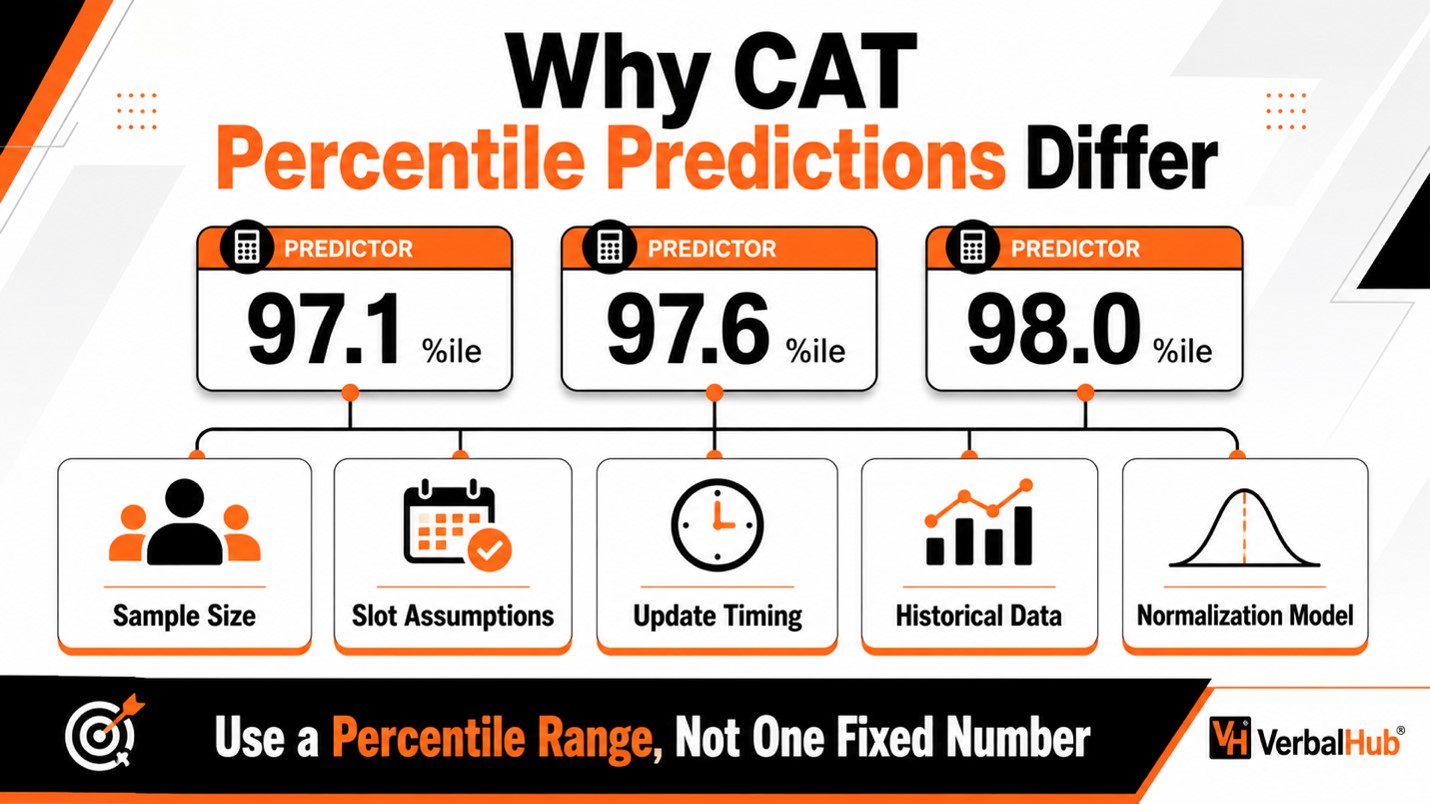
After the exam, most students paste their link into more than one tool — the VerbalHub CAT score calculator, and a few others. Then panic sets in when one says 97.2 and another says 98.1.
Relax. The difference is expected, and here is where it comes from:
| Reason | How It Changes the Prediction |
|---|---|
| Sample size | A tool with more response sheets maps the score distribution more precisely; small samples wobble |
| Slot assumption | If one tool rates your slot tougher, it awards a higher percentile for the same raw score |
| Update timing | A tool refreshed yesterday reflects newer data than one updated on day one |
| Historical model | Each platform anchors on its own past-year data and scaling assumptions |
| Data quality | Tools that de-duplicate uploads and filter junk entries produce steadier estimates |
| Normalization estimate | Every tool approximates IIM scaling differently, shifting scaled-score guesses by a few marks |
Notice what is not on the list: your raw score. Every properly built tool should show the same raw marks, because that part is mechanical. If two tools disagree on your raw score, one of them is using an outdated answer key — check the dates.
How to interpret a spread of predictions: take all the estimates, treat the lowest and highest as your realistic band, and plan for the middle. If tools say 96.9, 97.5 and 98.2, plan your college list for “around 97, possibly 98”. That single mindset shift removes most of the post-exam anxiety.
16. What Is a CAT Composite Score?

Here is where many aspirants get a shock: IIMs do not shortlist purely on CAT percentile. They compute a composite score for each applicant.
Quick recap of the ladder:
- CAT raw score: marks from your answers
- CAT scaled score: raw score after normalization
- CAT percentile: your rank based on the scaled score
- IIM composite score: a weighted blend of your CAT performance and your profile, used to shortlist candidates for interviews
- Final selection score: a second weighted blend, computed after interviews, that decides admission offers
What goes into a composite score? Depending on the IIM, some mix of:
- CAT overall (and sometimes sectional) performance
- Class 10 marks
- Class 12 marks
- Graduation marks
- Work experience (usually with caps and quality considerations)
- Academic diversity — points for non-engineering backgrounds at several IIMs
- Gender diversity — points for women candidates at several IIMs
- Professional qualifications such as CA, CS or ICWA at some institutes
- WAT or AWT — written ability test performance (final stage)
- Personal interview performance (final stage)
This is why a composite score calculator for IIM shortlists asks about your board marks and background, not just your percentile.
Quick Answer: What is an IIM composite score? It is the weighted total each IIM computes to shortlist and finally select candidates. CAT performance forms the largest chunk, but Class 10, Class 12 and graduation marks, work experience, academic and gender diversity, and later WAT and interview scores also carry weight. Each IIM publishes its own formula, and weights can change every admission cycle.
17. How Does an IIM Composite Score Calculator Work?
A CAT composite score calculator takes your CAT percentile plus your profile details and applies each IIM’s published admission formula to estimate your shortlisting chances. But three warnings before you trust any output.
First, every IIM has its own formula. IIM Ahmedabad’s approach (with its application-rating system for academics) differs completely from IIM Calcutta’s point-based structure or IIM Bangalore’s weight distribution.
Second, there are usually two separate composite scores: one for shortlisting (pre-interview) and one for final selection (post-interview, where PI and WAT weight enters). Confusing the two produces nonsense predictions.
Third, formulas change by admission cycle. A calculator quietly running the 2024 formula for the 2026 cycle will mislead you. Never combine weightages from different years.
The broad components across major IIMs look like this:
- CAT weight at shortlisting: historically the dominant component at most IIMs — often somewhere between 40 and 70 percent at the shortlist stage in recent policies, though it varies widely
- Academic-profile weight: Class 10, 12 and graduation marks
- Work-experience weight: capped points, often peaking around 2–3 years
- Diversity weight: academic and/or gender diversity points at several institutes
- Final-stage weight: PI (and WAT where used) typically becomes a large chunk — sometimes the largest — at final selection
| IIM | CAT Weight (Shortlist) | Academics | Work-Ex | Diversity | PI/WAT (Final) | Policy Year |
|---|---|---|---|---|---|---|
| IIM Ahmedabad | Refer to official policy | Refer to official policy | Refer to official policy | Refer to official policy | Refer to official policy | 2026–28 |
| IIM Bangalore | Refer to official policy | Significant | Considered | Considered | Significant | 2026–28 |
| IIM Calcutta | Refer to official policy | Considered | Limited | Considered | Significant | 2026–28 |
| IIM Lucknow | Refer to official policy | Considered | Considered | Considered | Significant | 2026–28 |
| IIM Kozhikode | Refer to official policy | Considered | Considered | Considered | Significant | 2026–28 |
| IIM Indore | Refer to official policy | Considered | Limited | Considered | Significant | 2026–28 |
| IIM Mumbai | Refer to official policy | Considered | Considered | Considered | Significant | 2026–28 |
| IIM Shillong | Refer to official policy | Considered | Considered | Considered | Significant | 2026–28 |
| CAP IIMs (newer IIMs, common process) | Refer to official policy | Considered | Considered | Considered | Significant | 2026–28 |
We have deliberately not printed exact numbers here, because each IIM’s admission-policy PDF for the 2026–28 cycle is the only document that counts, and a single stale figure can wreck a shortlisting estimate. Download the policy from each IIM’s official admissions page before running any composite calculation, and treat every third-party composite tool as a rough screen.
18. Why a 99 Percentile Does Not Guarantee an IIM Call
Every year, students with 99+ percentiles receive zero calls from the old IIMs, while others at 97 collect several. Neither is a fluke. Here is the mechanics:
- Sectional cutoffs: miss one section’s bar and the overall percentile becomes irrelevant at that IIM.
- Category criteria: cutoffs and composite thresholds differ across General, EWS, OBC-NC, SC, ST and PwD categories, per each institute’s official policy.
- Academic history: low Class 10 or 12 percentages drag down composite scores at academics-heavy IIMs, and no CAT score fully compensates there.
- Graduation stream: at IIMs awarding academic-diversity points, an engineer competes in the most crowded lane.
- Work experience: some formulas reward it; a fresher and a three-year professional with identical percentiles get different composites.
- Diversity points: gender-diversity marks at several IIMs shift shortlists meaningfully.
- Candidate pool: you are compared with everyone applying that year, and pools shift.
- Institute-specific formulas: the same profile can clear IIM Calcutta’s math and miss IIM Ahmedabad’s, or vice versa.
The same logic works in reverse, and this is the hopeful part: candidates at 95–98 percentile with strong, consistent academics, useful work experience, or diversity points routinely receive calls that pure-percentile logic would not predict. The composite system cuts both ways.
So read your 99 with pride but also with context — and read a 96 with more optimism than the forums will give you.
19. CAT Score to IIM and B-School Call Predictor

An IIM call predictor maps your percentile band to realistic college categories. Here are practical bands, based on recent shortlisting trends. None of this is a guarantee — profiles, categories and sectional scores move individual outcomes.
99 percentile and above. Top IIMs (Ahmedabad, Bangalore, Calcutta) come into play, alongside FMS Delhi, and the strongest programmes at Lucknow, Kozhikode and Indore. Sectional cutoffs must all be cleared, and academics still matter heavily at ABC. Applications to FMS, XLRI (via XAT) and others are separate — CAT alone does not apply anywhere except IIMs’ common process.
95–99 percentile. Strong zone for IIM Lucknow, Kozhikode, Indore, Mumbai and Shillong (profile depending), plus MDI Gurgaon, SPJIMR (which also weighs profile heavily), IITs’ management schools and top CAP-IIM calls. Sectional consistency is the make-or-break factor here.
90–95 percentile. Newer IIMs through CAP, IMT Ghaziabad, XIMB, TAPMI, GIM, IMI Delhi, IITs’ MBA programmes at the lower end of the band. Fill every application form on time — deadlines for many of these close before CAT results arrive.
85–90 percentile. Solid non-IIM schools: K J Somaiya, GLIM, FORE, LIBA, BIMTECH and similar. Profile, interviews and consistency across sections carry more relative weight in this band.
80–85 percentile. Respectable regional and specialised B-schools accept this range. Research placements and fees carefully — return on investment varies widely here.
Below 80 percentile. Options exist, but this is the band where a serious retake conversation makes sense, especially if your mocks were scoring higher than the real exam.
College-shortlisting checklist:
- Confirm you clear each college’s sectional cutoffs, not just overall.
- Check whether the college needs a separate application, and its deadline.
- Run your profile through each IIM’s official composite criteria.
- Build three lists: dream, realistic, safe — at least three colleges each.
- Note which schools accept XAT, SNAP or CMAT as backups.
- Verify fees, placements and location before applying, not after converting.
20. What Should You Do After Calculating Your CAT Score?
The calculator gave you a number. Now what? Here is the action plan, in order:
- Verify the score. Do one manual pass against the official answer key to confirm the tool’s raw score.
- Check sectional cutoffs. Compare your three sectional estimates against target-college requirements before dreaming or despairing.
- Review doubtful answers. Flag every question where you disagree with the provisional key — the objection window is short.
- Compare multiple percentile estimates. Two or three predictors give you a realistic band instead of a single misleading number.
- Check college deadlines. Non-IIM applications (and CAP registrations) have hard deadlines, several before results day.
- Build dream, realistic and safe lists. Percentile band + profile + composite criteria.
- Start WAT, GD and PI preparation. Shortlists arrive fast after results; interview prep started in December beats interview prep started after the shortlist.
- Keep preparing for XAT and SNAP. XAT typically falls in early January — your CAT preparation transfers almost entirely.
- Take the retake decision consciously. If the score badly trails your mock average, analyse why before deciding anything.
- Analyse the response sheet. Whatever the number, the sheet is a study document. Mine it.
Key Takeaway: The score is a checkpoint, not a verdict. The week after the response sheet releases is for verification, objections, applications and interview prep — in that order. Celebration and mourning can both wait for the official scorecard.
21. CAT Answer-Key Objection Process
CAT gives you a formal route to challenge the provisional answer key. Here is how the process has worked in recent cycles; confirm CAT 2026 specifics in the official notice on iimcat.ac.in.
The sequence: IIMs release the candidate response sheet and provisional answer key a few days after the exam (in CAT 2025, this happened on 4 December, four days after the 30 November exam). An objection window of a few days opens on the candidate portal. You select the question, state your claimed answer, attach supporting evidence (a standard textbook reference or clear solution), and pay a non-refundable fee per challenged question — in recent CAT cycles this fee has been ₹1,200 per question, but verify the CAT 2026 amount in the official notification before paying.
A panel reviews all objections. The final answer key is then published, usually alongside or just before results. If an objection is accepted, the correction applies to all candidates, not just the person who raised it — scores genuinely change some years when a question is dropped or an answer revised.
When not to object: when your only argument is “the question felt unfair”, when you have no citable source, or when the expected gain is 3 marks that will not change your college band. The fee is non-refundable either way.
Common objection mistakes:
- Objecting without documentary proof
- Missing the deadline (the window is genuinely short — often 3–4 days)
- Challenging a question just because it was difficult
- Citing coaching-institute answer keys as “evidence” instead of standard references
- Not saving the payment confirmation and objection acknowledgement
Expert Tip: Before paying for an objection, run the maths. If the disputed question flips from wrong to correct, you gain 4 marks (from −1 to +3 on an MCQ). Ask whether 4 marks moves you across a cutoff you actually care about. If yes, and your evidence is solid, object. If no, save the fee.
22. How to Analyse the CAT Response Sheet for a Retake
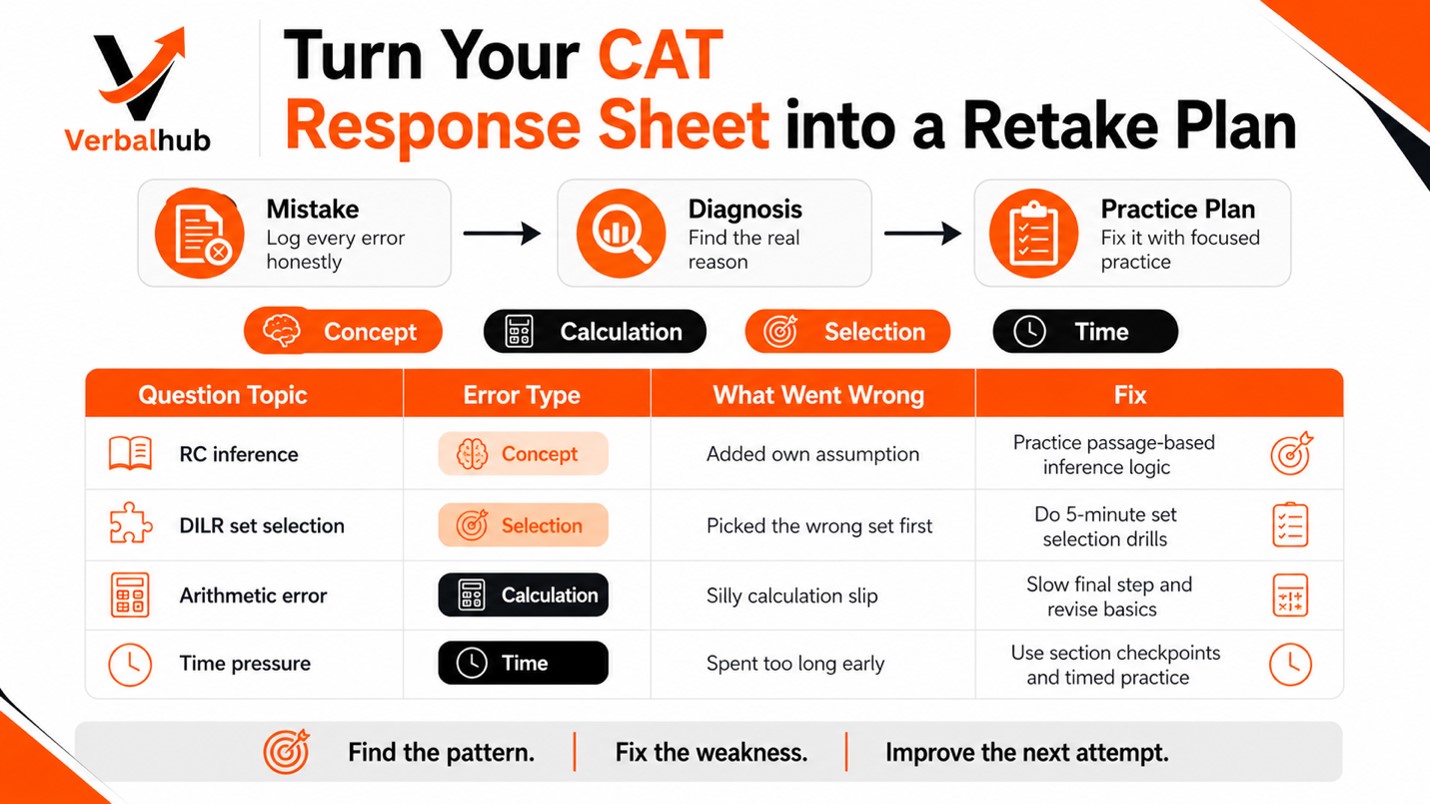
If a retake is on the table, your response sheet is the best diagnostic report money cannot buy. Analyse it section by section.
VARC
- RC accuracy: how many RC answers were wrong versus attempted? Below ~70 percent accuracy means comprehension or option-elimination gaps.
- Wrong inferences: did you pick answers that added your own assumptions to the passage?
- Extreme-option traps: count wrong answers containing words like “always”, “never”, “only” — a classic leak.
- Para-summary mistakes: were your wrong summaries too narrow, too broad, or subtly distorted?
- Question selection: did you attempt a nightmarish passage while an easier one sat untouched?
- Time per passage: four wrong answers clustered in the last passage usually means the first two ate your clock.
DILR
- Set selection: which sets did you open first, and were they the right ones in hindsight?
- Sunk-cost damage: did one stubborn set consume 15+ minutes for zero or partial marks?
- Calculation errors: right logic, wrong arithmetic — fixable with drills.
- Incomplete sets: three of four questions right in a set means you understood it; find what stopped the fourth.
- Missed easy sets: the most expensive mistake in DILR is the friendly set you never opened.
QA
- Topic gaps: cluster your wrong and skipped questions by topic — arithmetic, algebra, geometry, numbers, modern maths.
- Formula gaps: wrong answers where you knew the approach but blanked on the formula.
- Slow calculation: correct but presumably time-heavy solutions squeeze out attempts elsewhere.
- Avoidable errors: sign slips, misread units, answering a different question than asked.
- Question selection: did you burn minutes on the hardest 3 questions while easy ones went blank?
- Time pressure pattern: blanks concentrated in the last 10 minutes point to pacing, not knowledge.
Now convert all of this into a CAT error log — a simple spreadsheet with columns: question topic, error type (concept / calculation / selection / time), what the fix is, and a revision date. Retakers who keep an error log improve systematically; retakers who just “study harder” repeat the same exam.
| Response-Sheet Finding | Study-Plan Action |
|---|---|
| Low RC accuracy | Daily RC practice with answer-justification, not just answer-checking |
| Wrong DILR set choices | Set-selection drills: 5 minutes to rank 4 sets before solving |
| QA topic gaps | Concept rebuild for flagged topics, then timed topic tests |
| Careless calculation errors | Slow-down protocol on the final step + mental-math drills |
| Blanks from time pressure | Sectional tests with hard checkpoints at 15 and 30 minutes |
| Guess streaks at section end | Fixed rule: no blind MCQ guessing; the −1 is real |
23. Can You Prepare for CAT in Three Months?
Direct answer: yes, three months is enough to prepare seriously for CAT — if your effort is structured, consistent and mock-driven. It is not enough for a casual, weekends-only attempt starting from absolute zero.
Who realistically makes big progress in 90 days?
- Students with basic foundations — school-level maths intact and comfortable reading English
- Retakers — the syllabus is known; the job is fixing specific leaks, which is exactly a 90-day task
- Working professionals — 2.5 focused hours daily plus longer weekends adds up to 250+ quality hours
- College students — flexible schedules make 3–4 daily hours very achievable
- Late starters with consistency — a disciplined September start has produced 95+ percentiles every single year
Who should think about a longer runway? Someone rebuilding maths from Class 8 level, someone who reads English rarely and slowly, or someone whose calendar genuinely cannot spare 15 hours a week. For them, targeting the next cycle with a 6–9 month plan is smarter than a rushed attempt.
The honest pattern from years of mentoring: three-month success is less about starting level and more about whether the 90 days are planned or improvised.
Quick Answer: Is three months enough to prepare for CAT? Yes, for candidates with basic quant and reading foundations who can study 2.5 to 5 focused hours daily. A structured 90-day plan — one month of concepts, one month of application and sectional tests, one month of intensive mocks and analysis — has repeatedly produced 90 to 99 percentile results. Absolute beginners with very limited daily time usually need longer.
24. Three-Month CAT Preparation Plan
Here is a 12-week structure that VerbalHub mentors use with late starters. Adjust intensity to your starting level, but keep the phase logic intact.
Month 1: Build concepts and find weak areas
Start with a diagnostic mock in week 1 — not to score, but to map your starting point. Then rebuild the highest-weight foundations: arithmetic (percentages, ratios, averages, time-speed-distance, time and work) and algebra basics in QA; daily reading comprehension with two passages a day; the main verbal question types (para summary, para completion, odd sentence); and basic DILR sets — arrangements, tables, simple caselets. Close every week with topic tests on that week’s material.
Month 2: Improve application, speed and selection
Shift from learning to applying. Mix topics in practice so your brain stops getting chapter-wise hints. Add sectional tests twice a week per section, and move to two full mocks per week with same-day analysis. Start deliberate set-selection practice in DILR and passage-selection in VARC. Revise your error log every Sunday. The goal of month 2 is accuracy first, speed second.
Month 3: Shift to mock-driven preparation
Now the mock is the syllabus. Take two to three mocks per week, each followed by a 2–3 hour deep analysis session — the analysis matters more than the attempt. Keep a running formula and vocab revision cycle. Sharpen RC and DILR selection into a 3–5 minute scanning routine. Practise in your actual exam-slot timing so your body clock cooperates. Finalise your exam strategy — attempt order within sections, guessing rules, checkpoint timings — two weeks before the exam and stop experimenting.
| Week | VARC Focus | DILR Focus | QA Focus | Mock Plan |
|---|---|---|---|---|
| 1 | Daily RC habit | Arrangements | Percentages, ratios | 1 diagnostic mock |
| 2 | RC + para summary | Tables, caselets | Averages, mixtures | Topic tests |
| 3 | Odd sentence, para completion | Grids, puzzles | TSD, time & work | 1 mock |
| 4 | RC accuracy drills | Games & tournaments | Algebra basics | 1 mock + review |
| 5 | Mixed VARC sets | Mixed easy sets | Equations, inequalities | 2 mocks |
| 6 | Timed RC (8 min/passage) | Set selection drills | Numbers, functions | 2 mocks |
| 7 | Sectional tests | Sectional tests | Geometry core | 2 mocks |
| 8 | Error-log revision | Partial-solve strategy | Modern maths picks | 2 mocks |
| 9 | Selection routine | 2 sets in 40 min target | Full-topic mixed sets | 3 mocks |
| 10 | Weak-type repair | Speed + accuracy balance | Formula revision | 3 mocks |
| 11 | Exam-slot practice | Exam-slot practice | Exam-slot practice | 2–3 mocks |
| 12 | Light revision only | Light revision only | Light revision only | 1–2 easy mocks |
CTA: Want this 12-week plan customised to your diagnostic mock instead of a generic template? VerbalHub’s mentors build personal week-by-week plans as part of the CAT Crash Course — share your latest mock scorecard and get a plan that targets your actual weak areas. ## 25. Daily CAT Study Plan for Three Months
Different lives need different schedules. Pick your lane and stay in it.
25. Daily CAT Study Plan for Three Months
Different lives need different schedules. Pick your lane and stay in it.
Working professionals (2–3 hours on weekdays, more on weekends)
| Time | Weekday Plan |
|---|---|
| Morning (45–60 min) | One RC passage + 10 QA questions before work |
| Commute / breaks | Vocab, formulas, or one short DILR set on the phone |
| Evening (90 min) | Alternate days: QA concepts / DILR sets / VARC practice |
| Weekend Day 1 | Full mock in exam-slot timing (2 hrs) + full analysis (2–3 hrs) |
| Weekend Day 2 | Error-log revision + weak-topic practice (3–4 hrs) |
College students (3–4 hours most days)
| Time | Daily Plan |
|---|---|
| Slot 1 (75 min) | QA: one topic’s concepts + practice |
| Slot 2 (60 min) | VARC: 2 RC passages + one verbal question type |
| Slot 3 (60 min) | DILR: 2 sets, timed |
| Twice a week | Replace slots with a full mock + same-day analysis |
| Sunday | Error log, formula sheet, sectional test |
Full-time aspirants (5–6 focused hours, no burnout heroics)
| Time | Daily Plan |
|---|---|
| Morning (2 hrs) | QA: concept + timed practice |
| Midday (1.5 hrs) | VARC: 3 RC passages + verbal ability |
| Afternoon (1.5 hrs) | DILR: 3 sets with selection practice |
| Evening (1 hr) | Error log + revision + light reading |
| 3 days a week | Swap morning block for a full mock; analysis in the afternoon |
Non-negotiables in every schedule: one full rest evening a week, mock analysis time protected as fiercely as mock time, and sleep. A tired brain reads RC passages twice and still misses the point.
26. How Many CAT Mocks Should You Take in Three Months?
There is no magic number, because the right count depends on where you start. As an indicative range: 18 to 30 full mocks over three months — roughly one to two per week in month 1–2, rising to two or three per week in the final month — plus 20–30 sectional tests along the way.
What matters far more than the count:
- Analysis: a mock without 2–3 hours of analysis is entertainment, not preparation
- Sectional tests: they repair specific sections faster than full mocks can
- Error logs: every mock should add rows to the log, and Sundays should clear them
- Requeuing questions: re-solve last week’s wrong questions cold; if they fail again, the concept isn’t fixed
- Tracking three numbers: attempts, accuracy and time per section, mock after mock — trends beat single scores
Common mock mistakes:
- Taking daily mocks with zero analysis — score plateaus are almost always analysis deficits
- Chasing the score instead of the process, then panicking over one bad mock
- Changing strategy after every single mock — give any strategy at least three mocks
- Ignoring sectional performance because the overall number looks fine
- Taking only easy mocks to feel good — comfort mocks build false confidence
27. VerbalHub CAT Crash Course
If you are starting late or restarting after a gap, the VerbalHub CAT Crash Course is built for exactly that situation: maximum syllabus coverage of high-yield topics in a compressed, guided window.
It fits students who are:
- Late starters with 2–4 months on the clock
- Returning after a gap — syllabus half-remembered, confidence low
- Aspirants who have material everywhere but no structured plan
- Students who haven’t completed the syllabus and need prioritisation, not more PDFs
- Working professionals who need the plan to respect a job
What the course includes:
- Live classes on high-priority CAT topics, with recordings for missed sessions
- Section-wise preparation tracks for VARC, DILR and QA
- Topic tests and sectional tests built into the schedule
- Full-length mocks with structured mock-analysis sessions
- Doubt support so problems get cleared in days, not weeks
- Personal study planning — your week mapped to your diagnostic, not a generic calendar
- Evening and weekend batch options for working professionals
What we will not promise: a guaranteed percentile. Nobody can. What the crash course does is remove the two biggest late-starter killers — wrong prioritisation and unanalysed practice.
28. VerbalHub CAT Fast Track Course
The Fast Track Course is for a different student: someone who already knows the basics but is stuck. The syllabus is done, the mocks are happening, and the score refuses to move past 75 or 85 percentile.
Choose it if you are:
- Clear on fundamentals but leaking marks in application
- Plateaued at a mock score for a month or more
- A retaker whose response-sheet analysis shows selection and speed issues, not concept gaps
- Chasing speed and accuracy rather than coverage
- Preparing within a short, focused window
The course concentrates on:
- High-frequency topic mastery — the 20 percent of topics producing 80 percent of marks
- Question selection — training the skill of choosing the right 40 questions, which separates 85 from 99
- Timed practice in exam-pressure conditions
- Deep mock analysis with a mentor, not alone
- Sectional strategy tuned to your strong and weak sections
- Accuracy protocols to cut negative marks
- Personal feedback on every mock cycle
Think of it as coaching for the last mile — the difference between knowing CAT content and playing the CAT game well.
29. VerbalHub CAT Short-Term Course
Sometimes you don’t need a full programme. You need surgical help. The CAT Short-Term Course is targeted support for a specific gap in a limited time.
It works well for:
- Students with one weak section — say a 95-percentile aspirant whose DILR keeps sinking the shortlist
- Working professionals who can commit to a focused module but not a long course
- Retakers whose error log points to two or three specific problem areas
- Candidates needing final-phase revision and strategy polishing before the exam
- Anyone who cannot join a long course for time or budget reasons
The format is flexible by design: pick a section-specific track (VARC, DILR or QA), get a compact revision plan, mock-based improvement cycles, and mentor access for doubts and strategy. Short, sharp and specific.
30. CAT Crash Course vs Fast Track Course vs Short-Term Course
| Factor | CAT Crash Course | CAT Fast Track Course | CAT Short-Term Course |
|---|---|---|---|
| Best suited for | Late starters, restarters | Plateaued scorers, retakers | One-section or final-phase needs |
| Starting level | Beginner to intermediate | Basics already in place | Varies; gap-specific |
| Main focus | Full high-yield coverage | Speed, accuracy, selection | Targeted repair or revision |
| Syllabus coverage | Complete priority syllabus | Assumes coverage; refines it | Selected sections/topics only |
| Mock support | Full mocks + analysis | Intensive mock cycles + feedback | Mock-based improvement in chosen area |
| Personal guidance | Study plan + doubt support | Mentor feedback each cycle | Focused mentor access |
| Ideal preparation window | 2–4 months | 6–10 weeks | 3–8 weeks |
How to choose: be brutally honest about your starting point. If a diagnostic mock feels like a foreign language, take the Crash Course. If you score decently but the number hasn’t moved in weeks, Fast Track. If two sections are fine and one keeps failing you — or you just need the last month engineered well — Short-Term. Joining a short, refinement-focused course when you actually need foundations wastes both money and the calendar.
Still torn between the three? Send VerbalHub your last two mock scorecards or your CAT response-sheet analysis. A mentor will tell you honestly which course fits — including, sometimes, that you don’t need one yet.
31. Common Mistakes Students Make After Using a CAT Score Calculator
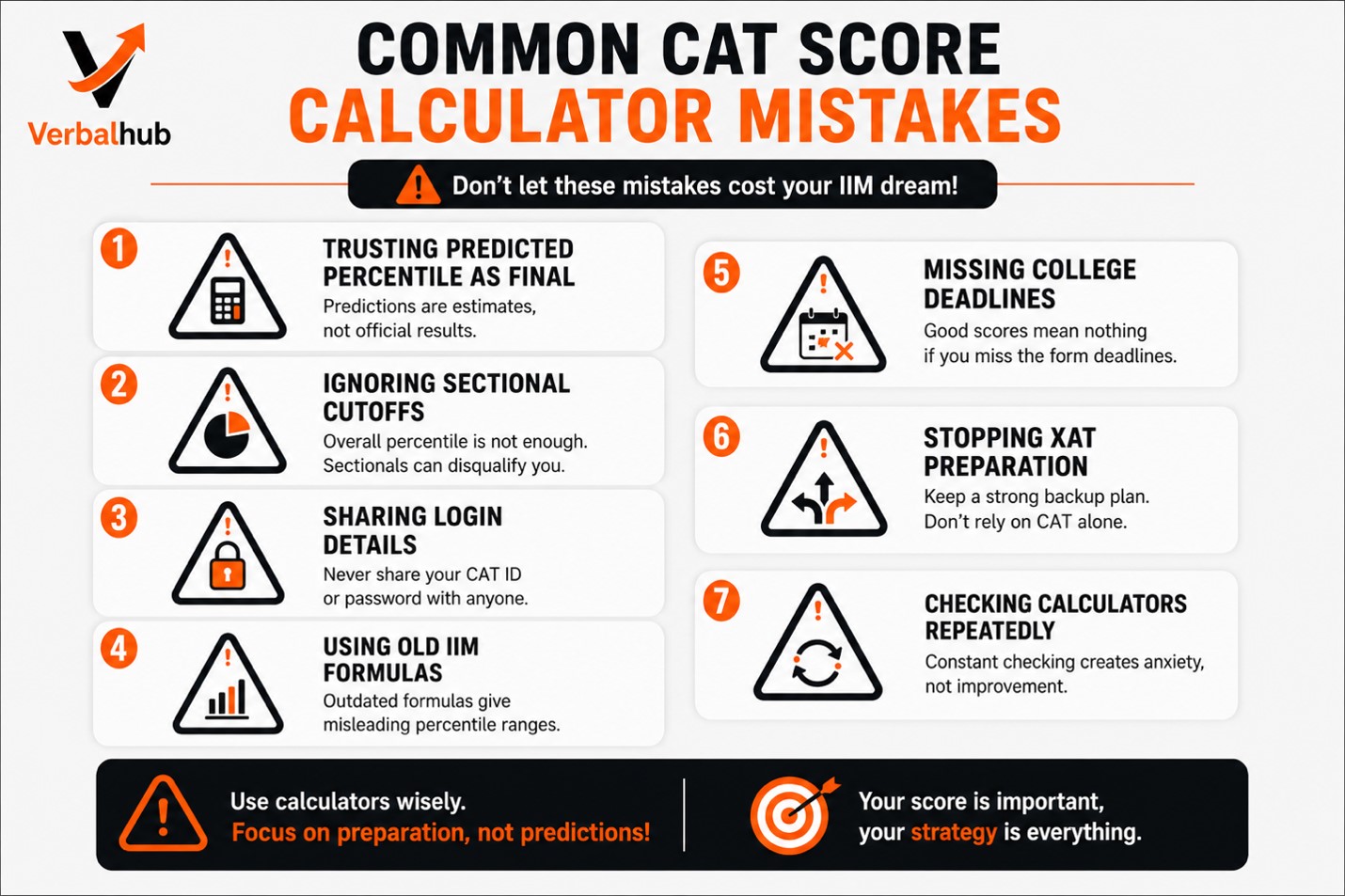
Watch for these — every one of them shows up every December:
- Treating the predicted percentile as final. It is an estimate that moves with data and answer-key changes.
- Ignoring sectional cutoffs. The overall number means little if one section misses the bar.
- Refreshing calculators every hour. Daily checks are plenty; hourly checks are anxiety with extra steps.
- Stopping preparation for XAT and SNAP. XAT lands weeks after CAT; those weeks are gold.
- Delaying GDPI preparation. Shortlists follow results quickly; interview skills need runway.
- Missing non-IIM deadlines. MDI, SPJIMR, IMT and others close applications on their own calendars.
- Assuming 99 percentile equals an IIM call. Composite scores and sectional cutoffs say otherwise.
- Using last year’s composite formula. IIM weightages change by cycle; always pull the current policy.
- Uploading the wrong link. A login-page URL or someone else’s forwarded link produces garbage output.
- Sharing login credentials. No legitimate calculator needs your CAT password. Ever.
- Panicking over small differences between tools. A 0.5 percentile spread across predictors is normal.
- Looking only at the overall score. The section-wise and question-wise story is where the learning lives.
32. Expert Tips for Using a CAT Score Calculator Wisely
- Save everything on day one. Response-sheet PDF, screenshots, answer key. Windows close fast.
- Verify doubtful answers manually against the official key before trusting or objecting.
- Work with a prediction range, not a single number — plan for the lower bound, hope for the upper.
- Read sectional scores first. They decide shortlists before the overall percentile does.
- Re-check after the final answer key. Accepted objections shift everyone’s scores.
- Put every college deadline in your phone calendar the same day you calculate your score.
- Start interview prep at 90+ predicted percentile. Waiting for the official scorecard wastes a month.
- Treat the response sheet as a textbook about yourself. It’s the most personalised study material you own.
- Recalculate after a few days. Predictions stabilise as calculators gather more response sheets.
33. Key Takeaways
- Your raw score can be calculated exactly today from the response sheet and provisional answer key — that part is arithmetic, not prediction.
- Scaled score and percentile remain estimates until IIMs publish official results; build a margin into every plan.
- Sectional performance decides shortlists as much as the overall number — read VARC, DILR and QA percentiles first.
- Different calculators will differ slightly. Sample sizes, slot assumptions and models vary; use the spread as your planning range.
- IIM composite scores blend CAT with academics, work experience and diversity — a percentile alone predicts calls poorly.
- The response sheet is a retake roadmap. Question-wise analysis converts a disappointing score into next year’s strategy.
- Three months is genuinely enough for structured, consistent, mock-driven preparation — the plan matters more than the calendar.
- The right short course depends on your starting level: Crash for coverage, Fast Track for refinement, Short-Term for targeted repair.
FAQs
Log in at iimcat.ac.in, open your candidate response sheet, and compare each answer with the official answer key for your slot. Count correct answers, wrong MCQs, wrong TITA answers and blanks. Apply the formula: (correct × 3) − (wrong MCQs × 1). Wrong TITA answers and unattempted questions carry no penalty. Do this section-wise for VARC, DILR and QA, then add them up. Or paste your response-sheet link into the VerbalHub CAT score calculator and get the same breakdown in under a minute.
The raw score is exact, provided the tool uses the current official answer key — that part is pure arithmetic. The percentile is an estimate built from collected response sheets, slot-difficulty assessments and past trends. In recent cycles, well-fed predictors have typically landed close to final percentiles, but answer-key revisions and final normalization can still shift results. Treat the raw score as fact and the percentile as a reliable range, not a promise.
IIMs rank all candidates by scaled score and compute the percentage of test takers who scored below you. If roughly three lakh candidates appear and 2.97 lakh score below you, your percentile is about 99. Percentiles are calculated for each section and overall, using scaled (normalized) scores rather than raw marks, and are rounded to two decimal places on the official scorecard.
The raw score is what your answers directly earn under the +3/−1 scheme — you can compute it today from your response sheet. The scaled score is the raw score after normalization, which adjusts for difficulty differences across the three exam slots. Your official scorecard shows scaled scores, and they can sit a few marks above or below your raw score depending on your slot’s relative difficulty.
Each tool works with its own pool of uploaded response sheets, its own slot-difficulty assumptions, its own historical model and its own update schedule. Small differences in any of these shift the percentile estimate by a few decimal points — which is why one tool may say 97.4 and another 98.1 for the same score. Raw scores should match across tools; percentiles will differ mildly. Use the full spread as your planning range.
It is the weighted score each IIM computes to shortlist candidates and later to make final offers. CAT performance is the biggest component, but Class 10, Class 12 and graduation marks, work experience, academic and gender diversity, and eventually WAT and interview performance also carry weight. Every IIM publishes its own formula in its admission policy, and the weightages can change each cycle — so always check the current official document.
No. You must also clear sectional cutoffs in all three sections, and your composite score — which includes academics, work experience and diversity components — must beat the institute’s shortlisting bar for your category. Candidates at 99+ with weak Class 12 marks sometimes miss calls from academics-heavy IIMs, while candidates at 96–98 with strong, balanced profiles receive them. Percentile opens the door; the composite score decides who walks through.
Yes, for candidates with basic quant and English foundations who can commit 2.5 to 5 focused hours daily. A structured plan — month one for concepts, month two for application and sectional tests, month three for intensive mocks with deep analysis — has repeatedly produced 90 to 99 percentile outcomes. Complete beginners with very limited daily time should consider a longer runway or a structured programme like a CAT crash course to compress the learning curve.
Yes. If the review panel accepts an objection, the correction is applied to all candidates — an answer may be revised or a question dropped, and scores are recalculated before the final result. This is why percentile predictions made on the provisional key can shift slightly after the final answer key. Save your objection receipts, and recheck your calculation once the final key is published.
35. Conclusion
A CAT score calculator response sheet tool does one thing perfectly and two things approximately. It computes your raw marks exactly, the moment your response sheet and the answer key exist. It then estimates your percentile and your likely college range — well, but never with certainty, because normalization and three lakh other candidates have a say.
Use it accordingly. Trust the raw score. Plan with the percentile range. Check sectional numbers before the overall one. And remember that IIM shortlists run on composite scores, so your profile matters alongside your percentile.
Most of all, treat the response sheet as more than a scoreboard. Read question by question, it tells you exactly where marks leaked — and that reading is what turns this attempt’s data into the next attempt’s strategy, or into a confident college shortlist right now.
Not sure what your CAT score means for your next step? Share your latest mock score or response-sheet analysis with VerbalHub. A mentor will help you identify your weak sections and decide honestly whether you need the CAT Crash Course, the CAT Fast Track Course, or a targeted CAT Short-Term Course — or simply a sharper self-study plan. CAT 2026 Preparation Strategy




Our Teachers

Dr. G Ravindra Babu
Quant Faculty
Ph. D in Mathematics Asian International University|| Mathematics Professor at Gitam University || Ex-Mathematics Professor SRM University Amaravathi || MBA in finance Acharya Bangalore B School || GMAT Quant 51, CAT Quant 99.58 %tile, GRE Quant 170 || 21 Different Teaching Certification || Believe in “Education is the mother of leadership”
view details

Dr. Rengarajan Parthasarathy
CAT Faculty
Ph. D in Mathematics from YCM University|| Mathematics Professor at Symbiosis International|| Author of Business Ethics || Ex-CAT Exam Syllabus Advisor in IIM || MBA & MPM from Symbiosis International (Deemed University) || College Topper in Mathematics in Ferguson College || Six Scholarships in Mathematics || 15 Years CAT Coaching, GMAT Coaching and GRE Coaching Experience|| UGC NET Qualified || GMAT Q51, V38 & CAT Q 99.31 & DILR 99.38 %tile, GRE Quant 170 || Believe in “Higher Education Shapes The World.”
view details

Dr. Nisha Tejpal
Verbal & AWA Faculty
Ph. D in English || Published a paper in English in ‘Research Journal of Philosophy and Social Sciences’ || MCA and B.Ed CCS University || A subject expert in Verbal Teaching || 10,000 Plus Essays Analysis || CTET and NET Qualified || More than 15 years of Experience || A writer, Author and Poet || Believe in “Think Beyond the Universe”
view details

Dhrithi Khattar
Verbal Faculty
A subject expert in Verbal Aptitude || More than 15 years of Experience || MBA in HR& Marketing & MA in Economics || Active Member of Hindu Alumni Association || Functional Member of Delhi ||Management Association (DMA) || Operational Member of All India Management Association (AIMA) ||The President of Key Club ||An active member of the French Club ||Gold Seal from California Scholarship Federation.
view details
M. U. Mir
DILR & Quant Faculty
A subject expert in Quantitative Aptitude Training || GMAT Q 51 & CAT DILR 99.75 %tile || GATE 2020 Qualified || M. Tech & B. Tech University Toper (1st Rank) || Awarded by Gov of Odisha, Bihar and J& K for the project Magnetic Floating Model || Ex-Quant Subject Expert in Arihant Publication || An Educationist and Social Worker || Believe in “Education is power”
view details

C. S. Rajawat
CAT Faculty
M. A in Mathematics CCS University|| M. Tech from SRM University || Visiting Mathematics Faculty CCS University ||Experience of 11 Years of CAT Coaching || District Topper in 10th & 12th || Best Teacher Awardee in 2021 & 2022 || CAT Quant 99.43 %tile || Discovered a new Theorem based on HCF in Math || Founder of C. S. Classes ||Believe in “Teaching and Training is an Art.”
view details

Dr. S.K. Singh
PTE/IELTS/CELPIP Expert
Ph. D. English Dr. B. R. Ambedkar University || Delhi & Center Government School Mentor || Founder of Entrepreneur & Learning Startup || IELTS & CELTA Certified from British Council || PTE Certified from Pearson...
view detailsRishabh Arora
PTE/IELTS/CELPIP Expert
MBA in HR International Institute of Management Sciences || PTE Certified from Pearson Test of English|| IELTS & CELTA Certified from British Council || BCA from Integral University || PTE 87 in 2017, IELTS 8.5 in 2018
view details
Jyoti Joshi
IELTS Trainer
Master in English (MA) and Bachelor in Education (B.Ed) || Certified Trainer || IELTS Speaking 9.0 Band holder || Believe in “Great teacher can inspire hope, ignite the imagination, and instill a love of learning”
view details
Surbhi Arora
IELTS / PTE Expert
English Language Expert || More than 3 years of Experience || M.A plus B. Ed Delhi University ||Author, Writer & Classical Singer|| Believe in “Language Language Learning & Teaching is Fun”
view details

Dilip Kumar Rathore
Quant Trainer
A business developer and genius in mathematics || Highly experienced || Master in Maths || well-verse in IT || Believe in “The art of teaching is the art of assisting discover”
view details

Imaam Hasan
Communication Expert
Master in English || Journalist and writer || Certified IELTS & PTE Trainer || A social educater and influencer || Believe in “Education is the movement from darkness to light”
view details