GMAT Study Plan 2026 for Working Professionals: Smart GMAT Focus Edition Hacks to Score 705+

TL;DR — Executive Summary
You do not need 4 hours a day. You need a smarter system.
This guide builds a complete GMAT study plan 2026 engineered for ambitious corporate professionals. If you work 40+ hours a week, manage unpredictable deadlines, and still want a 705+ on the GMAT Focus Edition — this is your roadmap.
What you will find inside:
- A micro-session framework that fits around your 9-to-6 schedule
- Section-by-section GMAT Focus Edition hacks for Quant, Verbal, and Data Insights
- A proven 6-month GMAT study plan professionals can actually complete
- AI and tech tools to track mistakes and compress prep time
- Fallback plans for travel weeks, quarter-end crunches, and missed sessions
• Why VerbalHub's hybrid model is designed for working professionals like you
Quick Answer: What is the best GMAT study plan 2026 for working professionals targeting 705+?
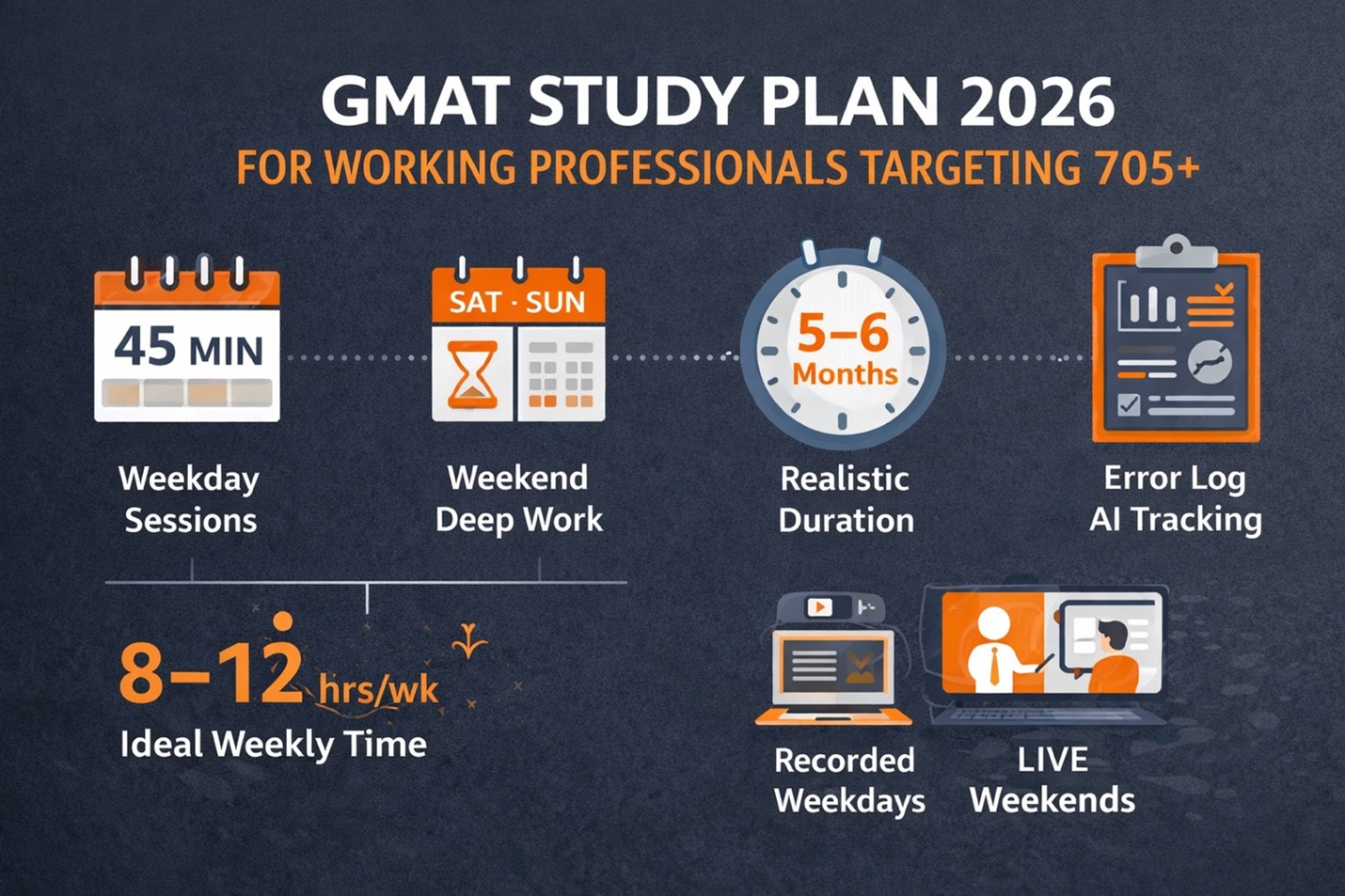
The best plan for a working professional is one built around protected 45-minute micro-sessions on weekdays, deeper sectional work on weekends, and a rigorous error-log system that prevents repeating the same mistakes. Aim for 8 to 12 focused hours per week over 5 to 6 months. Prioritize section balance across Quantitative Reasoning, Verbal Reasoning, and Data Insights — especially DI, which is now equally weighted and often underestimated. Use a hybrid learning model that gives you live guidance on weekends and recorded flexibility on weekdays. The goal is not a heroic study marathon. It is a consistent, data-driven system that compounds over time.
Who Is This Plan Best For?
This guide is written specifically for:
- Corporate employees and managers at Indian and multinational companies
- IT professionals and software engineers balancing project deadlines
- Consultants and analysts on unpredictable client-driven schedules
- Finance professionals during busy reporting and quarter-end periods
- Anyone targeting a top MBA who wants to prepare without quitting their job
If you have 6 months, 8 to 12 hours per week, and the discipline to follow a structured system — this plan is calibrated for you.
GMAT Study Plan 2026 for GMAT Prep Working Professionals: How to Score 705+ with Smart Focus Edition Hacks
You are not a student. You cannot afford to study 5 hours a day. After a full day of meetings, decisions, and screen time, your brain is not running at full capacity by 8 PM. And you know it.
Yet you want that MBA. You want the GMAT out of the way — and you want a score that actually opens the right doors.
The good news: you do not need 5 hours a day. You need a system built for the life you actually live.
This guide gives you a complete GMAT study plan 2026 designed specifically for GMAT prep working professionals. It covers the current exam structure, a proven micro-session methodology, section-specific Focus Edition hacks, a practical 6-month roadmap, and the mental game no one talks about.
Everything here is engineered for one type of person: someone with a full-time job, real-world pressure, and a serious target score.
What Does the 2026 GMAT Focus Edition Actually Look Like?
Before building your preparation system, understand the exam you are preparing for. The GMAT Focus Edition is not a slightly tweaked version of the old test. It is a genuinely redesigned instrument — and that redesign actually favors working professionals in several important ways.
Structure: Three Sections, Equal Weight
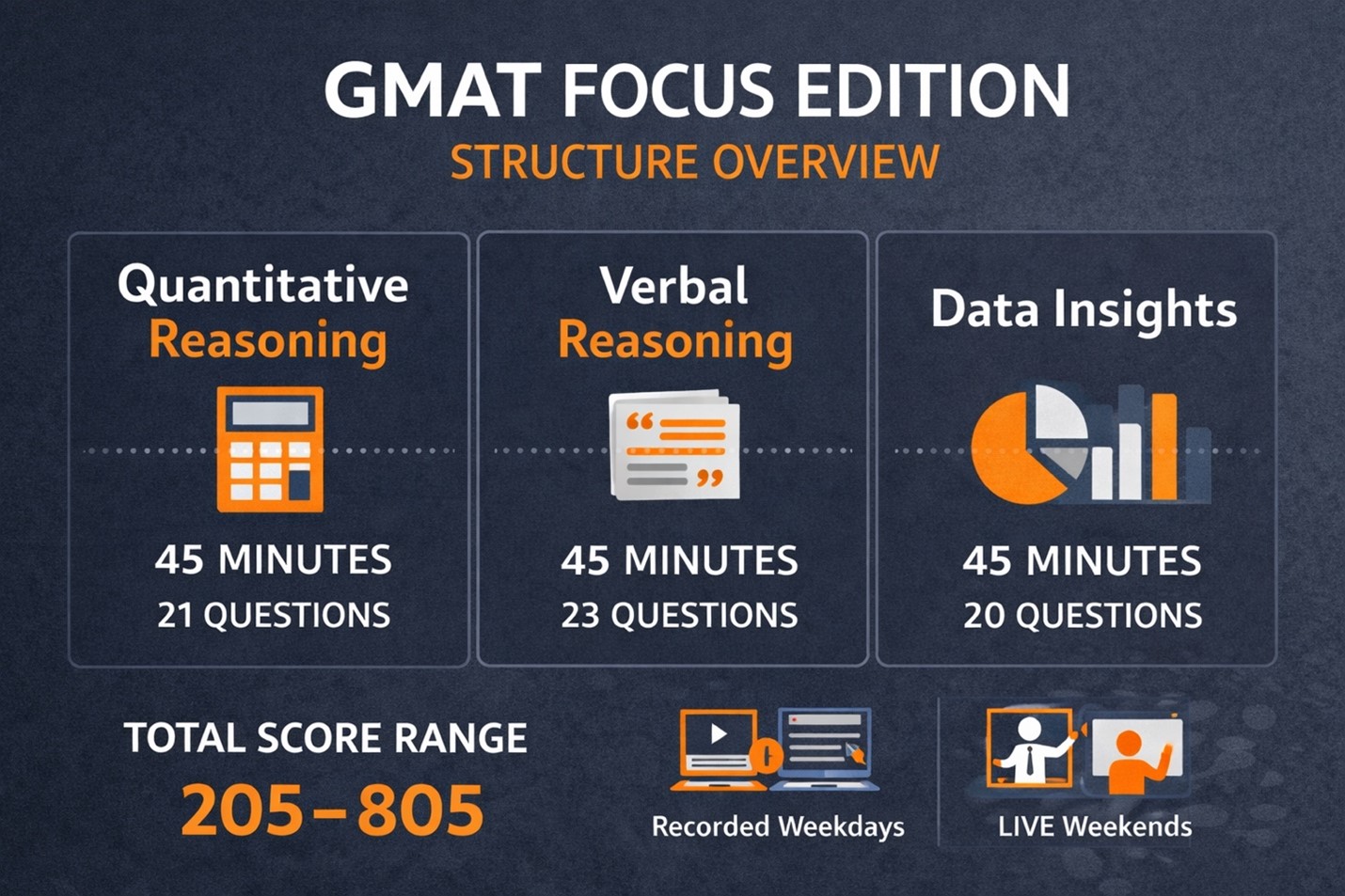
The GMAT Focus Edition runs for 2 hours and 15 minutes across three equally weighted sections:
- Quantitative Reasoning — 45 minutes, 21 questions, focused on arithmetic, algebra, and analytical problem solving
- Verbal Reasoning — 45 minutes, 23 questions, Critical Reasoning and Reading Comprehension only
- Data Insights — 45 minutes, 20 questions, combining Data Sufficiency, Multi-Source Reasoning, Table Analysis, Graphics Interpretation, and Two-Part Analysis
Total score range: 205 to 805. Each section contributes equally to the total.
How Should I Interpret GMAT Focus Edition Scores?
The GMAT Focus Edition uses a revised scoring scale. According to GMAC, a score of 645 on the Focus Edition corresponds roughly to what was previously considered a 700-level performance. This is not a relaxation of standards; it is a redefinition of the measuring scale.
What this means for you: do not obsess over the raw number. Focus on percentile standing and section-level balance. Business schools understand the new scale and evaluate candidates accordingly.
A 705+ target on the Focus Edition is genuinely competitive. Pursue it with that understanding, not with anxiety about the numbers looking different.
What Changed? Sentence Correction Is Gone — and That Is Good News
The most strategically important change for busy professionals: Sentence Correction has been removed. So has the Analytical Writing Assessment.
This matters enormously. Sentence Correction prep historically required months of grammar memorization — heavy, low-transfer work that consumed serious time. With SC gone, Verbal performance is now purely about reasoning: argument analysis, logical structure, reading comprehension.
For working professionals, this is a genuine advantage. Strong analytical thinkers who work in business environments already practice argument evaluation daily. That cognitive muscle transfers directly to the current Verbal section.
Why Data Insights Deserves Special Attention
Data Insights is not an afterthought. It is a full, equally weighted scoring pillar — and it is the section where the most working professionals lose ground.
GMAC designed Data Insights to test exactly what business schools want: the ability to synthesize data from multiple sources, filter irrelevance, and make confident decisions under time pressure.
The problem: many corporate professionals are good at reading dashboards but not at timed, multi-format inference under exam pressure. Being comfortable with data at work does not automatically translate to scoring well in DI. This section requires dedicated, structured practice.
Why Most Working Professionals Fail at GMAT Prep — and How to Avoid It
Motivation is rarely the problem. Most professionals who start GMAT prep are genuinely committed. The failure points are structural.
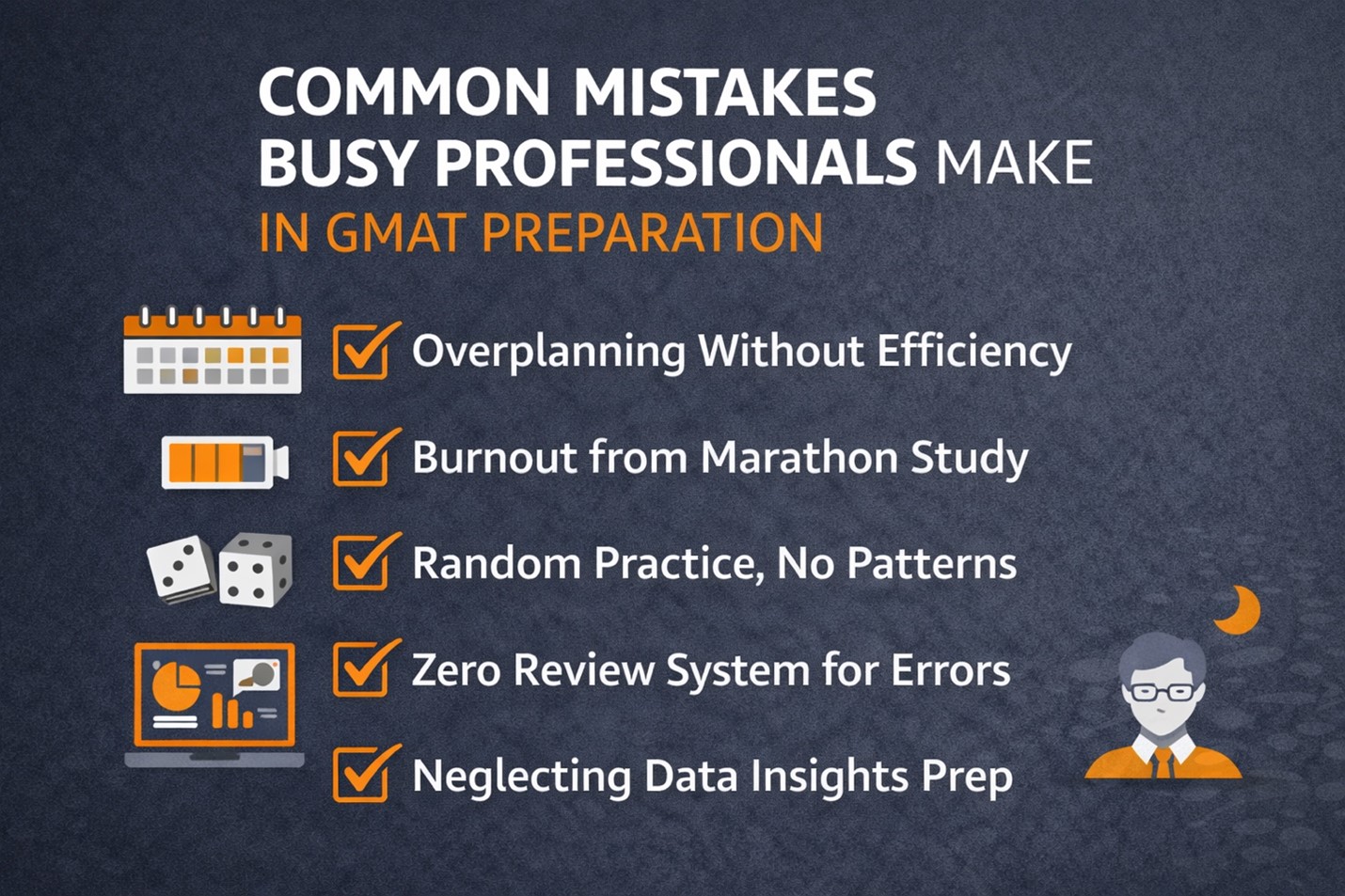
- Overplanning, under-executing. Building a beautiful study calendar feels productive. Following it for 6 months when real work pressure hits is another thing entirely. Plans without fallback mechanisms collapse at the first disruption.
- Studying without review. Solving 50 questions a week means little if you never systematically review what went wrong and why. Practice without pattern recognition is expensive and slow.
- Underestimating Data Insights. DI is not a bonus section. Candidates who treat it as a supplement to their "real" Quant and Verbal prep often finish their preparation with a DI accuracy rate that drags their total score down significantly.
- Wrong study window choices. Sitting down for hard Quant problems at 10:30 PM after a board presentation is almost guaranteed to produce errors, frustration, and poor retention. Studying in cognitively depleted windows reinforces bad habits.
- No systematic error tracking. The single biggest differentiator between candidates who plateau and those who keep improving is whether they have a structured mistake-review system. Random practice accumulates volume. Structured error review builds accuracy.
- Perfectionism after a bad mock. A disappointing mock score does not mean you are behind. It is diagnostic data. Professionals who spiral after one bad performance lose weeks of productive prep to anxiety rather than adjustment.
The Micro-Session Framework: How to Study Effectively When You Have 45 Minutes
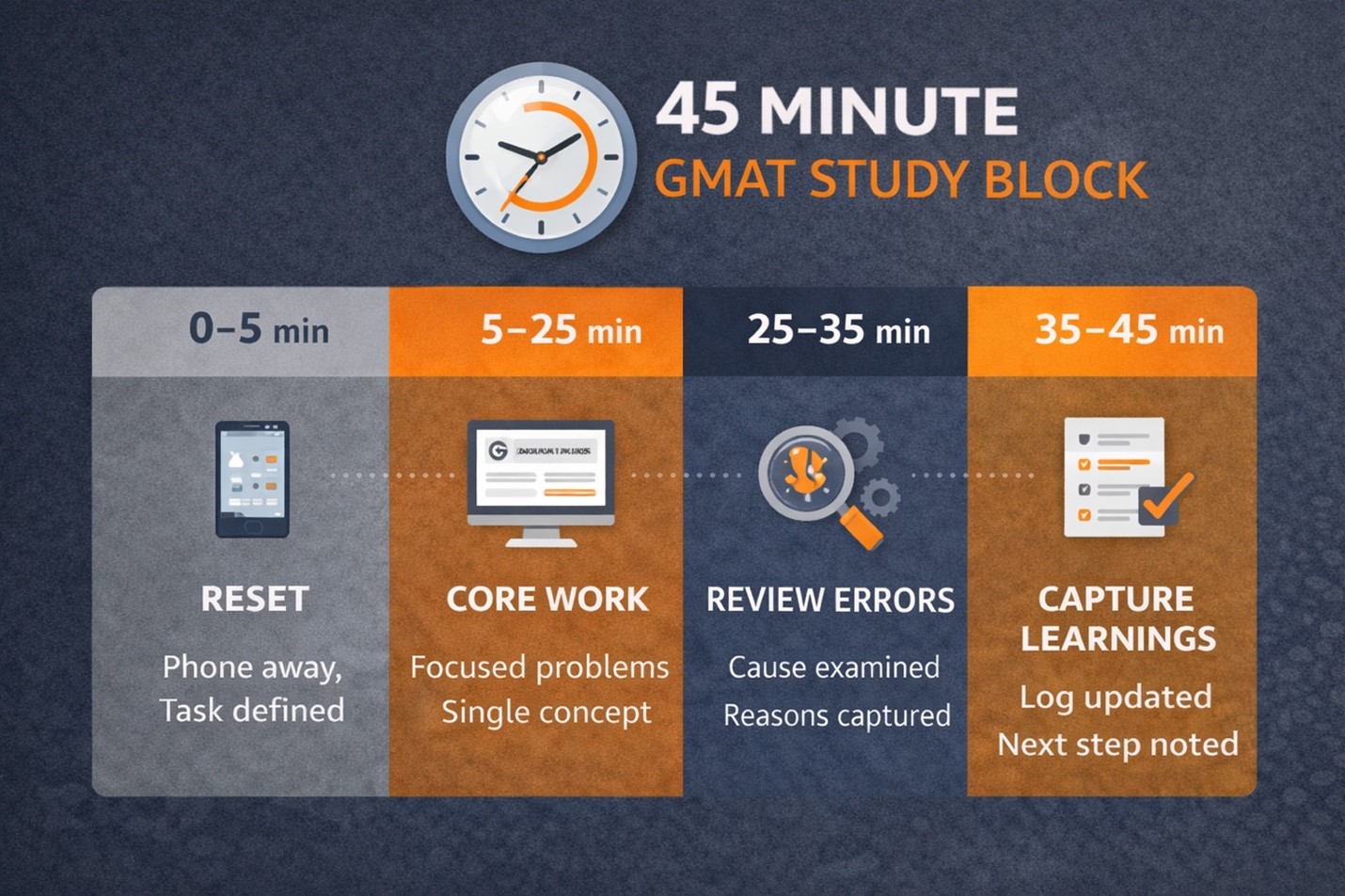
The single most practical GMAT Focus Edition hack for working professionals is this: stop trying to find 3-hour blocks. Build your entire prep system around 45-minute sessions.
A 45-minute micro-session, done with intention, outperforms an unfocused 2-hour block almost every time. Here is why it works — and how to structure it.
What Should a 45-Minute GMAT Micro-Session Look Like?
Minutes 0–5: Context Reset. Close everything except your study material. Write down the single objective for this session. "Finish CR question set 4" is an objective. "Study Verbal" is not.
Minutes 5–25: Core Work Window. This is your high-focus execution block. Solve a targeted set of 8 to 12 questions or work through one concept deeply. Do not multitask.
Minutes 25–35: Immediate Error Review. Do not skip this. Before moving on, identify why you missed what you missed. Not the topic — the exact failure point. Was it a reasoning gap? A timing decision? A trap you recognize in hindsight?
Minutes 35–45: Capture and Log. Update your error log. Add one flashcard. Write one takeaway sentence. End with a defined next step for the following session.
Why this format works: it prevents false productivity. You stop "touching GMAT" and start building something measurable. Each session has an input, a process, and an output.
Morning vs. Evening: Which Study Window Is Better?
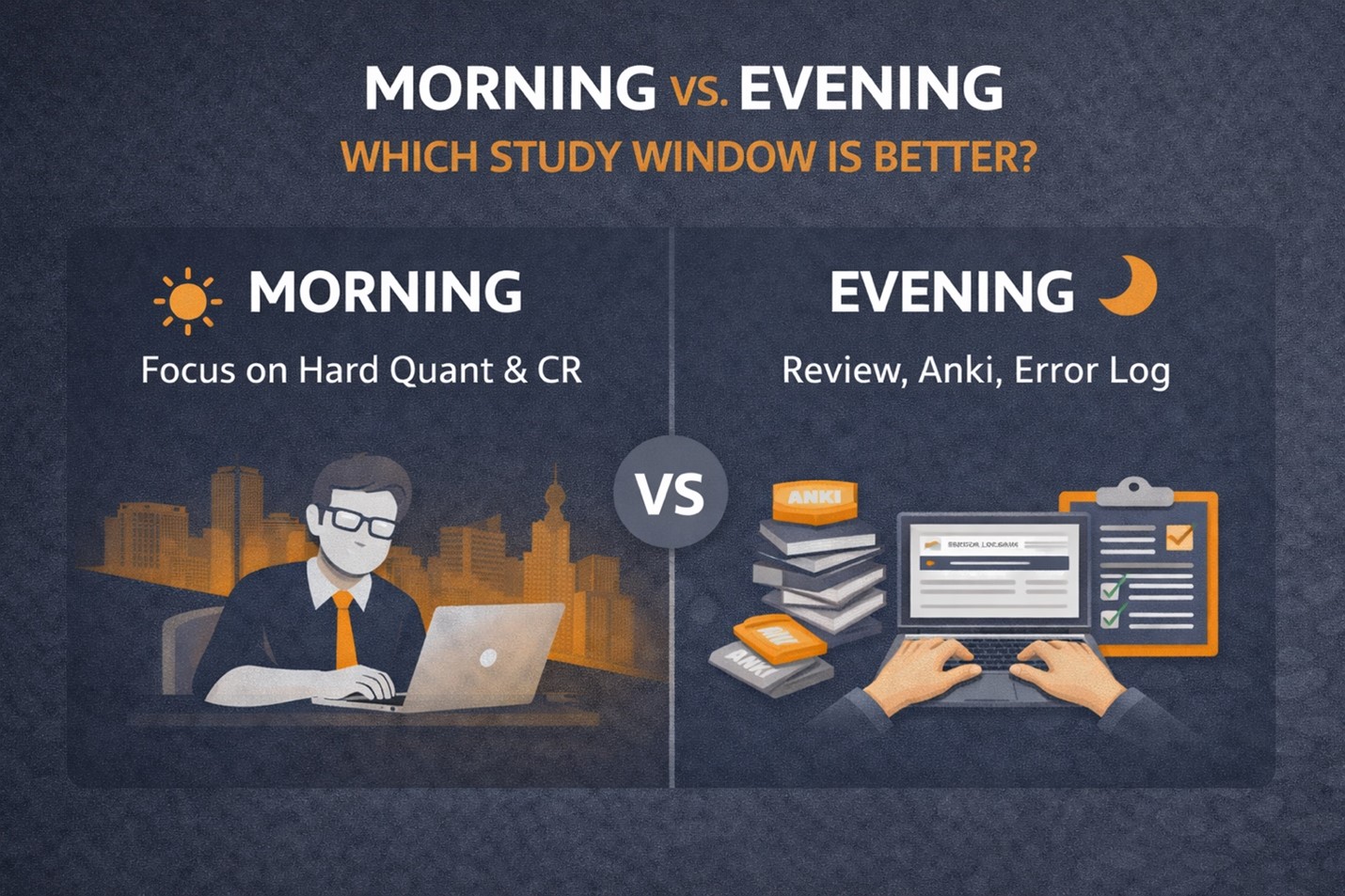
The honest answer: it depends on your chronotype and work pattern — but mornings are typically better for hard Quant and CR work, while evenings are better for review-based tasks.
If you are in a high-pressure role with unpredictable evening calls or late deliverables, morning sessions are more reliable. Even 45 minutes before you open email is high-value time.
If mornings are impossible due to commute or family commitments, protect a specific evening window and use a "low-energy mode" system so that even tired sessions produce something useful.
How to Salvage a Low-Energy Session
Not every session will be peak performance. That is expected. The mistake is canceling the session. Instead, switch to low-energy mode:
- Flashcard review on Anki (formulas, CR patterns, DI traps)
- Error log review — read, do not solve
- CR stem classification — no time pressure
- Passage mapping for RC without questions
- 10-minute mock question replay with verbal walkthrough
A low-energy session that maintains contact with the material is worth far more than a skipped session that breaks momentum.
How to Use Your Commute as Part of Your GMAT Study Plan 2026
Commute time is one of the most underutilized assets in a working professional's prep schedule. The Delhi/NCR metro commute alone — often 45 to 90 minutes each way — represents hundreds of hours of potential study time over a 6-month preparation period.
Your Commute Audit:
- Can I listen? Use audio-based concept reviews, CR argument breakdowns, or self-explanation recordings.
- Can I read? Use Anki flashcards, concept summaries, or a curated passage-mapping exercise.
- Can I recall? Use the last 10 minutes of your commute to mentally replay one mistake from your last session — what happened, and what you would do differently.
Three to five commute sessions per week can add the equivalent of an entire extra study day to your weekly total without requiring a single additional hour of desk time.

How AI and Technology Compress Study Time for Busy Professionals
Technology does not replace good study habits. But the right tech stack makes the same number of hours produce significantly better results. The core principle: technology should reduce re-learning and increase targeting. You study fewer things, remember them longer, and fix recurring mistakes faster.
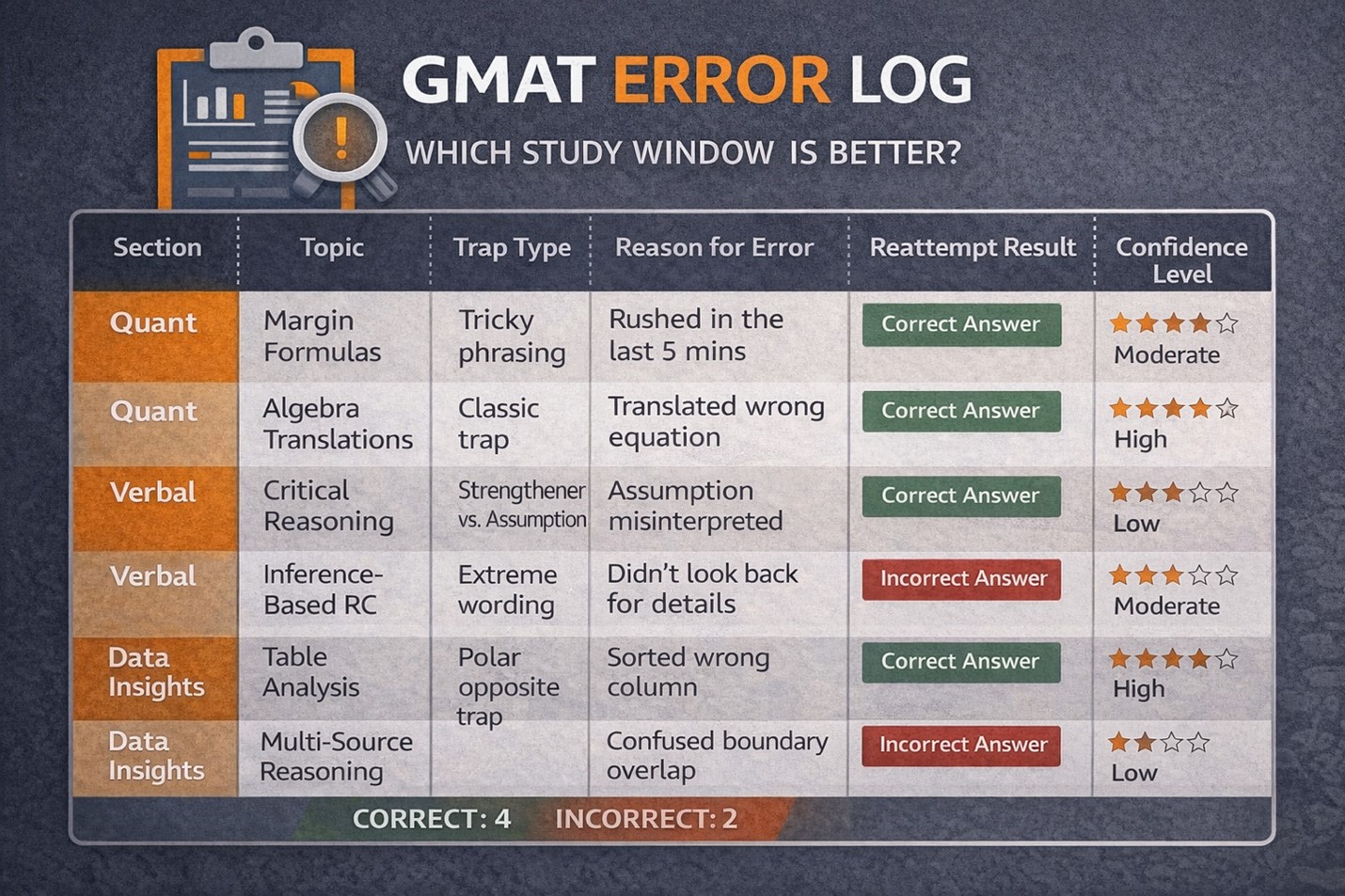
Your error log is the most important document in your preparation. Not your notes. Not your question count. Your error log.
A basic spreadsheet that records question numbers and topics is not enough. A properly structured GMAT error log AI tracking system should capture:
- Section and question type
- Topic and subtopic
- Time taken vs. target time
- Exact reason for the wrong answer — be specific
- Why the wrong answer was attractive (the trap)
- The correct reasoning principle or rule
- Reattempt result after review
- Confidence rating (1–5) after reattempting
When your log is properly tagged, patterns emerge automatically. You will see: careless arithmetic in late Quant questions. Scope traps in CR weaken questions. Over-reading in RC under time pressure. Poor tab navigation in MSR.
That insight is what converts practice into score improvement. You stop reviewing what feels hard and start fixing what repeatedly costs points.
Spaced Repetition: The Memory System Every Professional Needs
Anki or any equivalent spaced repetition tool should hold:
- Core Quant formulas and number property rules
- CR trap pattern definitions and examples
- DI question-type interpretation signals
- Common RC structure markers
- Personal notes from your error log — mistakes turned into cards
In a 6-month GMAT study plan professionals sustain through a long work year, forgetting is the silent killer. Spaced repetition keeps key patterns active without requiring long revision sessions. Even 10 minutes per day compounds into a significant retention advantage.
Using VerbalHub's AI Dashboard Strategically
A well-designed performance dashboard should answer three questions for every study session:
- What is my weakest subskill right now?
- Where am I spending the most time for the fewest correct answers?
- What should I prioritize in my next two sessions?
When your dashboard connects with your error log and mock results, you eliminate guesswork from your prep. Every session has a data-driven purpose.
Section-Specific GMAT Focus Edition Hacks That Move Your Score
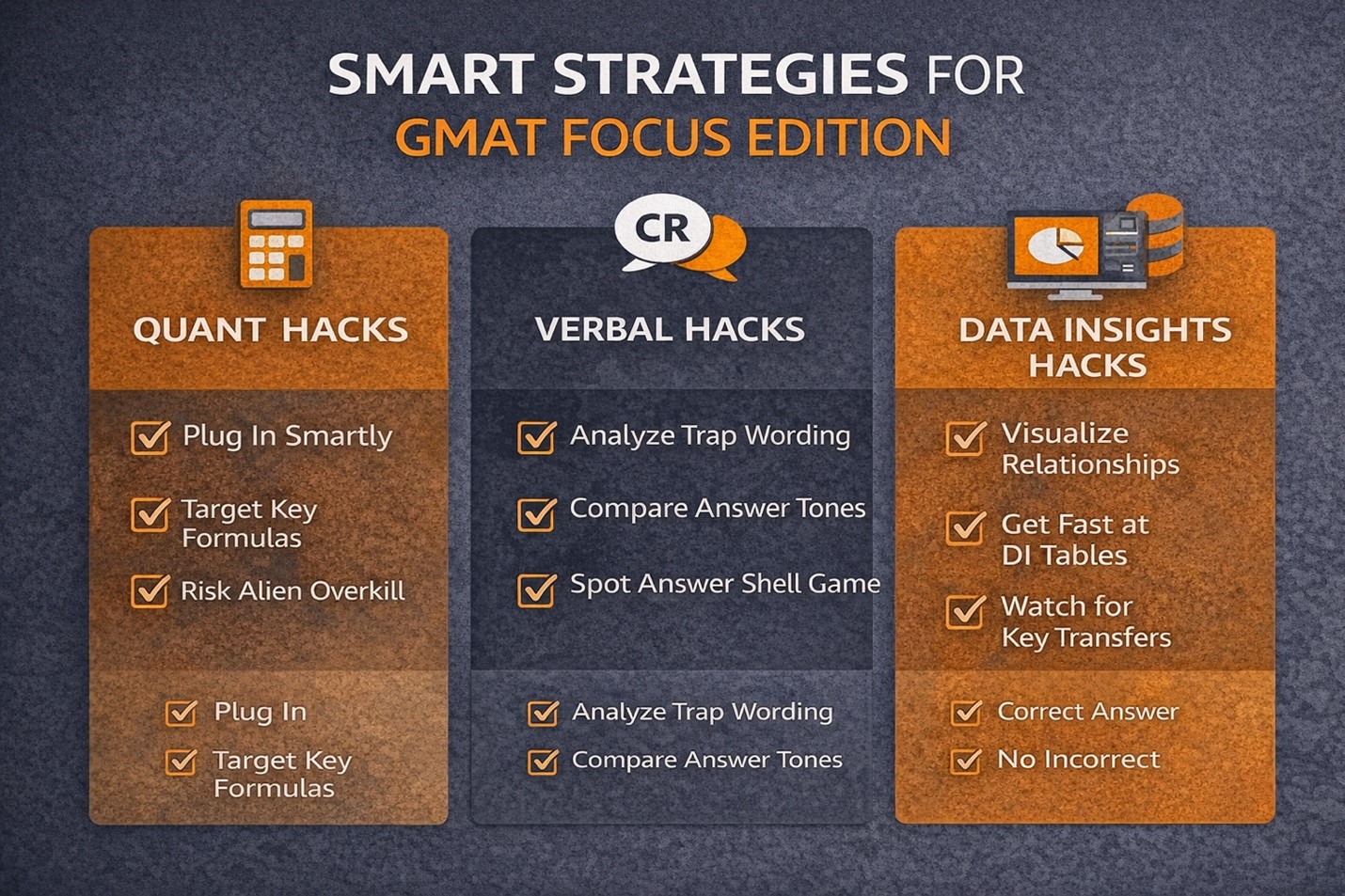
Quantitative Reasoning: How Do I Improve Faster as a Busy Professional?
For most working professionals, Quant improvement is not about learning harder math. It is about precision under time pressure, and eliminating the category of mistakes that come from rushing and carelessness.
High-priority Quant topics for your GMAT study plan 2026:
- Arithmetic fundamentals — percentages, ratios, fractions, estimation
- Algebra — equation translation, inequalities, simultaneous equations
- Word problem setup — extracting relationships before computing
- Number properties — factors, multiples, primes, odd/even rules
- Geometry — coordinate geometry, area and perimeter, triangles
Quant Hack 1: Translate before computing. Write the algebraic relationship explicitly before you touch numbers. The GMAT rewards structured setup more than fast calculation.
Quant Hack 2: Estimate aggressively. On many problems, option elimination through magnitude and approximation is faster and equally reliable. Avoid the instinct to calculate exact values you do not need.
Quant Hack 3: Build a careless error checklist. Before submitting: negative sign? Percent base? Variable condition? Integer restriction? Unit mismatch? Five seconds of checking prevents repeated careless losses.
Quant Hack 4: Revisit patterns, not problems. Do not reattempt every wrong question. Reattempt every mistake that reveals a reusable pattern. One real insight is worth ten repeated problems.
Verbal Reasoning: How Do I Improve Critical Reasoning Without Sentence Correction?
With Sentence Correction removed, Verbal is now entirely a reasoning test. This is good news for professionals with strong analytical habits — but only if you structure your approach correctly.
Critical Reasoning: Use Logic Mapping on Every Argument
Before reading answer choices, identify:
- The conclusion — what is being claimed?
- The evidence — what supports the claim?
- The assumption — what unstated bridge connects the two?
- The gap — what could disrupt that bridge?
- The task — what is the question actually asking you to do?
This is the highest-yield GMAT Focus Edition hack in Verbal. It converts CR from a reading-speed exercise into a repeatable method — and professionals who think analytically every day adapt to it quickly.
For assumption questions, ask yourself: what has to be true for the conclusion to logically follow from the evidence?" An assumption is not an opinion. It is a required, unstated premise.
For weaken questions: ask "What damages the logical link between evidence and conclusion — not just the topic area?" The most common professional mistake: choosing an answer that sounds smart but attacks the topic rather than the logic.
Your GMAT error log AI tracking system should specifically tag these CR trap categories:
- Scope traps — answer addresses a related but different issue
- Opposite effect — answer strengthens when you needed to weaken
- Irrelevant detail — answer is true but disconnected from the argument
- Restated premise — answer repeats the evidence rather than bridging the gap
Reading Comprehension: How Do I Handle RC When I Am Mentally Tired?
RC after a long workday is genuinely difficult. Your mind tends to blur details and lose passage structure. The solution is not to read faster — it is to read with more organizational intent.
Professional RC Strategy:
- Read for purpose and structure, not full memorization of content
- Note the author's main argument and tone in the first paragraph
- Identify each paragraph's role: introduces, qualifies, opposes, concludes
- Track contrast signals: "however," "yet," "while," "in contrast"
- Write a 5-word purpose summary per paragraph as you go
RC is best practiced during morning or weekend sessions. If you must practice RC in the evening, focus on passage mapping and structure recognition rather than full timed sets.
Data Insights: How Do I Gain Points Fastest in the Most Underestimated Section?
Data Insights is where well-prepared candidates separate from well-intentioned ones. The section rewards format awareness, pacing discipline, and the ability to synthesize under pressure.
Multi-Source Reasoning: Question-First Navigation
Do not try to absorb every tab equally before reading the question. Instead: read the question, identify what decision you need to make, then search the tabs for only the relevant evidence. This prevents cognitive overload and saves 60 to 90 seconds per MSR set.
Pacing Heatmaps: Where Is Your Time Actually Going?
After every DI practice set, record where you lost time:
- Early easy questions — overconfidence slow-down
- Middle-format confusion — unfamiliar question types
- Late-stage fatigue — slower reads and second-guessing
- Tab switching in MSR — inefficient navigation
- Re-reading graphics — lack of interpretation framework
A pacing heatmap combined with your GMAT error log AI tracking system reveals not just where you are wrong, but where your energy strategy is broken.
The DI minimum practice rule for a GMAT study plan 2026: at least one dedicated DI micro-session per week and one integrated DI review block on weekends. Never treat DI as optional catch-up.
The Mental Game: How to Protect Your Preparation When Work Gets Hard

No one talks about this enough. The biggest threat to your GMAT prep is not math difficulty or grammar rules. It is mental erosion — the slow drain of motivation, consistency, and confidence that happens when real professional life collides with ambitious study plans.
How Do I Handle Decision Fatigue After Work?
Decision fatigue is real. After a day of meetings, trade-offs, approvals, and deliverables, your brain resists one more set of choices. That is why so many professionals sit down at 9 PM with good intentions and spend 40 minutes deciding what to study.
Eliminate the decision in advance. Every week, assign a specific task to every study session before the week begins. Open your laptop already knowing the exact drill set, topic, or question type you will work on. The session starts immediately.
Define your low-energy mode in advance too. When you are tired, you default to the easiest available path. Make sure that path still produces learning.
How Do I Reset After a Bad Mock Score?
A disappointing mock is not evidence that you are failing. It is diagnostic data. The professionals who improve fastest treat every mock as a structured debrief, not an emotional event.
After a bad mock, do this:
- Do not study for 12 to 24 hours. Let the emotional reaction clear.
- Run a section-level accuracy breakdown. Where did you lose the most points?
- Identify whether the errors were conceptual, timing-based, or fatigue-driven.
- Build the next two weeks of study directly from that analysis.
- Take the next mock with a specific hypothesis to test, not just a hope to score higher.
A bad mock followed by good analysis is one of the most efficient learning events in your preparation cycle.
What Do I Do If I Fall Behind?
Missing a week — or even two — does not ruin a 6-month plan. Treating a missed week as a catastrophic failure does.
The recovery principle: do not try to "make up" lost volume. Instead, resume your regular schedule and add one additional 30-minute session for the next two weeks. Gradual re-entry maintains quality. Binge catch-up usually produces low-quality sessions and poor retention.
Guilt about missed sessions is a normal human feeling. The professionals who reach their target scores are not the ones who never miss. They are the ones who re-enter cleanly and keep the system running.
Comparison Anxiety and Perfectionism
Someone else just scored 725. Someone in your GMAT study group seems to be understanding things faster. You had three great sessions last week and a terrible one this morning.
None of that is relevant to your next session. GMAT performance is not a social competition. It is a private engineering problem with a personal timeline.
The only comparison that matters: you in this session versus you in the last session. Are the patterns improving? That is the only signal worth tracking.
The 6-Month GMAT Study Plan for Working Professionals: Month-by-Month Roadmap
A 6-month GMAT study plan professionals can complete while working is not built around ideal weeks. It is built around real ones — with buffers, milestones, and clear decision points.
Month 1: Build the Foundation
- Take a full diagnostic test under timed conditions
- Choose a realistic target score based on your current level and the requirements of your MBA programs.
- Establish your weekly schedule — assign study windows to your actual calendar
- Begin core concept work: arithmetic, algebra, basic CR logic
- Set up your error log and Anki deck — start using them from Day 1
- Identify your single biggest weakness area from the diagnostic
Month 2: Build Method
- Begin timed micro-sessions — every set should have a time target
- Introduce structured Data Insights practice: 2 sessions per week
- Deepen CR logic mapping: assumption, weaken, strengthen question types
- Add RC structure-reading practice to weekend sessions
- Review errors every week — look for patterns, not individual mistakes
- Build out your Anki deck actively from error log insights
Month 3: Push Sectional Performance
- Take regular sectional timed tests — one per section per week
- Apply pacing rules for the first time and document timing behavior
- Identify your top three timing leak points in DI
- Deepen stamina training: longer sessions, back-to-back question sets
- Introduce mock-style Verbal practice under timed conditions
- Mid-point review: adjust the plan based on what the error log is showing
Month 4: Increase Exam Realism
- Begin full-length mocks — one every 10 to 14 days
- Analyze mocks structurally: accuracy by section, by question type, by timing pattern
- Focus on high-frequency mistake clusters identified in your error log
- Calibrate your real GMAT schedule busy professionals can sustain under work pressure
- Practice section-order selection and mental transitions between sections
- Add recovery simulation: practice continuing strong after one difficult question
Month 5: Precision and Error Elimination
- Focus exclusively on patterns that appear 3+ times in your error log
- Redo every logged CR weaken/assumption error with fresh eyes
- Aggressive DI pacing work — full sections under stricter time targets
- Train psychological recovery: controlled response to hard questions mid-test
- Reduce concept introduction — increase execution and targeted review
- Maintain mock cadence: one full mock every 10 days
Month 6: Score Conversion and Execution
- Full mock rhythm: one per week, full review within 48 hours
- Lighter concept input — primarily execution and consolidation
- More review, less new practice material
- Polish three things: opening Quant accuracy, CR first-pass precision, DI pacing
- Final two weeks: reduce study volume, protect sleep, arrive rested
- Book your exam date by the end of Month 5 — the deadline creates focus
The 7-Day Weekly Planner for GMAT Prep Working Professionals
Below is a premium weekly template calibrated for high-pressure corporate schedules. Adapt it to your work calendar — but protect the structure.
| Day | Time Block | Focus | Output |
|---|---|---|---|
| Monday | 45 min | Quant fundamentals or targeted drill — algebra, number properties, word problems | 10–15 questions + error log entries |
| Tuesday | 45 min | Critical Reasoning: logic mapping, assumption and weaken sets | 8–12 CR questions + trap category tags in error log |
| Wednesday | 45 min | Data Insights micro-set — MSR or Table Analysis + pacing review | Pacing heatmap update + DI error log |
| Thursday | 20–30 min | Commute review: Anki flashcards, formula recall, error log replay | 5+ cards reviewed, 1 mistake replayed mentally |
| Friday | 45 min | Mixed weak-area session based on that week's error log | Reattempt 5–8 previously logged errors |
| Saturday | 2–3 hours | Live session or sectional drill + deep review and strategy adjustment | Concept correction notes + priorities for the following week |
| Sunday | 2–4 hours | Full-length mock or two timed sectionals + structured analysis | Score review, section-level diagnosis, next-week plan |
What If My Schedule Is Completely Unpredictable?
Use the Minimum Viable Week model. When work becomes chaotic, you need a non-negotiable floor — not an abandoned plan.
Your minimum viable week:
- 3 weekday micro-sessions of 45 minutes each
- 1 commute review cycle
- 1 weekend session of at least 90 minutes
- 1 error-log review pass
This floor keeps your preparation alive during quarter-end pressure, travel weeks, and high-intensity deliverable periods. It is not ideal. It is enough.
Travel Week Plan
- Use hotel morning time for 30-minute Anki and error log review
- Use flight time for RC passage mapping or CR argument practice
- Replace one missed desk session with two commute sessions
- Skip mocks during travel week — resume immediately after
Quarter-End or High-Pressure Work Period Plan
- Reduce to minimum viable week for 2 to 3 weeks
- Prioritize error log review over new content learning
- Keep weekend session even if it is shorter — 60 to 90 minutes
- Do not schedule a mock during peak work crunch
- Resume full schedule immediately after the pressure period ends
The 705+ Score Roadmap: What Does It Actually Take?
The 705+ Score Roadmap for Busy Professionals
Section-level accuracy benchmarks you should be hitting in your final two months:
- Quantitative: 80–85% accuracy on medium-hard questions, sub-2-minute average on standard problem-solving
- Verbal: 75–80% accuracy on CR, strong first-pass answer selection (limiting second-guessing)
- Data Insights: 70–75% accuracy, with pacing under 2:15 per question across the full section
Three behaviours that separate 680 performers from 705+ performers:
- They review mistakes as rigorously as they practice new material
- They practice under realistic time pressure consistently — not just when convenient
- They never skip Data Insights in their weekly plan
Why VerbalHub's Hybrid Model Works for GMAT Prep Working Professionals
The most common failure mode for working professionals is choosing a prep structure that was not designed for them. Generic daily live courses assume you can attend every evening. Self-study alone offers no accountability. Neither extreme fits the reality of a demanding job.
VerbalHub's hybrid GMAT course is built around this exact challenge.
Live weekend sessions give you structured, mentor-led instruction, doubt resolution, strategy calibration, and accountability. Two hours of focused weekend guidance replaces what would otherwise take 5 hours of self-directed material-hunting.
Recorded weekday library gives you the flexibility to study at 6 AM, 9 PM, or during a commute — and to revisit complex concepts as many times as needed. If a session is missed, nothing is lost. You watch, review, and continue.
This is not just scheduling flexibility. It is a fundamentally different approach to professional learning.
The hybrid model also includes structured progression, not just access to content. You follow a sequenced plan built for 6-month preparation, with regular checkpoints, performance reviews, and personalized guidance on where to focus next.
For GMAT prep working professionals, the question is not just "is the content good?" It is "does the structure fit my life?" VerbalHub's hybrid model is designed to answer both.
Common Mistakes Busy Professionals Make in GMAT Preparation
- Treating all study time as equal. A tired 90-minute session is not the same as a focused 45-minute session. Quality beats volume every time.
- Doing too many questions without reviewing enough. Volume builds familiarity. Review builds accuracy. You need both — but most candidates over-index on volume.
- Ignoring Data Insights until the last month. DI is a full scoring pillar. Building it late under time pressure almost never produces the results a 6-month integrated approach delivers.
- Building a plan and never adjusting it. The plan is a starting hypothesis. The error log tells you what the plan should become.
- Practicing without time pressure. If you never practice under real timing, you will not perform under real timing.
- Using mocks for score-checking rather than learning. Every mock is a dataset. If you are not spending as much time on mock review as on the mock itself, you are wasting half its value.
Frequently Asked Questions: GMAT Prep for Working Professionals
Most working professionals see strong results with 8 to 12 focused hours per week over 5 to 6 months. What matters most is not how many hours you study, but how consistently and well you study. A disciplined 8 hours per week with rigorous error review outperforms a scattered 15 hours without review. Build a schedule around your real calendar — one you can actually sustain — rather than an aspirational one that collapses in Week 3.
Yes — and many of the most successful GMAT candidates are working professionals. The key is a preparation system designed for real life: protected micro-sessions on weekdays, deeper work on weekends, and a hybrid learning model that offers flexibility without removing structure. The GMAT does not reward raw study time. It rewards consistent, targeted, well-reviewed practice.
For most candidates targeting 700+, 6 months is sufficient — provided the plan is structured, diagnostic-driven, and adaptive. A 6-month GMAT study plan professionals can sustain should include four phases: concept building, sectional skill development, mock-based execution training, and final conversion. If you have a strong foundation in Quant or Verbal from prior education, 5 months can be enough. If you are starting from a low baseline, give yourself the full 6.
The best schedule is the one that matches your real energy pattern and work calendar. A strong default: 3 to 4 weekday micro-sessions of 45 minutes each, commute-based review 3 to 4 times per week, and a 2 to 4-hour weekend session for mocks and deep review. Build in a minimum viable week as a fallback for high-pressure periods, and never plan to "make up" missed volume through binge sessions.
The answer is to remove friction from the decision. Decide your study window and specific task before the week starts. If you work until 7 PM, protect 8:00 to 8:45 PM as your study window before you check anything else. Use a low-energy mode on the hardest days: Anki flashcards, error log review, and light CR practice. Save your hardest Quant problems for morning sessions or the weekend when your cognitive reserves are higher.
Recorded classes are an essential component of preparation for working professionals — but they work best when combined with live mentorship. Recorded resources give you flexibility and replay capability. Live sessions give you accountability, strategy calibration, and real-time doubt resolution. The ideal structure is hybrid: live weekend sessions for direction and momentum, recorded library for flexible weekday execution.
Data Insights is equally weighted with Quantitative and Verbal Reasoning — it is one-third of your total score. Candidates who treat DI as a supplementary section consistently underperform relative to their potential. DI rewards a specific skill set: multi-source synthesis, format-switching under time pressure, and question-first reading. These skills require deliberate practice, not passive exposure. Start DI training from Month 2 at the latest.
The highest-yield hacks are behavioral, not clever tricks. Use 45-minute micro-sessions with a defined objective. Do commute-based Anki review 3 to 5 times a week. Apply CR logic mapping before reading answer choices. Use pacing heatmaps in DI to diagnose where time collapses. Tag error patterns by type, not just topic. Run spaced repetition on your personal mistake library. Combine live and recorded learning for accountability plus flexibility.
Take one full mock every 10 to 14 days in the middle phase of your preparation, increasing to once per week in Month 6. Always take mocks under real conditions: timed, uninterrupted, with a working environment as close to the actual test centre as possible. Immediately after the mock, do not restudy. Within 24 to 48 hours, run a structured analysis: accuracy by section, by question type, by timing pattern. Build your next two weeks of study directly from that analysis.
Final Actionable Checklist: Your 705+ GMAT Study Plan 2026
Before You Begin
☐ Take a full diagnostic test
☐ Set a specific target score (not just "as high as possible")
☐ Book your approximate exam date — give yourself a real deadline
☐ Set up your error log with all required fields
☐ Build your initial Anki deck (formulas, CR patterns, DI traps)
☐ Map your real weekly calendar and assign study windows
☐ Define your minimum viable week
Every Week
☐ Complete 3–4 weekday micro-sessions (45 min each)
☐ Run commute review at least 3 times
☐ Take one weekend sectional or full mock
☐ Review your error log and tag new patterns
☐ Update Anki deck with new mistake-derived cards
☐ Assign specific tasks to each session before the week starts
☐ Define next week's priorities based on this week's performance
Every Month
☐ Review month-level error log patterns — identify top 3 recurring mistakes
☐ Adjust the following month's focus areas based on performance data
☐ Take at least one full-length mock and run a structured debrief
☐ Check section balance — no section should be neglected for more than 10 days
☐ Review your timeline: are you on track for your exam date?
Ready to Build a 705+ Strategy That Fits Real Professional Life?
Stop waiting for the perfect moment. The perfect moment is a myth that costs 6-month windows you cannot buy back.
What you need is not more motivation. It is a system built for who you actually are: a busy professional with high ambitions, real constraints, and the capacity to execute when the structure is right.
VerbalHub's Hybrid GMAT Course is that structure.
Live weekend sessions with expert mentors. A full recorded library for flexible weekday preparation. Structured progression built around a 6-month professional timeline. Performance tracking, error-log guidance, and accountability designed for candidates who cannot afford to waste preparation time.
- Flexible: Study on your schedule — live guidance on weekends, recorded library on weekdays
- Structured: Follow a proven 6-month roadmap with monthly milestones and real checkpoints
- Expert-led: Learn from mentors who have coached working professionals to 700+ for years
- Data-driven: Track every mistake with our error log system and dashboard analytics
- Professional-first: Everything is designed for candidates with a full-time job, not full-time students
Join VerbalHub's Hybrid GMAT Course — and start building your 705+ strategy today.
Study with precision. Review with data. Improve with structure.



Our Teachers

Dr. G Ravindra Babu
Quant Faculty
Ph. D in Mathematics Asian International University|| Mathematics Professor at Gitam University || Ex-Mathematics Professor SRM University Amaravathi || MBA in finance Acharya Bangalore B School || GMAT Quant 51, CAT Quant 99.58 %tile, GRE Quant 170 || 21 Different Teaching Certification || Believe in “Education is the mother of leadership”
view details

Dr. Rengarajan Parthasarathy
CAT Faculty
Ph. D in Mathematics from YCM University|| Mathematics Professor at Symbiosis International|| Author of Business Ethics || Ex-CAT Exam Syllabus Advisor in IIM || MBA & MPM from Symbiosis International (Deemed University) || College Topper in Mathematics in Ferguson College || Six Scholarships in Mathematics || 15 Years CAT Coaching, GMAT Coaching and GRE Coaching Experience|| UGC NET Qualified || GMAT Q51, V38 & CAT Q 99.31 & DILR 99.38 %tile, GRE Quant 170 || Believe in “Higher Education Shapes The World.”
view details

Dr. Nisha Tejpal
Verbal & AWA Faculty
Ph. D in English || Published a paper in English in ‘Research Journal of Philosophy and Social Sciences’ || MCA and B.Ed CCS University || A subject expert in Verbal Teaching || 10,000 Plus Essays Analysis || CTET and NET Qualified || More than 15 years of Experience || A writer, Author and Poet || Believe in “Think Beyond the Universe”
view details

Dhrithi Khattar
Verbal Faculty
A subject expert in Verbal Aptitude || More than 15 years of Experience || MBA in HR& Marketing & MA in Economics || Active Member of Hindu Alumni Association || Functional Member of Delhi ||Management Association (DMA) || Operational Member of All India Management Association (AIMA) ||The President of Key Club ||An active member of the French Club ||Gold Seal from California Scholarship Federation.
view details
M. U. Mir
DILR & Quant Faculty
A subject expert in Quantitative Aptitude Training || GMAT Q 51 & CAT DILR 99.75 %tile || GATE 2020 Qualified || M. Tech & B. Tech University Toper (1st Rank) || Awarded by Gov of Odisha, Bihar and J& K for the project Magnetic Floating Model || Ex-Quant Subject Expert in Arihant Publication || An Educationist and Social Worker || Believe in “Education is power”
view details

C. S. Rajawat
CAT Faculty
M. A in Mathematics CCS University|| M. Tech from SRM University || Visiting Mathematics Faculty CCS University ||Experience of 11 Years of CAT Coaching || District Topper in 10th & 12th || Best Teacher Awardee in 2021 & 2022 || CAT Quant 99.43 %tile || Discovered a new Theorem based on HCF in Math || Founder of C. S. Classes ||Believe in “Teaching and Training is an Art.”
view details

Dr. S.K. Singh
PTE/IELTS/CELPIP Expert
Ph. D. English Dr. B. R. Ambedkar University || Delhi & Center Government School Mentor || Founder of Entrepreneur & Learning Startup || IELTS & CELTA Certified from British Council || PTE Certified from Pearson...
view detailsRishabh Arora
PTE/IELTS/CELPIP Expert
MBA in HR International Institute of Management Sciences || PTE Certified from Pearson Test of English|| IELTS & CELTA Certified from British Council || BCA from Integral University || PTE 87 in 2017, IELTS 8.5 in 2018
view details
Jyoti Joshi
IELTS Trainer
Master in English (MA) and Bachelor in Education (B.Ed) || Certified Trainer || IELTS Speaking 9.0 Band holder || Believe in “Great teacher can inspire hope, ignite the imagination, and instill a love of learning”
view details
Surbhi Arora
IELTS / PTE Expert
English Language Expert || More than 3 years of Experience || M.A plus B. Ed Delhi University ||Author, Writer & Classical Singer|| Believe in “Language Language Learning & Teaching is Fun”
view details

Dilip Kumar Rathore
Quant Trainer
A business developer and genius in mathematics || Highly experienced || Master in Maths || well-verse in IT || Believe in “The art of teaching is the art of assisting discover”
view details

Imaam Hasan
Communication Expert
Master in English || Journalist and writer || Certified IELTS & PTE Trainer || A social educater and influencer || Believe in “Education is the movement from darkness to light”
view details