Why Most GMAT Mock Tests Don't Move the Needle

Here is a scenario that plays out more often than you would think.
A student takes mock after mock — five, six, sometimes ten — and the score barely shifts. The first mock gives a 610. The sixth gives a 620. Somewhere between practice test number four and number seven, the frustration sets in: I'm practicing. Why am I not improving?
The problem is rarely effort. The problem is almost always the wrong kind of practice.
Choosing the best GMAT mock test series is not just about a high number of Mock tests. It's about finding a system that diagnoses your weaknesses, gives you the right practice to fix them, and tracks whether those fixes are actually working.
This guide is written for serious GMAT aspirants — people targeting 650, 700, or 730+ — who want to understand how to pick the right GMAT online test series, what separates a useful test series from a forgettable one, and why VerbalHub's structured approach to GMAT mock practice is built differently from what most platforms offer.
Why GMAT Mock Tests Are Not Just Practice Tests
Ask most students what a GMAT mock test is for, and they'll say: to check my score.
That's only half the answer.
A mock test is primarily a diagnostic tool. Its job is to reveal exactly where your decision-making breaks down under timed pressure. Is your Verbal score low because you're slow on Reading Comprehension, or because you're guessing on Critical Reasoning? Is your Quant score inconsistent because of careless errors at the 600 level, or are you genuinely unprepared for 700-level Data Sufficiency?
A full-length GMAT mock test simulates the real test environment — including pacing, stamina, and the mental fatigue that sets in around the 45-minute mark. That simulation is valuable. But simulation without analysis is just repetition.
What a good GMAT mock test experience should include:
- Timed, exam-like conditions
- Immediate post-test breakdown by section and topic
- Question-level accuracy analysis
- Time-per-question tracking
- Difficulty-level performance (600, 650, or 700 level)
- A clear path forward: what to fix, how to fix it
Without those elements, mocks are just expensive timers.
What Makes the Best GMAT Test Series?
Not every test series is built the same. Here's a useful GMAT test series vs one that just engages you in mock.
1. Exam-Like Full-Length Mocks
The mocks should closely mirror the GMAT Focus Edition format — structure, timing, and question style. Practicing on outdated or poorly designed mocks builds bad habits.
2. Sectional Tests
Full-length mocks show you that something is wrong. Sectional tests help you fix it. A student struggling with Critical Reasoning needs targeted CR practice — not another full 2.5-hour test.
3. Topic-Wise Practice
Within Verbal, Reading Comprehension and Critical Reasoning require very different skills. Within Quant, Arithmetic and Algebra have different error patterns. Good test series allow you to drill by topic, not just by section.
4. Difficulty-Level Separation
Practicing only medium-difficulty questions will not push your score to 700+. A strong test series separates questions by difficulty — 600, 650, and 700 level — so you know exactly where your ceiling is and how to raise it.
5. Detailed Analytics
After every test, you should know: Which question types cost you the most points? Where did you rush? Where did you over-invest time? Where are you systematically guessing?
6. Error Tracking
A test series without an error-log system forces students to rely on memory, which fades within 48 hours. Error-log tracking builds long-term pattern recognition.
7. Retake Strategy
The best GMAT online test series gives you enough material to retake and refresh — not just a handful of mocks that expire after one use.
VerbalHub GMAT Mock Test Series: What You Get
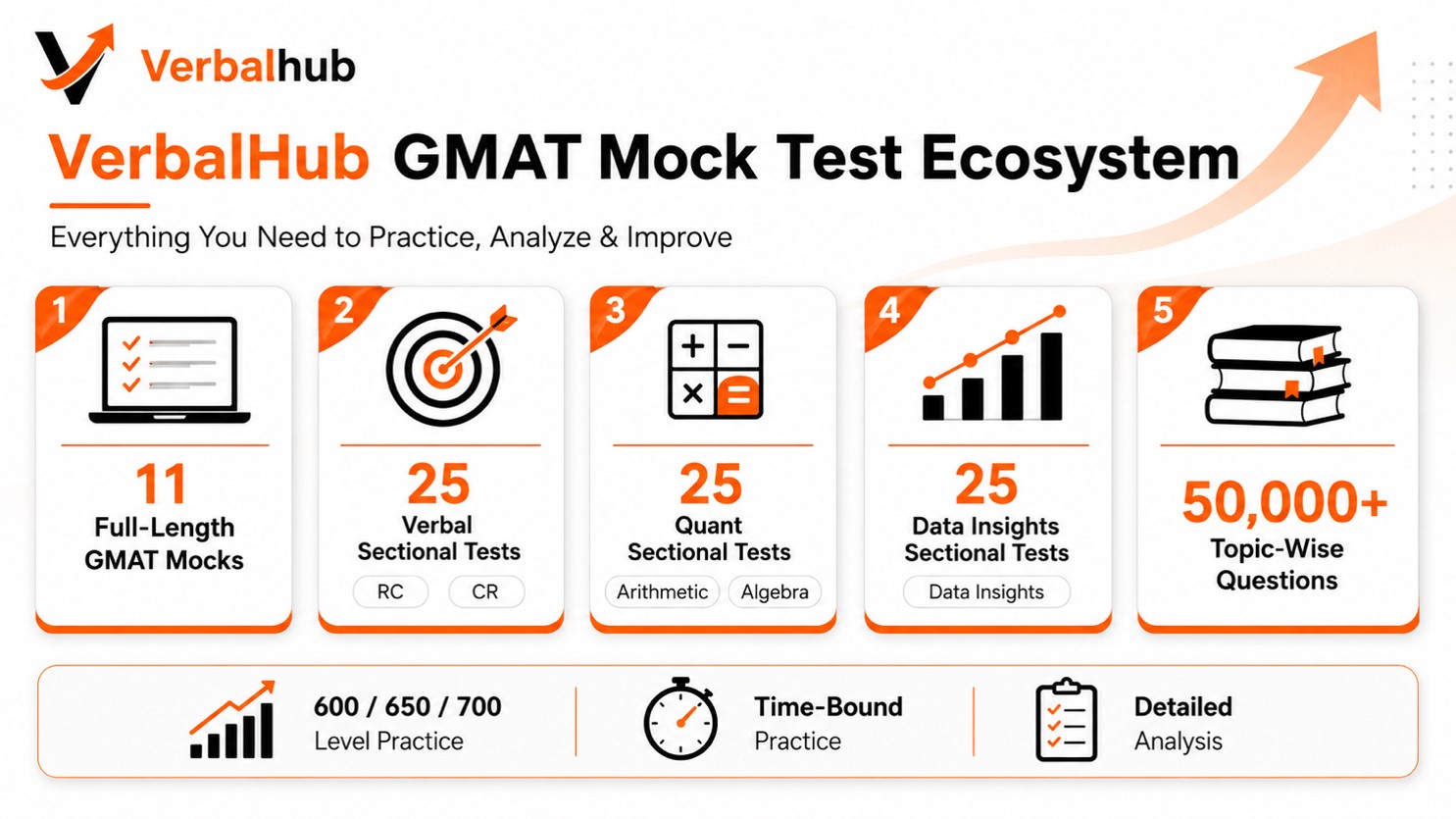
VerbalHub has built a GMAT mock test ecosystem specifically for students who want structured, measurable improvement — not just practice volume.
Full-Length Mock Tests
11 full-length GMAT mock tests, designed to replicate the GMAT Focus Edition experience in timing, structure, and question difficulty. Eleven mocks give you enough material for a 10–12 week preparation cycle without repeating content prematurely.
Sectional Tests — A Deep Practice Layer
This is where VerbalHub's approach stands apart. Most test series give you a handful of sectional tests. VerbalHub provides:
- 25 Verbal sectional tests — covering Reading Comprehension and Critical Reasoning
- 25 Quant sectional tests — covering all Quant topics in GMAT Focus Edition
- 25 Data Insights sectional tests — the most underserved section in most test prep programs
- 100+ topic-wise sectional tests covering RC, CR, Arithmetic, Algebra, Data Sufficiency, and more
Question Volume That Builds Real Fluency
50,000+ GMAT practice questions across all sections. Fluency on the GMAT comes from repeated exposure to question patterns — not from reading about those patterns.
Difficulty-Level Practice: 600, 650, and 700 Level
All questions are tagged by difficulty level. This allows students to:
- Build foundational accuracy at the 600 level before moving on
- Develop consistency at the 650 level
- Push into elite reasoning territory at the 700 level
Additional Features
- Level-wise practice books with a clear study path
- Detailed mock analysis after every full-length test
- Error-log integration for tracking recurring mistake patterns
- Time-bound practice across all sectional and topic-wise tests
Why Sectional Tests Matter More Than Students Think
Here's an analogy that makes this clear.
Imagine you're training for a marathon and your coach gives you a full 42km run every week. You track your time. It keeps declining. But you have no idea whether the problem is your pace in the first 10km, your stamina in the final stretch, or your breathing technique throughout.
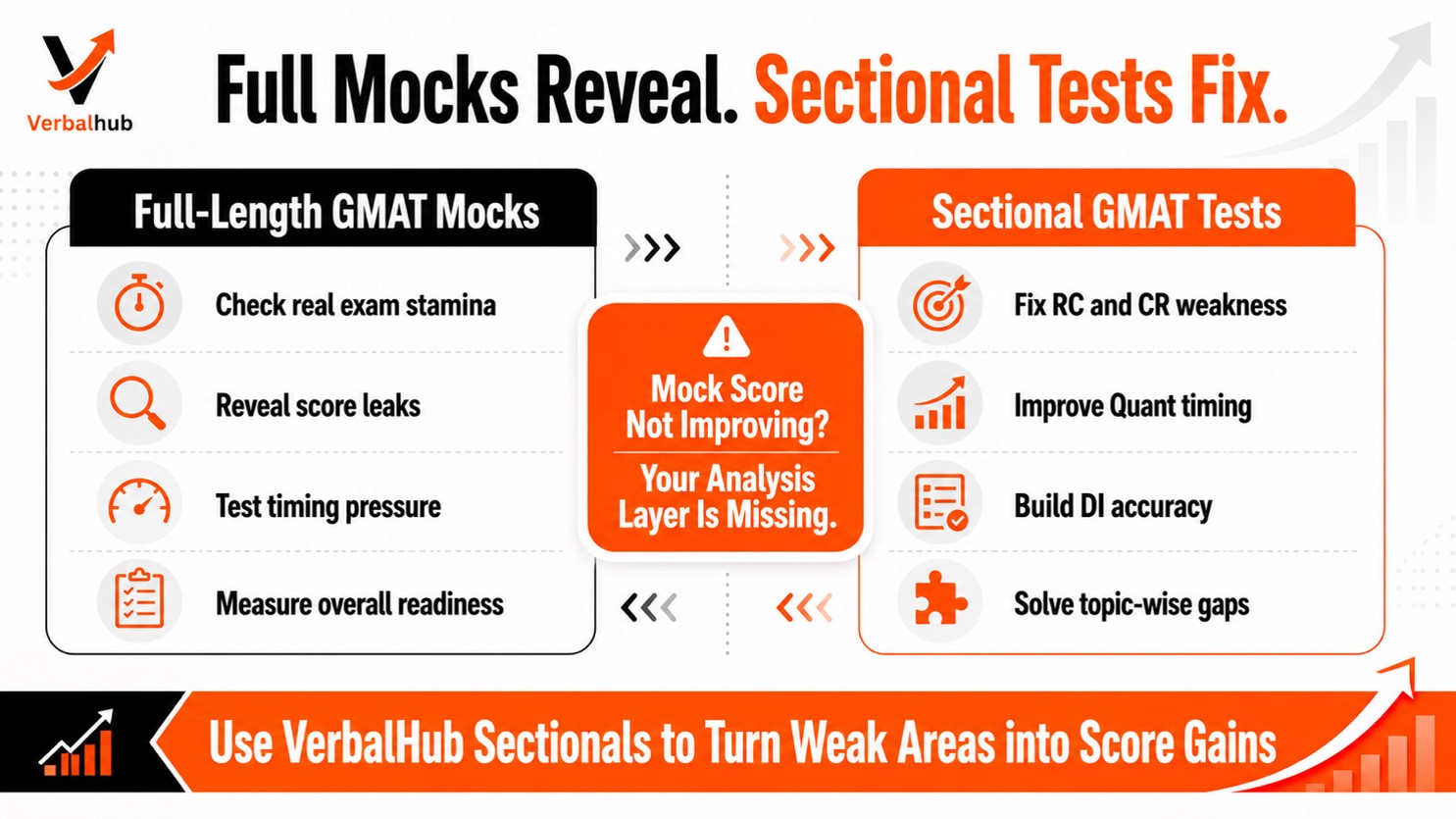
Full mocks are your marathon runs. Sectional tests are your interval training.
A student scoring 610 overall might be scoring 68th percentile in Quant but 35th percentile in Verbal. That student does not need another full mock. They need targeted CR practice, RC timing drills, and structured Verbal sectionals — which is exactly what VerbalHub's 25 Verbal sectional tests are designed to deliver.
Data Insights is the section most students underestimate. It combines data interpretation, graph reading, and logical reasoning in a way that rewards consistent, structured practice far more than last-minute cram sessions.
The Principle
Full mocks reveal the problem. Sectional tests fix it.
VerbalHub's Difficulty-Based Practice System
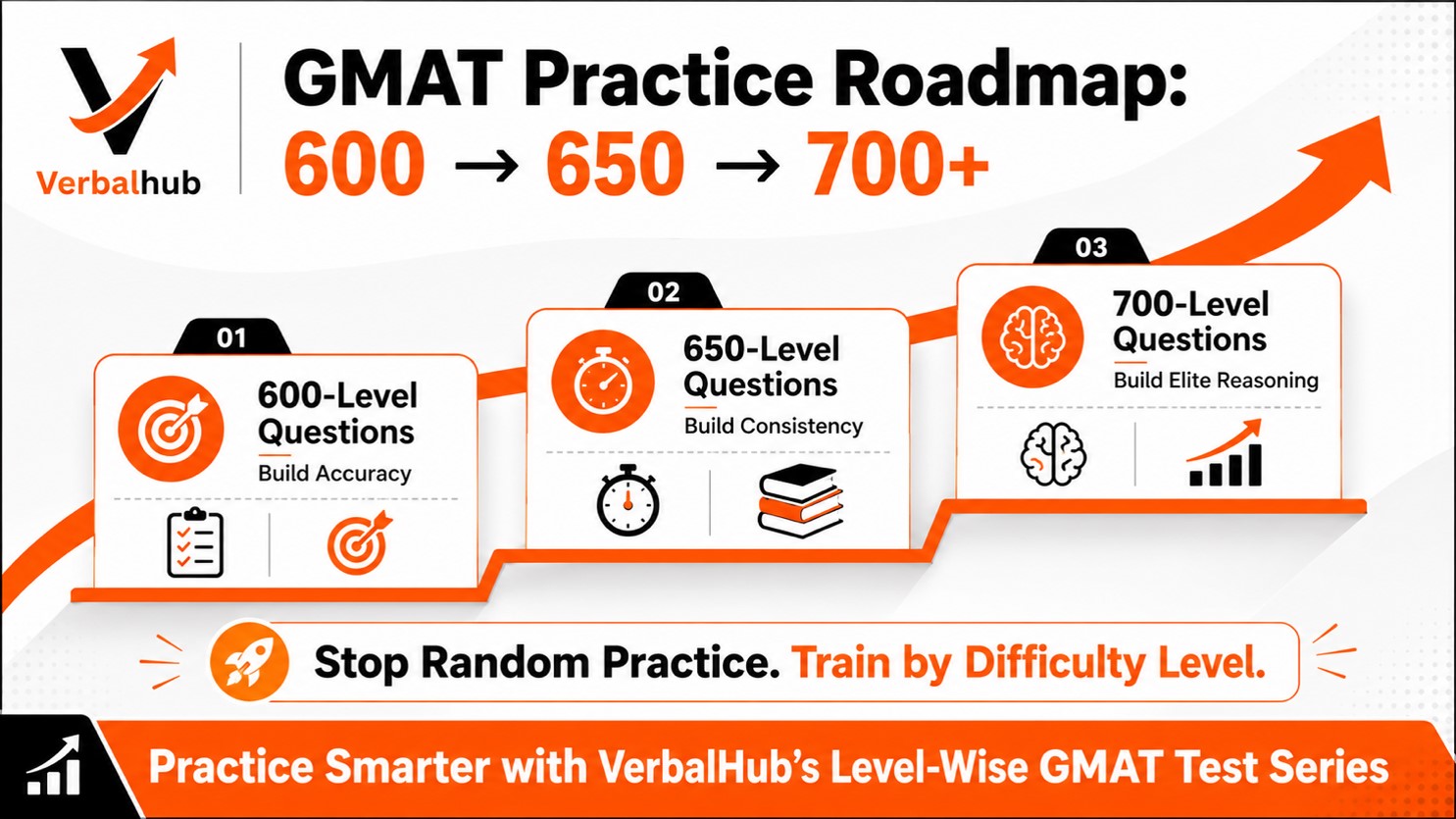
One of the most common mistakes GMAT students make is practicing at a comfortable difficulty level for too long. This feels productive but doesn't push the score.
600-Level Questions — Building Accuracy
These questions test whether you've understood the core concept correctly. Students who rush past the 600 level often carry conceptual errors into higher-difficulty practice, leading to frustrating inconsistency.
650-Level Questions — Building Consistency
At this level, questions require accurate application of concepts under moderate time pressure. This is where most students between 600–660 spend too little time.
700-Level Questions — Building Elite Reasoning
These questions test whether you can apply concepts under high-pressure conditions, with deliberate trap answer choices. Mastery here is what separates a 680 from a 720.
GMAT Mock Test Series Comparison: 2026
Which GMAT test series is right for you? Here's a balanced comparison of the major platforms.
| Platform | Best For | Strength | Limitation | Ideal Student |
|---|---|---|---|---|
| VerbalHub | Structured mock + sectional practice | 11 mocks, 75 sectionals, 50,000+ Qs, difficulty-level system | Less focused on video theory | Students targeting 650-730+ needing structured practice |
| GMAT Official Practice | Official simulation | Most accurate score prediction (made by GMAC) | Limited question volume; no deep analytics | All students — use as a benchmark |
| Target Test Prep (TTP) | Quant mastery | Exceptional Quant curriculum | Less emphasis on Verbal; expensive | Students needing Quant rebuilding |
| Manhattan Prep | Conceptual learning | Strong strategy and theory content | Fewer mocks; better for learning | Students in early conceptual phase |
| Magoosh | Budget-friendly prep | Affordable; good video explanations | Lower question quality at 700+ level | Students on a budget or early prep stage |
| e-GMAT | Verbal for non-native speakers | Strong Verbal framework, especially CR | Can feel process-heavy | Non-native speakers building Verbal |
| Kaplan | Test familiarity | Structured course format | Not cutting-edge for GMAT Focus | Students wanting classroom-style course |
| Princeton Review | Foundational preparation | Good for beginners; accessible | Less depth at 700+ level | Students beginning from a low baseline |
Where VerbalHub fits: Built specifically for students who need high-volume, structured, analytics-driven practice — particularly those targeting 700+ who have already done some preparation and now need to convert knowledge into a reliable score.
Who Should Choose VerbalHub's GMAT Online Test Series?
VerbalHub's test series is not designed for casual test-takers. It is built for students who are serious about reaching a specific score target.
You will get the most from VerbalHub's GMAT test series if you are:
- A working professional with limited daily study time who needs a high-efficiency practice plan
- A GMAT retaker stuck in the 600–650 range who needs a more systematic approach
- Stuck between 555 and 655 and unable to identify why the score isn't moving
- Targeting 700+ and ready to commit to difficulty-level progression and detailed mock analysis
- Weak in Verbal Reasoning, particularly CR and RC, and need dedicated topic-wise Verbal practice
- Struggling with Quant timing — you know the concepts but run out of time mid-section
- Confused by Data Insights, the newest GMAT section with the least available preparation material
- Done with random question solving and ready for a structured, trackable practice system
How to Use the VerbalHub GMAT Test Series for Maximum Score Improvement
Here is a practical weekly structure that experienced GMAT mentors recommend for students using VerbalHub's test series:
- Every 7–10 days: Take one full-length mock under strict exam conditions. No pauses, no phone, no breaks beyond what the real GMAT allows.
- Within 24 hours after the mock: Complete your full mock analysis. Review every wrong answer. Log errors by category. Identify the top 2–3 areas needing immediate attention.
- 3–4 times per week: Take sectional tests in your target improvement areas. If CR accuracy is at 55%, take 2–3 CR sectional tests before your next full mock.
- Daily (30–45 minutes): Topic-wise practice at the right difficulty level. Start at 600-level for new concepts. Move to 650 and 700 once accuracy is consistent.
- Weekly: Review your error log. Look for patterns — are you making the same mistake on Data Sufficiency? Consistently slow on long RC passages?
- Every two weeks: Adjust difficulty level upward if accuracy has improved. Staying at 600-level is comfortable but not productive.
Common Mistakes Students Make with GMAT Mocks
Avoiding these mistakes will save you weeks of unproductive preparation.
- Taking mocks without analysis — a mock you don't analyze is a mock you wasted
- Ignoring sectional tests — full mocks show the problem; sectionals fix it
- Only practicing easy questions — staying in your comfort zone is the most common reason scores plateau
- Not reviewing incorrect options in depth — you must kno why you clicked the wrong answer
- Ignoring timing errors — many students lose points not due to lack of knowledge but because of time management
- Comparing mock scores without fixing weaknesses — score movement without root-cause work is luck, not improvement
Final Verdict: Which GMAT Test Series Is Right for You in 2026?
The best GMAT mock test series has no relation with the most famous name. It is the one that gives you the right combination of full-length mocks, targeted sectional practice, high-quality questions at the right difficulty level, and detailed analysis that tells you exactly what to do next.
VerbalHub's GMAT Mock Test Series was built with that combination in mind — 11 full mocks, 75 sectional tests, 100+ topic-wise tests, including 15,000+ Quant drills, 20,000+ Verbal logic, and 15,000 DILR questions, difficulty-level progression from 600 to 700, and detailed performance tracking designed to turn consistent practice into a predictable score improvement.
For students who are serious about 700+, who want structure rather than randomness, and who are ready to treat GMAT preparation as a skill-building process rather than a test-taking exercise — this is the system worth investing in.
Start Here
Want to know exactly where your GMAT score is leaking? Start with VerbalHub's GMAT Mock Test Series and access 11 full-length mocks, 75 sectional tests, topic-wise practice, and detailed performance analysis — all designed for serious 700+ aspirants.
Or book a free GMAT strategy discussion with VerbalHub. In one conversation, a VerbalHub mentor will review your current preparation, identify the section costing you the most points, and give you a clear roadmap to your target score.
Frequently Asked Questions
The best GMAT mock test series depends on what you need most. If you need official score benchmarking, GMAT Official Practice is essential. If you need high-volume structured practice with sectional tests and difficulty-level tracking, VerbalHub's GMAT mock test series is one of the most comprehensive options available, especially for students targeting 650–730+.
For a 700+ score, you need a test series that goes beyond full-length mocks. You need sectional tests to fix specific weaknesses, 700-level question practice to develop elite reasoning, and detailed analytics after every test. VerbalHub's GMAT online test series is designed specifically for this — combining 11 full mocks, 75 sectional tests, including 15,000+ Quant drills, 20,000+ Verbal logic, and 15,000 DILR questions.
Most serious GMAT aspirants benefit from 8–12 full-length mocks over a 10–12 week preparation period — roughly one every 7–10 days. Taking mocks more frequently than that, without time for proper analysis in between, tends to produce diminishing returns.
Yes — sectional tests are arguably more important than full-length mocks for score improvement. Full mocks tell you your overall and section scores. Sectional tests let you drill the specific topics where you're losing points. Students who skip sectional practice often find their score plateauing despite taking many full mocks.
VerbalHub is particularly strong for students who want structured, analytics-driven mock practice. The combination of 11 full mocks, 75 sectional tests, including 15,000+ Quant drills, 20,000+ Verbal logic, and 15,000 DILR questions, and difficulty-level progression makes it one of the more comprehensive test series available for Indian and GCC students targeting 700+.
Improving your GMAT mock score requires three things working together: targeted sectional practice to address specific weaknesses, difficulty-level progression to push your ceiling, and consistent error-log review to break recurring mistake patterns. Taking more mocks without doing these three things in between rarely produces meaningful score improvement.
Start with a full mock to establish your baseline and understand your section-level strengths and weaknesses. Then move into sectional and topic-wise practice to address the gaps the mock revealed. Return to full mocks every 7–10 days to measure progress. The cycle is: full mock → sectional practice → full mock.
There is no fixed number, but students targeting 700+ typically need exposure to 2,000–5,000+ high-quality practice questions across all sections and difficulty levels. The more important factor is quality of review — 500 questions carefully analyzed will do more for your score than 2,000 questions completed without review.



Our Teachers

Dr. G Ravindra Babu
Quant Faculty
Ph. D in Mathematics Asian International University|| Mathematics Professor at Gitam University || Ex-Mathematics Professor SRM University Amaravathi || MBA in finance Acharya Bangalore B School || GMAT Quant 51, CAT Quant 99.58 %tile, GRE Quant 170 || 21 Different Teaching Certification || Believe in “Education is the mother of leadership”
view details

Dr. Rengarajan Parthasarathy
CAT Faculty
Ph. D in Mathematics from YCM University|| Mathematics Professor at Symbiosis International|| Author of Business Ethics || Ex-CAT Exam Syllabus Advisor in IIM || MBA & MPM from Symbiosis International (Deemed University) || College Topper in Mathematics in Ferguson College || Six Scholarships in Mathematics || 15 Years CAT Coaching, GMAT Coaching and GRE Coaching Experience|| UGC NET Qualified || GMAT Q51, V38 & CAT Q 99.31 & DILR 99.38 %tile, GRE Quant 170 || Believe in “Higher Education Shapes The World.”
view details

Dr. Nisha Tejpal
Verbal & AWA Faculty
Ph. D in English || Published a paper in English in ‘Research Journal of Philosophy and Social Sciences’ || MCA and B.Ed CCS University || A subject expert in Verbal Teaching || 10,000 Plus Essays Analysis || CTET and NET Qualified || More than 15 years of Experience || A writer, Author and Poet || Believe in “Think Beyond the Universe”
view details

Dhrithi Khattar
Verbal Faculty
A subject expert in Verbal Aptitude || More than 15 years of Experience || MBA in HR& Marketing & MA in Economics || Active Member of Hindu Alumni Association || Functional Member of Delhi ||Management Association (DMA) || Operational Member of All India Management Association (AIMA) ||The President of Key Club ||An active member of the French Club ||Gold Seal from California Scholarship Federation.
view details
M. U. Mir
DILR & Quant Faculty
A subject expert in Quantitative Aptitude Training || GMAT Q 51 & CAT DILR 99.75 %tile || GATE 2020 Qualified || M. Tech & B. Tech University Toper (1st Rank) || Awarded by Gov of Odisha, Bihar and J& K for the project Magnetic Floating Model || Ex-Quant Subject Expert in Arihant Publication || An Educationist and Social Worker || Believe in “Education is power”
view details

C. S. Rajawat
CAT Faculty
M. A in Mathematics CCS University|| M. Tech from SRM University || Visiting Mathematics Faculty CCS University ||Experience of 11 Years of CAT Coaching || District Topper in 10th & 12th || Best Teacher Awardee in 2021 & 2022 || CAT Quant 99.43 %tile || Discovered a new Theorem based on HCF in Math || Founder of C. S. Classes ||Believe in “Teaching and Training is an Art.”
view details

Dr. S.K. Singh
PTE/IELTS/CELPIP Expert
Ph. D. English Dr. B. R. Ambedkar University || Delhi & Center Government School Mentor || Founder of Entrepreneur & Learning Startup || IELTS & CELTA Certified from British Council || PTE Certified from Pearson...
view detailsRishabh Arora
PTE/IELTS/CELPIP Expert
MBA in HR International Institute of Management Sciences || PTE Certified from Pearson Test of English|| IELTS & CELTA Certified from British Council || BCA from Integral University || PTE 87 in 2017, IELTS 8.5 in 2018
view details
Jyoti Joshi
IELTS Trainer
Master in English (MA) and Bachelor in Education (B.Ed) || Certified Trainer || IELTS Speaking 9.0 Band holder || Believe in “Great teacher can inspire hope, ignite the imagination, and instill a love of learning”
view details
Surbhi Arora
IELTS / PTE Expert
English Language Expert || More than 3 years of Experience || M.A plus B. Ed Delhi University ||Author, Writer & Classical Singer|| Believe in “Language Language Learning & Teaching is Fun”
view details

Dilip Kumar Rathore
Quant Trainer
A business developer and genius in mathematics || Highly experienced || Master in Maths || well-verse in IT || Believe in “The art of teaching is the art of assisting discover”
view details

Imaam Hasan
Communication Expert
Master in English || Journalist and writer || Certified IELTS & PTE Trainer || A social educater and influencer || Believe in “Education is the movement from darkness to light”
view details