

- Quick Answer:
Can you start CAT 2026 preparation in April?
Yes — and it’s one of the most strategic choices you can make. April gives you a full 8-month runway: enough time to build strong fundamentals, develop section-wise skills, take structured mocks, and revise with confidence before CAT 2026. It stands as one of the strongest starting points available.
Is 8 months enough for CAT preparation?
Yes. A focused, well-structured 8-month CAT study plan is sufficient for most serious aspirants — provided they follow a clear phase-wise strategy and remain consistent throughout.
April is not just an acceptable time to begin CAT 2026 preparation. It is a genuinely strategic one.
Instead of compressing everything into the final three or four months, starting in April gives you the time to build concepts properly, develop section-wise skills, run a structured mock cycle, and revise with clarity before exam day. That combination — depth, practice, and revision — is what separates aspirants who score in the 95th percentile from those who plateau at 80.
A lot of aspirants ask: “How do I prepare for CAT 2026 starting April?” The answer is never about studying randomly for long hours. It’s about following a clear month-by-month roadmap, progressing through the right phases at the right time, and combining concept learning with timed testing and targeted revision.
A structured CAT 2026 online course can reinforce this process significantly — adding mentorship, accountability, and performance analytics. But whether you enroll or self-study, April gives you exactly the runway you need to prepare well and perform better.
Don’t Just Plan — Execute.
Join the VerbalHub April Foundation Batch and start your CAT 2026 journey with a structured roadmap, expert-led classes, and a free Profile Evaluation.
→ Claim Your Free Profile Evaluation ←
Why April Is One of the Best Times to Begin CAT 2026 Preparation
This is not a motivational talking point. It’s a structural advantage. Here is exactly why April sets you up better than most other start dates.
1. You Have Time to Build Concepts Properly
Arithmetic, algebra, geometry, logical reasoning — none of these can be absorbed in a rush. Starting in April means you do not need shortcuts as your first strategy. You can understand patterns deeply, strengthen weak fundamentals, and approach CAT’s problem-solving demands with genuine skill.
2. You Avoid the Last-Minute Compression Trap
Students who begin in August or September almost always spend their final months simply trying to finish the syllabus — with almost no time for revision. April starters move through a stable four-phase cycle: learn, practice, test, revise. That stability is what converts effort into percentile.
3. Your Mock Test Window Becomes More Productive
If you begin full-length mocks in August with solid preparation behind you, those mocks become genuine learning tools. You can analyze, adjust, and grow. Begin mocks with half-built preparation and they become demoralizing score shocks with no time to course-correct.
4. It Works Realistically for Working Professionals
A disciplined routine of 2–3 hours on weekdays and 4–6 hours on weekends is both practical and sustainable over an 8-month period. That’s very different from the intense daily commitment required if you start late. For professionals and final-year students managing other commitments, April is the most manageable entry point.
5. You Get a Real Revision Phase
Most aspirants dramatically underestimate revision. The difference between a 90 percentile and a 99 percentile score is often not syllabus coverage — it’s how well you have revised, refined, and internalized what you know. Starting in April guarantees you a proper revision phase in October and November. Starting in August does not.
Who Should Follow This 8-Month CAT Study Plan?
This roadmap is designed for aspirants who want structure, not just advice. It works especially well for:
- First-time CAT aspirants building from scratch
- College students targeting the IIMs and top MBA programmes
- Working professionals with limited but consistent daily time
- Repeat test-takers who want a more disciplined, phase-based approach
- Aspirants targeting 90, 95, 99, or 99+ percentile
The monthly CAT plan from April to November is not just a topic checklist. It moves through four carefully designed phases, with each stage building on the previous one.
The 4-Phase CAT 2026 Preparation Framework
A full 8-month preparation period should never be treated as one long undifferentiated stretch. The most effective CAT 2026 preparation strategy divides the journey into four distinct phases, each with a specific objective.
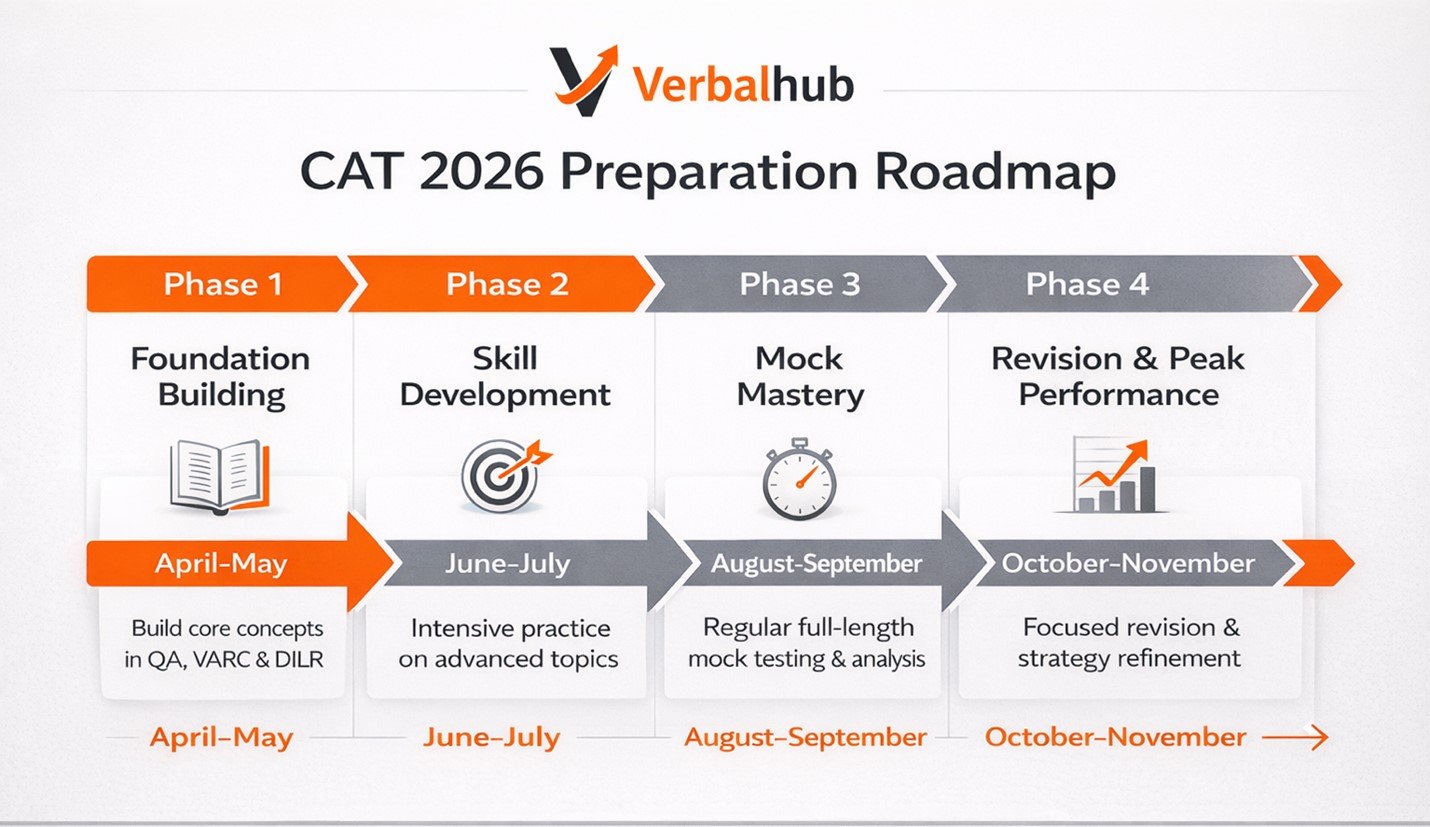
The Four Phases at a Glance
Phase 1 — Foundation Building → April – May
Phase 2 — Skill Development & Intensive Practice → June – July
Phase 3 — Mock Mastery & Strategy Building → August – September
Phase 4 — Revision & Peak Performance → October – November
Phase 1: Foundation Building (April – May)
The first two months are where your entire CAT 2026 preparation is anchored. Master this phase, and everything that follows becomes significantly more productive. Rush through it and you will keep hitting the same conceptual walls throughout the year.
Primary Goal
Establish confidence and deep conceptual clarity across all three sections: Quantitative Aptitude, VARC, and DILR.
Realistic Daily Time Targets
- College students: 2.5 to 4 hours per day
- Working professionals: 2 to 3 hours on weekdays
- Weekends (both groups): 4 to 6 hours, used for longer practice sessions and review
Quant: What to Cover in April and May
Begin with the highest-value foundational topics. These will appear repeatedly throughout your preparation and directly impact your ability to handle advanced problems later.
- Number System and divisibility
- Percentages and their applications
- Ratio and Proportion
- Profit, Loss and Discount
- Averages and Mixtures
- Time and Work
- Time, Speed and Distance
- Simple and Compound Interest
- Basic Algebra and Linear Equations
These form the core of your CAT Quant foundation. Master them before you move on.
VARC: How to Build the Right Habits Early
Your first goal in VARC is not speed — it is comfort with dense, argument-heavy text. Develop that first and speed follows naturally.
- Begin reading daily: quality editorials, opinion columns, academic essays
- Focus on understanding tone, argument structure, and author intent
- Practice Reading Comprehension sets with attention to inference and logic
- Work on Para Jumbles and Para Summary to sharpen logical sequencing
- Identify and practise Odd Sentence Out questions
DILR: Building Pattern Recognition
DILR is often the most neglected section in early preparation — and the one that surprises students most in the actual exam. Begin early and stay consistent.
- Start with arrangements, grouping and distribution problems
- Work through tables, bar charts and simple data interpretation
- Practice family-based logic, scheduling and routing sets
- Focus on understanding how each set is constructed, not just speed
Phase 1 Milestone Checkpoint
By the end of May, you should have:
- Solid familiarity with core Quant topics
- A consistent daily reading habit for VARC
- Comfort solving 1 to 2 DILR sets per day
A stable daily study rhythm that you can maintain

The Rule of Three: Your Daily Study Schedule
Knowing what to study is one thing. Knowing how to organise your day is what makes preparation sustainable over 8 months. The Rule of Three is a simple, effective framework that works whether you are a student or a working professional.
| Time Slot | Section | Daily Activity |
|---|---|---|
| Morning (1 Hour) | Quantitative Aptitude | 1 concept topic + 20 timed practice questions |
| Evening (45 Minutes) | VARC | 1 editorial read + 1 full RC set with analysis |
| Night (45 Minutes) | DILR | 1 logic puzzle or structured data set |
Why This Schedule Works
- Realistic for people managing jobs, college, or other responsibilities
- Keeps all three sections active every day — no area falls behind
- Prevents the burnout that comes from long single-section sessions
- Builds habitual momentum through repetition and consistency
This kind of structured daily routine is particularly valuable for aspirants preparing for CAT 2026 starting in April while managing professional or academic commitments.
Phase 2: Skill Development and Intensive Practice (June – July)
Phase 1 was about building your base. Phase 2 is about application. You move from understanding concepts to deploying them under time pressure — which is where CAT preparation actually becomes exam preparation.
Quant: Expanding Into the Next Layer
Once arithmetic and algebra basics are firm, introduce the next set of topics and begin solving in mixed-topic conditions.
- Advanced Arithmetic and Algebra
- Inequalities and Logarithms
- Geometry and Mensuration
- Modern Math: P&C, Probability, Set Theory
- Mixed-topic timed solving (crucial for CAT format)
CAT does not test your memory of chapters. It tests your ability to shift between concepts under pressure. From June onward, mixed-topic practice becomes non-negotiable — it’s essential.
VARC: Increasing Intensity and Accuracy
- Increase to 2 to 3 RC sets on practice days
- Time your Para Jumbles and Para Summary attempts
- Work on elimination-based decision-making in close answer options
- Develop the habit of reading passage structure before answering
- Goal: sharpen accuracy, not just reading speed
DILR: Increasing Variety and Difficulty
- Tournament-based and selection-logic sets
- Complex arrangement combinations
- Caselets and mixed DI-LR formats
- Graph-based and chart-heavy reasoning
- Target: solving 2 to 3 sets on most practice days
Start Sectional Tests in June
June and July are the right months to introduce timed sectional tests. These reveal what concepts actually hold under time pressure and which ones collapse. A serious CAT 2026 online course should start emphasising sectionals and analytics heavily at this stage, because this is where preparation becomes measurable.
- Identify topics that lose accuracy under time pressure
- Understand where you waste time within a section
- Track which question types consistently reduce your score
Phase 3: Mock Mastery and Strategy Building (August – September)
This is the phase where many aspirants begin to see the real gap between studying and scoring. The mechanics of performance — attempt selection, time management, mental composure — now matter as much as content knowledge.
Recommended Full-Length Mock Schedule
- August: 1 to 2 full-length mocks per week
- September: 2 full-length mocks per week
But do not measure progress by mock count alone. One carefully analyzed mock consistently offers greater value than three poorly reviewed attempts.
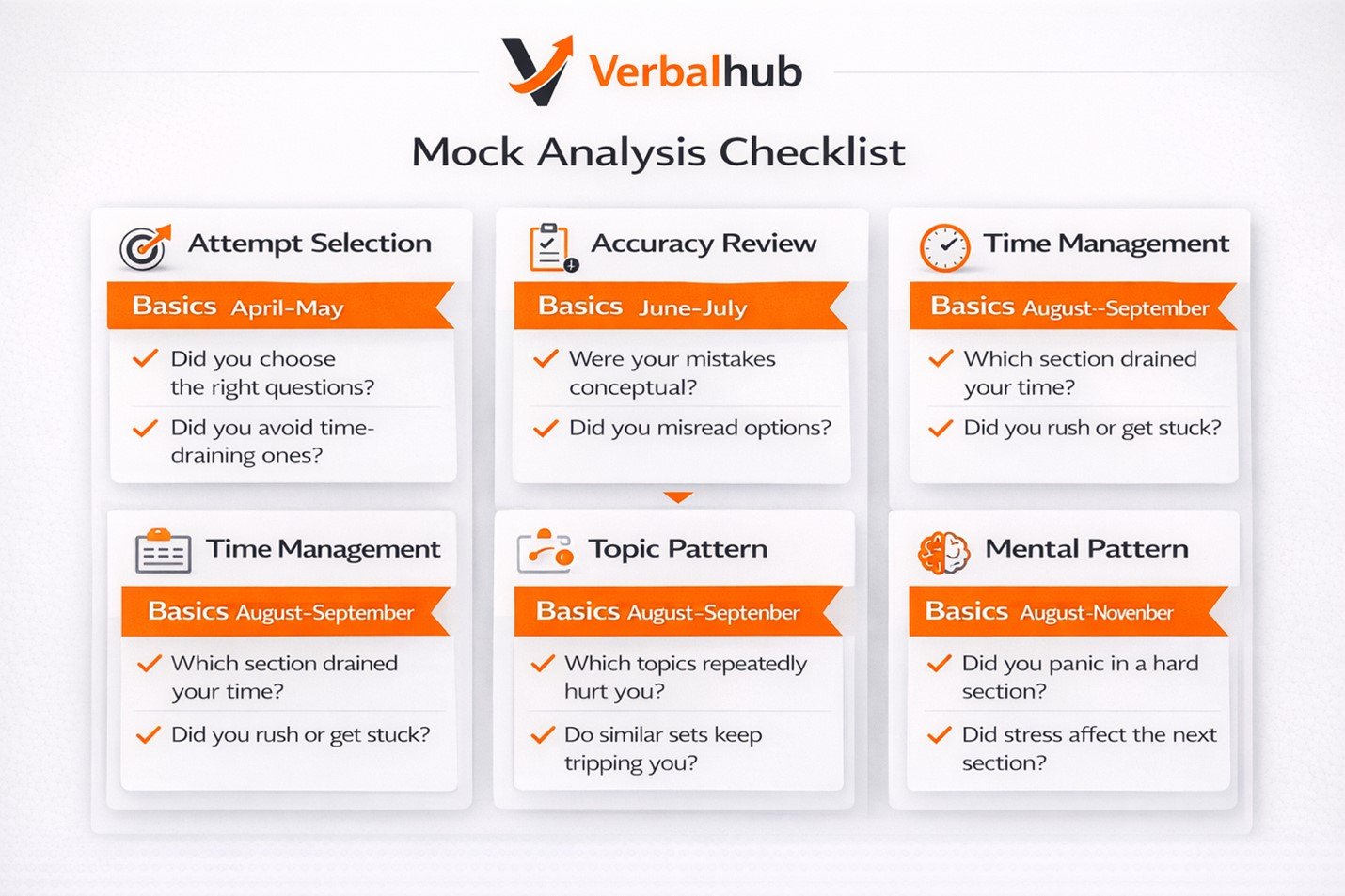
How to Analyze a Mock Properly
After every mock, work through these five dimensions before you move on:
Attempt Selection
Did you choose the right questions? Did you waste time on difficult ones too early? Did you miss easier opportunities because of poor sequencing?
Accuracy Review
Were your errors conceptual, careless, or strategic? Did you misread options under pressure? Did you guess when you should have moved on?
Time Management
Which section or set consumed disproportionate time? Did one difficult problem damage the rest of your section? Did you rush toward the end?
Topic Pattern Analysis
Are certain areas repeatedly costing you marks? Do you consistently struggle with geometry, para summary, or specific DILR formats? These patterns are valuable data.
Mental Pattern
Did a difficult start cause you to panic? Did lower confidence in one section carry into the next? Mental composure is trainable — but only if you track it honestly.
Section-Wise Strategy for Phase 3
Quantitative Aptitude
- Develop a clear question-selection hierarchy in mock conditions
- Improve speed in familiar topic areas
- Identify and stop forcing low-probability, high-time questions
VARC
- Sharpen passage selection and reading approach
- Reduce time spent on ambiguous or difficult RC passages
- Refine elimination-based reasoning for close option pairs
DILR
- Train yourself to identify the most workable sets in the first 2 minutes
- Move away from ego-driven problem-solving
- Learn to abandon a set decisively before it damages the full section
Phase 4: Revision and Peak Performance (October – November)
The final phase is not the time to start learning new material. It is about protecting accuracy, stabilising performance, and peaking at the right moment. Aspirants who start in April reach this phase with far better emotional control than those who start late — and that makes a significant difference on exam day.
October Focus
- 2 to 3 full-length mocks per week
- Systematic formula revision: Quant and DILR
- Error log review from all previous mocks
- Focused weak-area correction sessions
- Daily VARC reading to maintain rhythm
November Focus
- Maintain calm — avoid introducing new material
- Revise only high-yield topics
- Keep your routine stable and predictable
- Protect sleep and mental sharpness in the final fortnight
Final 20-Day Revision Strategy
- Revise all major arithmetic and algebra formulas
- Review every significant error from your mock history
- Solve selective, familiar DILR sets for confidence
- Keep RC practice active — even 1 passage per day
- Focus on execution quality, not new coverage
Section-Wise 8-Month CAT Roadmap
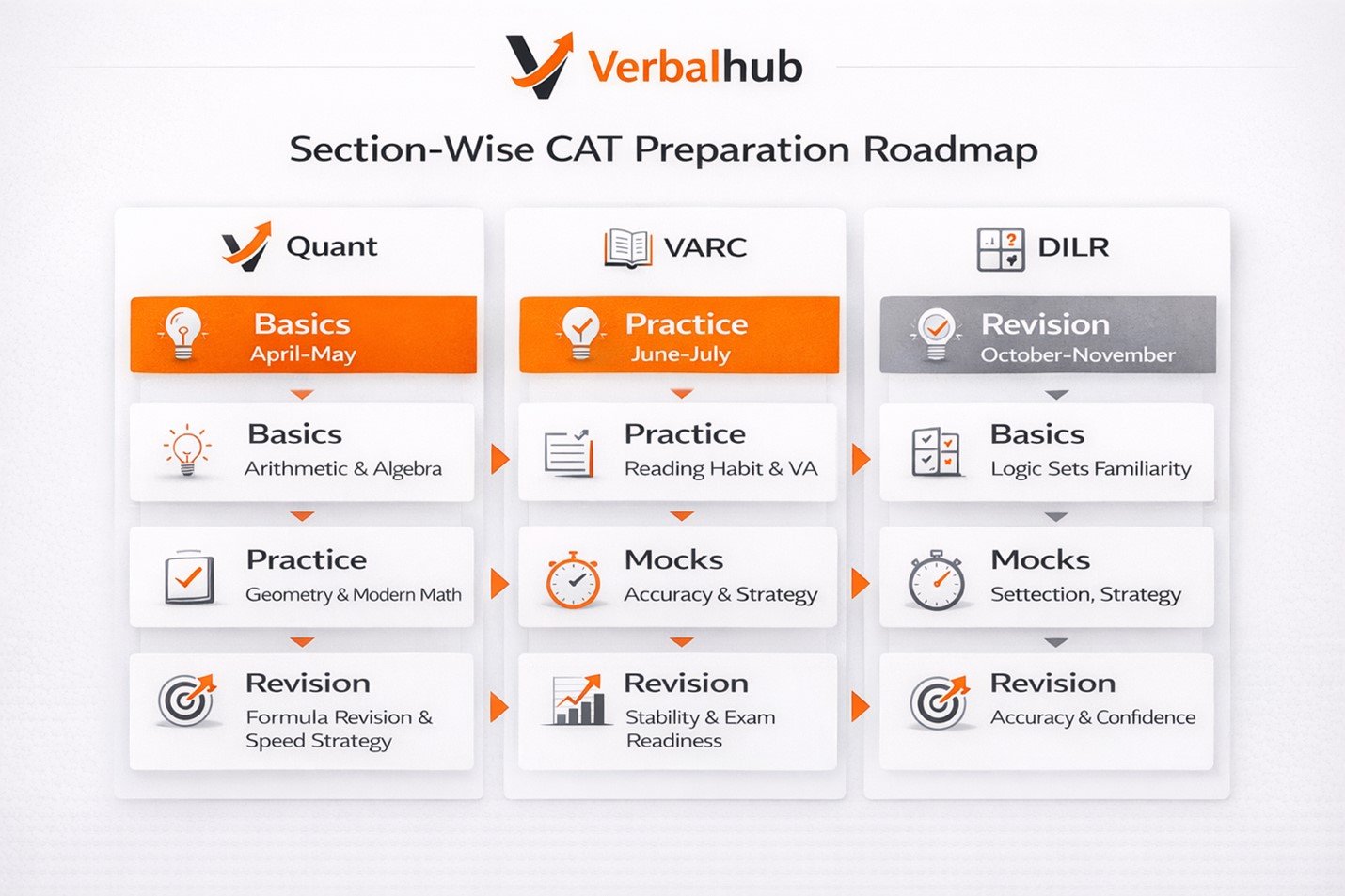
Here is a consolidated view of your complete CAT Quant, VARC, and DILR roadmap from April to November.
| Phase / Months | Quant | VARC | DILR |
|---|---|---|---|
| Phase 1 Apr–May | Arithmetic & algebra basics | Reading habit, RC basics, para-based Qs | Basic set exposure & frameworks |
| Phase 2 Jun–Jul | Geometry, modern math, mixed practice | Timed RCs, elimination, verbal ability | Variety, difficulty, timed solving |
| Phase 3 Aug–Sep | Sectionals, mocks, time strategy | Strategy refinement, accuracy focus | Set selection & mock practice |
| Phase 4 Oct–Nov | Formula revision, question selection | Stability & consistent performance | Accuracy, revision, confidence |
Common Mistakes to Avoid Even When You Start Early
Starting in April is an advantage — but only if you use the time well. These are the six most common errors that derail early starters:
- Spending too much time on theory without timed application
Conceptual understanding only becomes useful when tested under time pressure. Without regular timed practice, your preparation remains theoretical.
- Neglecting DILR in the early months
DILR is best developed through repeated exposure over time. Delaying it to Phase 2 or 3 creates compounding anxiety and leaves you under-practiced in one of CAT’s most unpredictable sections.
- Starting full mocks too late
Mocks should not begin in October. They need to be part of your system from August, so you have enough time to analyze, adjust, and improve.
- Taking mocks without proper analysis
A mock without review is a missed chance for meaningful learning. The score tells you very little without understanding why each answer went wrong.
- Overloading on resources
Too many books, too many YouTube channels, too many PDFs — this creates noise, not progress. Focus on a small set of quality resources and use them thoroughly.
- Changing strategy every week
CAT rewards disciplined consistency over a sustained period. Constant strategy shifts prevent you from building the depth that top percentile scores require.

Why a Structured CAT 2026 Online Course Accelerates Your Journey
Self-study works for some aspirants. But many serious CAT candidates lose valuable preparation time because they lack a clear sequence, consistent feedback, or a reliable support structure. A structured course solves these problems.
What a Structured CAT 2026 Course Provides
- A clear, phase-wise preparation roadmap
- Expert-led topic-wise and section-wise classes
- Sectional tests and full-length mock series
- Detailed mock analysis and performance tracking
- Mentor feedback and doubt resolution
Revision planning and accountability
VerbalHub’s April Foundation Batch is built specifically for aspirants starting their CAT 2026 preparation now. It combines structure, strategy, and expert mentorship into a single, cohesive programme designed to take you from foundations to final-stage performance.
Join the VerbalHub April Foundation Batch
Get a structured CAT 2026 roadmap, section-wise coaching, full mock analysis, and expert mentorship — all in one place.
✔ Free Profile Evaluation Included | ✔ Limited April Batch Seats
→ Claim Your Free Evaluation ←
📋 Not Ready to Enrol Yet? Start Here.
Download VerbalHub’s Free 8-Month CAT Study Plan PDF and see exactly what to study, month by month, from April to November for CAT 2026.
Also available: Free CAT Diagnostic Test | Free Strategy Call for CAT 2026 Aspirants
Final Thoughts: April Is Where Serious Preparation Begins
If you want to score well in CAT 2026, starting in April gives you something that most late starters never truly get: time to prepare with composure.
A strong 8-month CAT study plan is not simply about completing the syllabus. It is about moving through a system with intention:
- Build the right foundations in the first two months
- Develop section-wise skills through application and variety
- Convert preparation into percentile through structured mock practice
- Revise, stabilise, and peak at exactly the right time
That is how serious CAT aspirants build the kind of performance that holds up on exam day.
If you start now, stay consistent, and follow a clear month-by-month roadmap, April becomes far more than a start date. It becomes the decision that changes your CAT 2026 outcome.
Frequently Asked Questions About CAT 2026 Preparation
These questions are drawn from the most frequent searches and voice queries among CAT aspirants. Answers are structured for AI answer engines and featured snippet extraction.
Yes. April is one of the strongest start points available. It gives you a full 8-month runway to cover concepts, practise section-wise, build mock experience, and revise properly. Most aspirants who start in April reach the exam in a far calmer and more prepared state than those who begin later.
Yes, for most serious aspirants. An 8-month CAT study plan that covers foundation building, skill development, mock practice, and revision is sufficient to target high percentile scores — provided preparation is consistent and phase-based.
Begin with arithmetic fundamentals in Quant, build a daily reading habit for VARC, and start basic DILR sets for pattern exposure. Focus on consistency over volume in the first two months. Detailed topic guidance is covered in Phase 1 above.
Yes. A focused plan of 2 to 3 hours on weekdays and 4 to 6 hours on weekends can work very effectively over 8 months. Starting in April is especially important for working professionals, as the longer timeline reduces the daily study pressure.
Sectional tests can begin by June or July. Full-length mock tests should ideally start in August, with frequency increasing to 2 to 3 mocks per week by October.
Balance and time for revision. Aspirants who start in April can move through all four preparation phases — foundation, skill development, mock practice, and revision — without compressing or skipping any stage. Revision in particular is what often separates average scores from top-percentile performance.
It is a structured CAT 2026 online course designed for aspirants starting preparation in April. It includes expert-led coaching across all three sections, a full mock series with analysis, mentor support, and a free profile evaluation for all enrollees.
Ready to Begin?
Join the VerbalHub April Foundation Batch. Get a structured CAT study roadmap, expert coaching across Quant, VARC and DILR, full mock analysis, and a free Profile Evaluation.
→ Claim Your Free Profile Evaluation Today ←
Or download the Free 8-Month CAT Study Plan PDF and start planning today.



Our Teachers

Dr. G Ravindra Babu
Quant Faculty
Ph. D in Mathematics Asian International University|| Mathematics Professor at Gitam University || Ex-Mathematics Professor SRM University Amaravathi || MBA in finance Acharya Bangalore B School || GMAT Quant 51, CAT Quant 99.58 %tile, GRE Quant 170 || 21 Different Teaching Certification || Believe in “Education is the mother of leadership”
view details

Dr. Rengarajan Parthasarathy
CAT Faculty
Ph. D in Mathematics from YCM University|| Mathematics Professor at Symbiosis International|| Author of Business Ethics || Ex-CAT Exam Syllabus Advisor in IIM || MBA & MPM from Symbiosis International (Deemed University) || College Topper in Mathematics in Ferguson College || Six Scholarships in Mathematics || 15 Years CAT Coaching, GMAT Coaching and GRE Coaching Experience|| UGC NET Qualified || GMAT Q51, V38 & CAT Q 99.31 & DILR 99.38 %tile, GRE Quant 170 || Believe in “Higher Education Shapes The World.”
view details

Dr. Nisha Tejpal
Verbal & AWA Faculty
Ph. D in English || Published a paper in English in ‘Research Journal of Philosophy and Social Sciences’ || MCA and B.Ed CCS University || A subject expert in Verbal Teaching || 10,000 Plus Essays Analysis || CTET and NET Qualified || More than 15 years of Experience || A writer, Author and Poet || Believe in “Think Beyond the Universe”
view details

Dhrithi Khattar
Verbal Faculty
A subject expert in Verbal Aptitude || More than 15 years of Experience || MBA in HR& Marketing & MA in Economics || Active Member of Hindu Alumni Association || Functional Member of Delhi ||Management Association (DMA) || Operational Member of All India Management Association (AIMA) ||The President of Key Club ||An active member of the French Club ||Gold Seal from California Scholarship Federation.
view details
M. U. Mir
DILR & Quant Faculty
A subject expert in Quantitative Aptitude Training || GMAT Q 51 & CAT DILR 99.75 %tile || GATE 2020 Qualified || M. Tech & B. Tech University Toper (1st Rank) || Awarded by Gov of Odisha, Bihar and J& K for the project Magnetic Floating Model || Ex-Quant Subject Expert in Arihant Publication || An Educationist and Social Worker || Believe in “Education is power”
view details

C. S. Rajawat
CAT Faculty
M. A in Mathematics CCS University|| M. Tech from SRM University || Visiting Mathematics Faculty CCS University ||Experience of 11 Years of CAT Coaching || District Topper in 10th & 12th || Best Teacher Awardee in 2021 & 2022 || CAT Quant 99.43 %tile || Discovered a new Theorem based on HCF in Math || Founder of C. S. Classes ||Believe in “Teaching and Training is an Art.”
view details

Dr. S.K. Singh
PTE/IELTS/CELPIP Expert
Ph. D. English Dr. B. R. Ambedkar University || Delhi & Center Government School Mentor || Founder of Entrepreneur & Learning Startup || IELTS & CELTA Certified from British Council || PTE Certified from Pearson...
view detailsRishabh Arora
PTE/IELTS/CELPIP Expert
MBA in HR International Institute of Management Sciences || PTE Certified from Pearson Test of English|| IELTS & CELTA Certified from British Council || BCA from Integral University || PTE 87 in 2017, IELTS 8.5 in 2018
view details
Jyoti Joshi
IELTS Trainer
Master in English (MA) and Bachelor in Education (B.Ed) || Certified Trainer || IELTS Speaking 9.0 Band holder || Believe in “Great teacher can inspire hope, ignite the imagination, and instill a love of learning”
view details
Surbhi Arora
IELTS / PTE Expert
English Language Expert || More than 3 years of Experience || M.A plus B. Ed Delhi University ||Author, Writer & Classical Singer|| Believe in “Language Language Learning & Teaching is Fun”
view details

Dilip Kumar Rathore
Quant Trainer
A business developer and genius in mathematics || Highly experienced || Master in Maths || well-verse in IT || Believe in “The art of teaching is the art of assisting discover”
view details

Imaam Hasan
Communication Expert
Master in English || Journalist and writer || Certified IELTS & PTE Trainer || A social educater and influencer || Believe in “Education is the movement from darkness to light”
view details